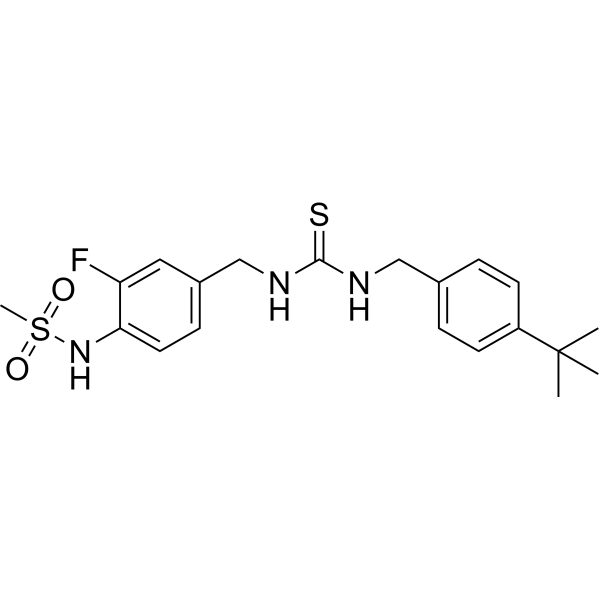
Physicochemical Properties
| Molecular Formula | C20H26FN3O2S2 |
| Molecular Weight | 423.57 |
| Exact Mass | 423.145 |
| CAS # | 401907-26-4 |
| PubChem CID | 10295883 |
| Appearance | White to off-white solid powder |
| Density | 1.3±0.1 g/cm3 |
| Boiling Point | 546.6±60.0 °C at 760 mmHg |
| Flash Point | 284.4±32.9 °C |
| Vapour Pressure | 0.0±1.5 mmHg at 25°C |
| Index of Refraction | 1.609 |
| LogP | 3.27 |
| Hydrogen Bond Donor Count | 3 |
| Hydrogen Bond Acceptor Count | 5 |
| Rotatable Bond Count | 7 |
| Heavy Atom Count | 28 |
| Complexity | 608 |
| Defined Atom Stereocenter Count | 0 |
| InChi Key | DUHBVFMCIJLUJX-UHFFFAOYSA-N |
| InChi Code | InChI=1S/C20H26FN3O2S2/c1-20(2,3)16-8-5-14(6-9-16)12-22-19(27)23-13-15-7-10-18(17(21)11-15)24-28(4,25)26/h5-11,24H,12-13H2,1-4H3,(H2,22,23,27) |
| Chemical Name | 1-[(4-tert-butylphenyl)methyl]-3-[[3-fluoro-4-(methanesulfonamido)phenyl]methyl]thiourea |
| Synonyms | JYL-1421; JYL 1421; JYL1421 |
| HS Tariff Code | 2934.99.9001 |
| Storage |
Powder-20°C 3 years 4°C 2 years In solvent -80°C 6 months -20°C 1 month |
| Shipping Condition | Room temperature (This product is stable at ambient temperature for a few days during ordinary shipping and time spent in Customs) |
Biological Activity
| ln Vitro | Capsaicin (330 nM)-induced Ca2+ buildup was concentration-dependently reduced by JYL 1421 incubation for 5 minutes. At the lowest dose (5 nM), JYL 1421's inhibitory action became significant, and at 1 μM, the response was nearly completely abolished, with just 3.1 ± 0.65% of the initial Ca2+ influx caused by capsaicin being seen. The IC50 value of JYL 1421 is 8 nM. Meanwhile, capsaicin had a much lower effect, only producing 41.7% inhibition at 1 μM; nevertheless, this inhibition did not rise to 50% at 10 μM or higher [1]. |
| ln Vivo | After dripping 50 μL of capsaicin solution (10 μg/mL) into the rat's left eye, the animal wiped 12.9 ± 1.3 times in just three minutes. Rats' wiping behavior was not substantially affected by pretreatment with 0.4 or 1 mg/kg ip JYL 1421; however, the number of wiping movements was dose-dependently decreased with 2–5 mg/kg. A value of 4.6 mg/kg is the ID50. Rats without treatment had a mean arterial pressure of 109.9±4.2 Hgmm (n=6). When 1 and 2 μg/kg capsaicin were injected intravenously, the subjects' blood pressure temporarily dropped to 47.4±4.7 and 59.6±4.2 Hgmm, respectively (n=6). In both cases, JYL 1421 did not result in hypotension (0.4 and 1.6 mg/kg). The requirement for greater capsaicin dosages to produce reflex hypotension after JYL 1421 administration than before to treatment indicates that JYL 1421 dose-dependently suppresses the drops in blood pressure that capsaicin causes. Even at dosages as high as 2 mg/kg, capsaicin is unable to substantially prevent capsaicin-induced hypotension [1]. |
| References |
[1]. Pharmacological characterization of the TRPV1 receptor antagonist JYL1421 (SC0030) in vitro and in vivo in the rat. Eur J Pharmacol. 2005 Jul 4;517(1-2):35-44. |
Solubility Data
| Solubility (In Vitro) | DMSO : ~100 mg/mL (~236.09 mM) |
| Solubility (In Vivo) |
Solubility in Formulation 1: ≥ 2.5 mg/mL (5.90 mM) (saturation unknown) in 10% DMSO + 40% PEG300 + 5% Tween80 + 45% Saline (add these co-solvents sequentially from left to right, and one by one), suspension solution. For example, if 1 mL of working solution is to be prepared, you can add 100 μL of 25.0 mg/mL clear DMSO stock solution to 400 μL PEG300 and mix evenly; then add 50 μL Tween-80 to the above solution and mix evenly; then add 450 μL normal saline to adjust the volume to 1 mL. Preparation of saline: Dissolve 0.9 g of sodium chloride in 100 mL ddH₂ O to obtain a clear solution. Solubility in Formulation 2: ≥ 2.5 mg/mL (5.90 mM) (saturation unknown) in 10% DMSO + 90% (20% SBE-β-CD in Saline) (add these co-solvents sequentially from left to right, and one by one), clear solution. For example, if 1 mL of working solution is to be prepared, you can add 100 μL of 25.0 mg/mL clear DMSO stock solution to 900 μL of 20% SBE-β-CD physiological saline solution and mix evenly. Preparation of 20% SBE-β-CD in Saline (4°C,1 week): Dissolve 2 g SBE-β-CD in 10 mL saline to obtain a clear solution. Solubility in Formulation 3: ≥ 2.5 mg/mL (5.90 mM) (saturation unknown) in 10% DMSO + 90% Corn Oil (add these co-solvents sequentially from left to right, and one by one), clear solution. For example, if 1 mL of working solution is to be prepared, you can add 100 μL of 25.0 mg/mL clear DMSO stock solution to 900 μL of corn oil and mix evenly. (Please use freshly prepared in vivo formulations for optimal results.) |
| Preparing Stock Solutions | 1 mg | 5 mg | 10 mg | |
| 1 mM | 2.3609 mL | 11.8044 mL | 23.6088 mL | |
| 5 mM | 0.4722 mL | 2.3609 mL | 4.7218 mL | |
| 10 mM | 0.2361 mL | 1.1804 mL | 2.3609 mL |