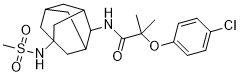
JNJ303 is a potent and specific inhibitor of heteromeric Kv7.1/KCNE1 channel complexes in a concentration- and time-dependent manner. It is a potent IKs blocker with an IC50 value of 64 nM. JNJ 303 does not have any effects on other cardiac channels at concentrations of 3.3 μM for INa, Ica, Ito, and IKr. JNJ 303 induces QT-prolongations and causes unprovoked torsades de pointes (TdP).
Physicochemical Properties
| Molecular Formula | C21H29CLN2O4S |
| Molecular Weight | 440.98 |
| Exact Mass | 440.154 |
| CAS # | 878489-28-2 |
| Related CAS # | 878489-28-2; |
| PubChem CID | 11575823 |
| Appearance | Light yellow to yellow solid powder |
| LogP | 5.422 |
| Hydrogen Bond Donor Count | 2 |
| Hydrogen Bond Acceptor Count | 5 |
| Rotatable Bond Count | 6 |
| Heavy Atom Count | 29 |
| Complexity | 726 |
| Defined Atom Stereocenter Count | 2 |
| SMILES | CC(C)(C(=O)NC1[C@@H]2CC3C[C@H]1CC(C2)(C3)NS(=O)(=O)C)OC4=CC=C(C=C4)Cl |
| InChi Key | OSGIRCJRKSAODN-UHFFFAOYSA-N |
| InChi Code | InChI=1S/C21H29ClN2O4S/c1-20(2,28-17-6-4-16(22)5-7-17)19(25)23-18-14-8-13-9-15(18)12-21(10-13,11-14)24-29(3,26)27/h4-7,13-15,18,24H,8-12H2,1-3H3,(H,23,25) |
| Chemical Name | 2-(4-Chloro-phenoxy)-N-(5-methanesulfonylamino-adamantan-2-yl)-2-methyl-propionamide |
| Synonyms | JNJ303 JNJ-303 JNJ 303 AC-1 AC 1 AC1 |
| HS Tariff Code | 2934.99.9001 |
| Storage |
Powder-20°C 3 years 4°C 2 years In solvent -80°C 6 months -20°C 1 month |
| Shipping Condition | Room temperature (This product is stable at ambient temperature for a few days during ordinary shipping and time spent in Customs) |
Biological Activity
| ln Vitro | JNJ 303's IC50 value of 64 nM allows it to block IK[1]. Other cardiac channels are unaffected by JNJ 303 (3.3 μM) [1]. Unprovoked torsade de pointes (TdP) and QT prolongation are brought on by JNJ 303 [1]. |
| ln Vivo | JNJ 303 mimics the decrease in mice's fasting blood glucose levels caused by Exn4 [2]. |
| References |
[1]. The effect of the KV7/KCNE 1 inhibitor JNJ 303 on heart slices and the L-type calcium channel of cardiac cells. [2]. Glucose-sensing glucagon-like peptide-1 receptor neurons in the dorsomedial hypothalamus regulate glucose metabolism. Sci Adv. 2022 Jun 10;8(23):eabn5345. |
Solubility Data
| Solubility (In Vitro) | DMSO : ~62.5 mg/mL (~141.73 mM) |
| Solubility (In Vivo) |
Note: Listed below are some common formulations that may be used to formulate products with low water solubility (e.g. < 1 mg/mL), you may test these formulations using a minute amount of products to avoid loss of samples. Injection Formulations (e.g. IP/IV/IM/SC) Injection Formulation 1: DMSO : Tween 80: Saline = 10 : 5 : 85 (i.e. 100 μL DMSO stock solution → 50 μL Tween 80 → 850 μL Saline) *Preparation of saline: Dissolve 0.9 g of sodium chloride in 100 mL ddH ₂ O to obtain a clear solution. Injection Formulation 2: DMSO : PEG300 :Tween 80 : Saline = 10 : 40 : 5 : 45 (i.e. 100 μL DMSO → 400 μLPEG300 → 50 μL Tween 80 → 450 μL Saline) Injection Formulation 3: DMSO : Corn oil = 10 : 90 (i.e. 100 μL DMSO → 900 μL Corn oil) Example: Take the Injection Formulation 3 (DMSO : Corn oil = 10 : 90) as an example, if 1 mL of 2.5 mg/mL working solution is to be prepared, you can take 100 μL 25 mg/mL DMSO stock solution and add to 900 μL corn oil, mix well to obtain a clear or suspension solution (2.5 mg/mL, ready for use in animals). Injection Formulation 4: DMSO : 20% SBE-β-CD in saline = 10 : 90 [i.e. 100 μL DMSO → 900 μL (20% SBE-β-CD in saline)] *Preparation of 20% SBE-β-CD in Saline (4°C,1 week): Dissolve 2 g SBE-β-CD in 10 mL saline to obtain a clear solution. Injection Formulation 5: 2-Hydroxypropyl-β-cyclodextrin : Saline = 50 : 50 (i.e. 500 μL 2-Hydroxypropyl-β-cyclodextrin → 500 μL Saline) Injection Formulation 6: DMSO : PEG300 : castor oil : Saline = 5 : 10 : 20 : 65 (i.e. 50 μL DMSO → 100 μLPEG300 → 200 μL castor oil → 650 μL Saline) Injection Formulation 7: Ethanol : Cremophor : Saline = 10: 10 : 80 (i.e. 100 μL Ethanol → 100 μL Cremophor → 800 μL Saline) Injection Formulation 8: Dissolve in Cremophor/Ethanol (50 : 50), then diluted by Saline Injection Formulation 9: EtOH : Corn oil = 10 : 90 (i.e. 100 μL EtOH → 900 μL Corn oil) Injection Formulation 10: EtOH : PEG300:Tween 80 : Saline = 10 : 40 : 5 : 45 (i.e. 100 μL EtOH → 400 μLPEG300 → 50 μL Tween 80 → 450 μL Saline) Oral Formulations Oral Formulation 1: Suspend in 0.5% CMC Na (carboxymethylcellulose sodium) Oral Formulation 2: Suspend in 0.5% Carboxymethyl cellulose Example: Take the Oral Formulation 1 (Suspend in 0.5% CMC Na) as an example, if 100 mL of 2.5 mg/mL working solution is to be prepared, you can first prepare 0.5% CMC Na solution by measuring 0.5 g CMC Na and dissolve it in 100 mL ddH2O to obtain a clear solution; then add 250 mg of the product to 100 mL 0.5% CMC Na solution, to make the suspension solution (2.5 mg/mL, ready for use in animals). Oral Formulation 3: Dissolved in PEG400 Oral Formulation 4: Suspend in 0.2% Carboxymethyl cellulose Oral Formulation 5: Dissolve in 0.25% Tween 80 and 0.5% Carboxymethyl cellulose Oral Formulation 6: Mixing with food powders Note: Please be aware that the above formulations are for reference only. InvivoChem strongly recommends customers to read literature methods/protocols carefully before determining which formulation you should use for in vivo studies, as different compounds have different solubility properties and have to be formulated differently. (Please use freshly prepared in vivo formulations for optimal results.) |
| Preparing Stock Solutions | 1 mg | 5 mg | 10 mg | |
| 1 mM | 2.2677 mL | 11.3384 mL | 22.6768 mL | |
| 5 mM | 0.4535 mL | 2.2677 mL | 4.5354 mL | |
| 10 mM | 0.2268 mL | 1.1338 mL | 2.2677 mL |