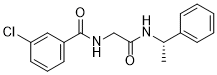
JNJ-63533054, a glycine benzamide analog, is a potent, selective and brain penetrant agonist of hGPR139 (human G-protein-coupled receptors) with an EC50 of 16 nM. It was found during a targeted high throughput screening for GPR139 that was carried out for a chosen 100K compounds. Following further examination and research on the structure-activity relationship, (S)-3-chloro-N-(2-oxo-2-((1-phenylethyl)amino)ethyl)benzamide, also known as JNJ-63533054, was found to be a strong and specific agonist of hGPR139, with an EC50 of 16 nM. JNJ-63533054 was found to cross the blood-brain barrier and have good drug-like properties amenable for oral dosing in rat.
Physicochemical Properties
| Molecular Formula | C17H17CLN2O2 | |
| Molecular Weight | 316.79 | |
| Exact Mass | 316.097 | |
| Elemental Analysis | C, 64.46; H, 5.41; Cl, 11.19; N, 8.84; O, 10.10 | |
| CAS # | 1802326-66-4 | |
| Related CAS # |
|
|
| PubChem CID | 2548547 | |
| Appearance | White to off-white solid powder | |
| Density | 1.2±0.1 g/cm3 | |
| Boiling Point | 559.7±45.0 °C at 760 mmHg | |
| Flash Point | 292.3±28.7 °C | |
| Vapour Pressure | 0.0±1.5 mmHg at 25°C | |
| Index of Refraction | 1.586 | |
| LogP | 3.13 | |
| Hydrogen Bond Donor Count | 2 | |
| Hydrogen Bond Acceptor Count | 2 | |
| Rotatable Bond Count | 5 | |
| Heavy Atom Count | 22 | |
| Complexity | 383 | |
| Defined Atom Stereocenter Count | 1 | |
| SMILES | ClC1=C([H])C([H])=C([H])C(=C1[H])C(N([H])C([H])([H])C(N([H])[C@@]([H])(C([H])([H])[H])C1C([H])=C([H])C([H])=C([H])C=1[H])=O)=O |
|
| InChi Key | MWDVCHRYCKXEBY-LBPRGKRZSA-N | |
| InChi Code | InChI=1S/C17H17ClN2O2/c1-12(13-6-3-2-4-7-13)20-16(21)11-19-17(22)14-8-5-9-15(18)10-14/h2-10,12H,11H2,1H3,(H,19,22)(H,20,21)/t12-/m0/s1 | |
| Chemical Name | 3-chloro-N-[2-oxo-2-[[(1S)-1-phenylethyl]amino]ethyl]benzamide | |
| Synonyms |
|
|
| HS Tariff Code | 2934.99.9001 | |
| Storage |
Powder-20°C 3 years 4°C 2 years In solvent -80°C 6 months -20°C 1 month |
|
| Shipping Condition | Room temperature (This product is stable at ambient temperature for a few days during ordinary shipping and time spent in Customs) |
Biological Activity
| Targets | human GPR139 ( Ki = 0.024 μM ); mouse GPR139 ( Ki = 0.054 μM ); rat GPR13 ( Ki = 0.075 μM ) |
| ln Vitro | JNJ-63533054 specially induces human GPR139 in the calcium mobilization (EC50 = 16 ± 6 nM) and GTPγS binding (EC50 = 17 ± 4 nM) assays. JNJ-63533054 exhibits comparable potency in activating the GPR139 receptors in rats and mice (rat EC50 = 63 ± 24 nM, mouse EC50 = 28 ± 7 nM)[1]. |
| ln Vivo | According to the results of an external selectivity panel comprising 50 known GPCRs, ion channels, and transporters, the small-molecule JNJ-63533054 exhibits no cross-reactivity and has appropriate pharmacokinetic characteristics for in vivo investigations. JNJ-63533054, when administered orally to rats, crosses the blood-brain barrier and reaches exposure in the micromolar range. JNJ-63533054 administration reduces rats' spontaneous locomotor activity[1]. |
| Animal Protocol | Male Sprague-Dawley rats (350-450 g)[1] 3 mg/kg, 10 mg/kg, and 30 mg/kg Oral administration; once |
| References |
[1]. GPR139, an Orphan Receptor Highly Enriched in the Habenula and Septum, Is Activated by the Essential Amino Acids L-Tryptophan and L-Phenylalanine. Mol Pharmacol. 2015 Nov;88(5):911-25. [2]. Identification and SAR of Glycine Benzamides as Potent Agonists for the GPR139 Receptor. ACS Med Chem Lett. 2015 Jul 20;6(9):1015-8. |
Solubility Data
| Solubility (In Vitro) |
|
|||
| Solubility (In Vivo) |
Solubility in Formulation 1: ≥ 2.5 mg/mL (7.89 mM) (saturation unknown) in 10% DMSO + 40% PEG300 + 5% Tween80 + 45% Saline (add these co-solvents sequentially from left to right, and one by one), clear solution. For example, if 1 mL of working solution is to be prepared, you can add 100 μL of 25.0 mg/mL clear DMSO stock solution to 400 μL PEG300 and mix evenly; then add 50 μL Tween-80 to the above solution and mix evenly; then add 450 μL normal saline to adjust the volume to 1 mL. Preparation of saline: Dissolve 0.9 g of sodium chloride in 100 mL ddH₂ O to obtain a clear solution. Solubility in Formulation 2: ≥ 2.5 mg/mL (7.89 mM) (saturation unknown) in 10% DMSO + 90% Corn Oil (add these co-solvents sequentially from left to right, and one by one), clear solution. For example, if 1 mL of working solution is to be prepared, you can add 100 μL of 25.0 mg/mL clear DMSO stock solution to 900 μL of corn oil and mix evenly. (Please use freshly prepared in vivo formulations for optimal results.) |
| Preparing Stock Solutions | 1 mg | 5 mg | 10 mg | |
| 1 mM | 3.1567 mL | 15.7833 mL | 31.5667 mL | |
| 5 mM | 0.6313 mL | 3.1567 mL | 6.3133 mL | |
| 10 mM | 0.3157 mL | 1.5783 mL | 3.1567 mL |