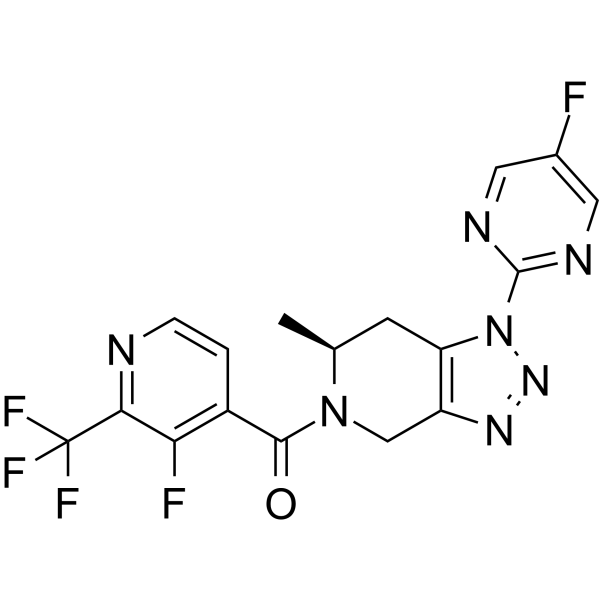
Physicochemical Properties
| Molecular Formula | C17H12F5N7O |
| Molecular Weight | 425.315499305725 |
| Exact Mass | 425.102 |
| CAS # | 2166558-11-6 |
| PubChem CID | 90408860 |
| Appearance | White to light yellow solid powder |
| LogP | 1.5 |
| Hydrogen Bond Donor Count | 0 |
| Hydrogen Bond Acceptor Count | 11 |
| Rotatable Bond Count | 2 |
| Heavy Atom Count | 30 |
| Complexity | 632 |
| Defined Atom Stereocenter Count | 1 |
| SMILES | FC1C(C(F)(F)F)=NC=CC=1C(N1CC2=C(C[C@@H]1C)N(C1N=CC(=CN=1)F)N=N2)=O |
| InChi Key | LMDWZBQISRTEBH-QMMMGPOBSA-N |
| InChi Code | InChI=1S/C17H12F5N7O/c1-8-4-12-11(26-27-29(12)16-24-5-9(18)6-25-16)7-28(8)15(30)10-2-3-23-14(13(10)19)17(20,21)22/h2-3,5-6,8H,4,7H2,1H3/t8-/m0/s1 |
| Chemical Name | [(6S)-1-(5-fluoropyrimidin-2-yl)-6-methyl-6,7-dihydro-4H-triazolo[4,5-c]pyridin-5-yl]-[3-fluoro-2-(trifluoromethyl)pyridin-4-yl]methanone |
| HS Tariff Code | 2934.99.9001 |
| Storage |
Powder-20°C 3 years 4°C 2 years In solvent -80°C 6 months -20°C 1 month Note: Please store this product in a sealed and protected environment (e.g. under nitrogen), avoid exposure to moisture and light. |
| Shipping Condition | Room temperature (This product is stable at ambient temperature for a few days during ordinary shipping and time spent in Customs) |
Biological Activity
| Targets | P2X7 Receptor |
| ln Vitro | The pKi of the rat P2X7 channel and the recombinant human channel are 8.5 and 8.1, respectively, according to JNJ-55308942. In human blood, mouse blood, and microglia, JNJ-55308942 potently and concentration-dependently reduces the release of IL-1β [2]. |
| ln Vivo | JNJ-55308942 (30 mg/kg; oral) reduces the activation of microglia in mice induced by LPS[2]. Oral JNJ-55308942 (30 mg/kg) treatment corrected BCG-induced sucrose preference and social interaction deficits in a model of depression generated by BCG. With an ED50 of 0.07 mg/kg, the chemical exhibited dose- and concentration-dependent occupancy of rat brain P2X7 following oral treatment. Target engagement has a functional influence on the brain of conscious rats, as demonstrated by the P2X7 antagonist (3 mg/kg, oral) which prevents the release of IL-1β in the brain caused by Bz-ATP[2]. F, Vss, CL, Cmax, and AUC24h values for JNJ-55308942 (5 mg/kg; po) are 81%, 1.7 L/kg, 3.7 mL min/kg, 1747 ng/mL, and 17549 (ng/mL) h, respectively[1]. |
| Animal Protocol |
Animal/Disease Models: Sixteen male C57/BL6J mice[2] Doses: 30 mg/kg Route of Administration: Po (after an ip injection of LPS (0.8 mg/kg, ip)) Experimental Results: Dramatically attenuated the effect of LPS on FSC, CD45 surface expression and CD11b surface expression. Animal/Disease Models: Rat[1] Doses: Po (pharmacokinetic/PK Analysis) Route of Administration: 5 mg/kg Experimental Results: The F, Vss, CL, Cmax and AUC24h were 81%, 1.7 L/kg, 3.7 mL min /kg, 1747 ng/mL, and 17549 (ng/mL) h, respectively. |
| References |
[1]. Neuropsychopharmacology of JNJ-55308942: evaluation of a clinical candidate targeting P2X7 ion channels in animal models of neuroinflammation and anhedonia. Neuropsychopharmacology. 2018;43(13):2586-2596. [2]. A Dipolar Cycloaddition Reaction To Access 6-Methyl-4,5,6,7-tetrahydro-1H-[1,2,3]triazolo[4,5-c]pyridines Enables the Discovery Synthesis and Preclinical Profiling of a P2X7 Antagonist Clinical Candidate. J Med Chem. 2018;61(1):207-223. |
Solubility Data
| Solubility (In Vitro) | DMSO: 100 mg/mL (235.12 mM) |
| Solubility (In Vivo) |
Solubility in Formulation 1: ≥ 4 mg/mL (9.40 mM) (saturation unknown) in 10% DMSO + 40% PEG300 + 5% Tween80 + 45% Saline (add these co-solvents sequentially from left to right, and one by one), clear solution. For example, if 1 mL of working solution is to be prepared, you can add 100 μL of 40.0 mg/mL clear DMSO stock solution to 400 μL PEG300 and mix evenly; then add 50 μL Tween-80 to the above solution and mix evenly; then add 450 μL normal saline to adjust the volume to 1 mL. Preparation of saline: Dissolve 0.9 g of sodium chloride in 100 mL ddH₂ O to obtain a clear solution. Solubility in Formulation 2: ≥ 4 mg/mL (9.40 mM) (saturation unknown) in 10% DMSO + 90% (20% SBE-β-CD in Saline) (add these co-solvents sequentially from left to right, and one by one), clear solution. For example, if 1 mL of working solution is to be prepared, you can add 100 μL of 40.0 mg/mL clear DMSO stock solution to 900 μL of 20% SBE-β-CD physiological saline solution and mix evenly. Preparation of 20% SBE-β-CD in Saline (4°C,1 week): Dissolve 2 g SBE-β-CD in 10 mL saline to obtain a clear solution. Solubility in Formulation 3: ≥ 4 mg/mL (9.40 mM) (saturation unknown) in 10% DMSO + 90% Corn Oil (add these co-solvents sequentially from left to right, and one by one), clear solution. For example, if 1 mL of working solution is to be prepared, you can add 100 μL of 40.0 mg/mL clear DMSO stock solution to 900 μL of corn oil and mix evenly. (Please use freshly prepared in vivo formulations for optimal results.) |
| Preparing Stock Solutions | 1 mg | 5 mg | 10 mg | |
| 1 mM | 2.3512 mL | 11.7559 mL | 23.5117 mL | |
| 5 mM | 0.4702 mL | 2.3512 mL | 4.7023 mL | |
| 10 mM | 0.2351 mL | 1.1756 mL | 2.3512 mL |