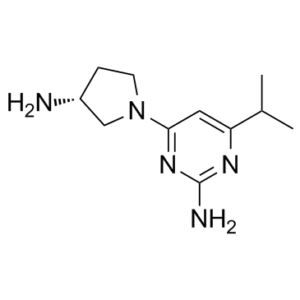
JNJ-39758979 is a novel, potent and selective, high-affinity histamine H4 receptor antagonist with a Ki of 12.5 nM. has been investigated in phase II clinical trials for atopic dermatitis and asthma. Utilizing insights from the tricyclic pyrimidines and expanding upon our SAR investigations of saturated derivatives from the indole carboxamide series, exemplified by JNJ 7777120, allowed us to arrive at the 6-alkyl-2,4-diaminopyrimidine series. Several 6-alkyl-2,4-diaminopyrimidines that acted as antagonists at the human and rodent H4 receptor were produced by a concentrated medicinal chemistry effort. A panel of antagonists that were profiled in animal models of inflammatory disease resulted from additional optimization. JNJ 39758979 was chosen as a clinical candidate based on the preclinical profile and effectiveness in multiple animal models; however, phase II development was stopped due to the discovery of drug-induced agranulocytosis (DIAG) in two subjects.
Physicochemical Properties
| Molecular Formula | C11H19N5 |
| Molecular Weight | 221.302061319351 |
| Exact Mass | 221.164 |
| Elemental Analysis | C, 59.70; H, 8.65; N, 31.65 |
| CAS # | 1046447-90-8 |
| Related CAS # | 1620648-30-7 (HCl salt) |
| PubChem CID | 24994634 |
| Appearance | White to off-white solid powder |
| Density | 1.2±0.1 g/cm3 |
| Boiling Point | 439.6±55.0 °C at 760 mmHg |
| Flash Point | 219.6±31.5 °C |
| Vapour Pressure | 0.0±1.1 mmHg at 25°C |
| Index of Refraction | 1.594 |
| LogP | -0.18 |
| Hydrogen Bond Donor Count | 2 |
| Hydrogen Bond Acceptor Count | 5 |
| Rotatable Bond Count | 2 |
| Heavy Atom Count | 16 |
| Complexity | 232 |
| Defined Atom Stereocenter Count | 1 |
| SMILES | C1(N)=NC(C(C)C)=CC(N2CC[C@@H](N)C2)=N1 |
| InChi Key | COOGVHJHSCBOQT-MRVPVSSYSA-N |
| InChi Code | InChI=1S/C11H19N5/c1-7(2)9-5-10(15-11(13)14-9)16-4-3-8(12)6-16/h5,7-8H,3-4,6,12H2,1-2H3,(H2,13,14,15)/t8-/m1/s1 |
| Chemical Name | 4-[(3R)-3-aminopyrrolidin-1-yl]-6-propan-2-ylpyrimidin-2-amine |
| Synonyms | JNJ-39758979; JNJ 39758979; JNJ39758979 |
| HS Tariff Code | 2934.99.9001 |
| Storage |
Powder-20°C 3 years 4°C 2 years In solvent -80°C 6 months -20°C 1 month Note: This product requires protection from light (avoid light exposure) during transportation and storage. |
| Shipping Condition | Room temperature (This product is stable at ambient temperature for a few days during ordinary shipping and time spent in Customs) |
Biological Activity
| Targets | Human H4 Receptor ( Ki = 12.5 nM ); Mouse H4 Receptor ( Ki = 5.3 nM ); Monkey H4 receptor ( Ki = 25 nM ); Rat H4 receptor ( Ki = 188 nM ); Guinea pig H4 receptor ( Ki = 306 nM ) |
| ln Vitro |
JNJ 39758979 effectively counteracts histamine-induced cAMP inhibition. It is a selective, high-affinity histamine H4 receptor antagonist with a Ki of 12.5 nM versus the human H4 receptor with a pA2 of 7.9 in transfected cells. At mouse H4R, pA2=8.3 and Ki=5.3 nM are found. At the monkey H4R, pA2=7.5 and Ki=25 nM. While JNJ 39758979 has little to no affinity for the dog H4R (Ki≥10 μM), it has a moderate affinity for the rat (Ki=188 nM, pA2 = 7.2) and guinea pig H4R (Ki=306 nM). Due to its low affinity for the H1, H2, and H3 receptors, the compound is highly selective for the H4R receptor[1]. JNJ-39758979 is metabolically stable (t1/2 >120 min) in vitro when cultured with liver microsomes from rats, dogs, or monkeys[1]. |
| ln Vivo |
JNJ-39758979 (10 mg/kg; p.o.) treatment reveals that the Cmax, t1/2, and F values are, in that order, 0.3 μM, 7.5 hours, and 36%[1]. JNJ-39758979 (2 mg/kg; i.v.) treatment reveals that the Vss, AUC, CL, and t1/2 were, in that order, 19.9 L/kg, 1.4 μM*h, 2.2 L/h, and 2.1 hours [1]. |
| Animal Protocol |
Sprague-Dawley rats 10 mg/kg Oral administration (Pharmacokinetic Analysis) |
| References |
[1]. Discovery and SAR of 6-alkyl-2,4-diaminopyrimidines as histamine H4 receptor antagonists. J Med Chem. 2014 Mar 27;57(6):2429-39. [2]. Phase 2a, randomized, double-blind, placebo-controlled, multicenter, parallel-group study of a H4 R-antagonist (JNJ-39758979) in Japanese adults with moderate atopic dermatitis. |
Solubility Data
| Solubility (In Vitro) | DMSO: ~33.3 mg/mL (~150.6 mM) |
| Solubility (In Vivo) |
Solubility in Formulation 1: ≥ 3.5 mg/mL (15.82 mM) (saturation unknown) in 10% DMSO + 40% PEG300 + 5% Tween80 + 45% Saline (add these co-solvents sequentially from left to right, and one by one), clear solution. For example, if 1 mL of working solution is to be prepared, you can add 100 μL of 35.0 mg/mL clear DMSO stock solution to 400 μL PEG300 and mix evenly; then add 50 μL Tween-80 to the above solution and mix evenly; then add 450 μL normal saline to adjust the volume to 1 mL. Preparation of saline: Dissolve 0.9 g of sodium chloride in 100 mL ddH₂ O to obtain a clear solution. Solubility in Formulation 2: ≥ 3.5 mg/mL (15.82 mM) (saturation unknown) in 10% DMSO + 90% (20% SBE-β-CD in Saline) (add these co-solvents sequentially from left to right, and one by one), clear solution. For example, if 1 mL of working solution is to be prepared, you can add 100 μL of 35.0 mg/mL clear DMSO stock solution to 900 μL of 20% SBE-β-CD physiological saline solution and mix evenly. Preparation of 20% SBE-β-CD in Saline (4°C,1 week): Dissolve 2 g SBE-β-CD in 10 mL saline to obtain a clear solution. Solubility in Formulation 3: ≥ 3.5 mg/mL (15.82 mM) (saturation unknown) in 10% DMSO + 90% Corn Oil (add these co-solvents sequentially from left to right, and one by one), clear solution. For example, if 1 mL of working solution is to be prepared, you can add 100 μL of 35.0 mg/mL clear DMSO stock solution to 900 μL of corn oil and mix evenly. (Please use freshly prepared in vivo formulations for optimal results.) |
| Preparing Stock Solutions | 1 mg | 5 mg | 10 mg | |
| 1 mM | 4.5188 mL | 22.5938 mL | 45.1875 mL | |
| 5 mM | 0.9038 mL | 4.5188 mL | 9.0375 mL | |
| 10 mM | 0.4519 mL | 2.2594 mL | 4.5188 mL |