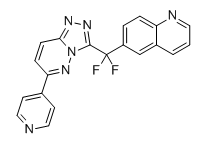
OMO-1 (formerly known as JNJ-38877618) is a novel, potent, highly selective and orally bioavailable Met kinase inhibitor with nM binding affinity (Kd=1.4 nM) and enzyme inhibitory activity against wt and M1268T mutant MET (IC50 2 and 3 nM ). Proliferation, colony formation, and motility assays were used to evaluate the inhibitory effects of MET. Against MET Ampl/mutant and therapy-resistant models, OMO-1 demonstrated nM potency. In three models (the SNU5 MET amp gastric, the U87-MG HGF autocrine glioblastoma, and the Hs746T MET exon 14 skipping mutant gastric cancer) OMO-1 completely inhibited the growth of the tumors in vivo. OMO-1 caused MET kinase activation to be inhibited in a dose- and time-dependent manner, leading to the regression of large MET amplified EBC-1 SqNSCLC. The target shut down duration was significantly longer than the plasma exposure times. The well-tolerated combination treatments enhanced the EGFR-targeted therapy. OMO-1 as a single agent had no effect on NSCLC HCC827 EGFR; however, when combined with erlotinib, the onset of tumor recurrence was delayed. It was discovered that the obtained EGFR inhibitor resistant model HCC827-ER1 was MET amplified. In this model, erlotinib and OMO-1 individually inhibited tumor growth, but together they caused tumor regression. OMO-1, a single agent, caused tumor stasis in a PDX resistant to EGFR inhibitors with MET amplification, while MetMab/erlotinib only delayed the growth of the tumor. The strong preclinical activity seen is in favor of OMO-1's continued clinical development in individuals with tumors driven by the MET pathway. with 2 and 3 nM IC50s for mutant and wild type Met, respectively.
Physicochemical Properties
| Molecular Formula | C20H12F2N6 |
| Molecular Weight | 374.346289634705 |
| Exact Mass | 374.11 |
| Elemental Analysis | C, 64.17; H, 3.23; F, 10.15; N, 22.45 |
| CAS # | 943540-74-7 |
| Related CAS # | 943540-74-7 |
| PubChem CID | 57654476 |
| Appearance | White to off-white solid powder |
| LogP | 2.7 |
| Hydrogen Bond Donor Count | 0 |
| Hydrogen Bond Acceptor Count | 7 |
| Rotatable Bond Count | 3 |
| Heavy Atom Count | 28 |
| Complexity | 543 |
| Defined Atom Stereocenter Count | 0 |
| InChi Key | KOAWAWHSMVKCON-UHFFFAOYSA-N |
| InChi Code | InChI=1S/C20H12F2N6/c21-20(22,15-3-4-16-14(12-15)2-1-9-24-16)19-26-25-18-6-5-17(27-28(18)19)13-7-10-23-11-8-13/h1-12H |
| Chemical Name | 6-[difluoro-(6-pyridin-4-yl-[1,2,4]triazolo[4,3-b]pyridazin-3-yl)methyl]quinoline |
| Synonyms | JNJ-38877618; JNJ 38877618; JNJ38877618 |
| HS Tariff Code | 2934.99.9001 |
| Storage |
Powder-20°C 3 years 4°C 2 years In solvent -80°C 6 months -20°C 1 month |
| Shipping Condition | Room temperature (This product is stable at ambient temperature for a few days during ordinary shipping and time spent in Customs) |
Biological Activity
| Targets | wt Met (IC50 = 2 nM); mutant Met (IC50 = 2 nM) |
| ln Vitro | OMO-1 (formerly JNJ-38877618) is an oral bioavailable, highly selective, potent Met kinase inhibitor with nM binding affinity (Kd=1.4 nM) and IC50 values of 2 and 3 nM for both wild-type and M1268T mutant Met. Assays for colony formation, motility, and proliferation are used to evaluate the effects of met inhibitors. When it comes to Met Ampl/mutant and therapy-resistant models, JNJ-38877618 exhibits nM potency[1]. |
| ln Vivo | JNJ-38877618 causes total inhibition of tumor growth in three models: Hs746T Met exon 14 skipping mutant gastric cancer, U87-MG HGF autocrine glioblastoma, and SNU5 Met amp gastric cancer. Large Met amplified EBC-1 SqNSCLC is regressed when exposed to JNJ-38877618, which inhibits Met kinase activation in a time- and dose-dependent manner. The duration of target shut down is significantly longer than that of plasma exposure times. Combination therapies have enhanced EGFR targeted therapy and are well tolerated[1]. |
| References |
[1]. OMO-1, a potent, highly selective, orally bioavailable, Met kinase inhibitor with a favorable preclinical toxicity profile, shows both monotherapy activity, against Met pathway-driven tumors, and EGFR TKI combination activity in acquire |
| Additional Infomation | MET Kinase Inhibitor OMO-1 is an inhibitor of the proto-oncogene and receptor tyrosine kinase (RTK) hepatocyte growth factor receptor (c-Met; HGFR; MET) with potential antineoplastic activity. Upon administration, OMO-1 selectively binds to c-Met, thereby inhibiting c-Met phosphorylation and disrupting c-Met signal transduction pathways. This may induce cell death in tumor cells overexpressing c-Met protein or expressing constitutively activated c-Met protein. c-Met, a receptor tyrosine kinase overexpressed or mutated in many tumor cell types, plays key roles in tumor cell proliferation, survival, invasion, metastasis, and tumor angiogenesis. |
Solubility Data
| Solubility (In Vitro) |
DMSO: 5~10 mg/mL (13.4~26.7 mM) Ethanol: ~2 mg/mL (~5.3 mM) |
| Solubility (In Vivo) |
Solubility in Formulation 1: ≥ 0.5 mg/mL (1.34 mM) (saturation unknown) in 10% DMSO + 40% PEG300 + 5% Tween80 + 45% Saline (add these co-solvents sequentially from left to right, and one by one), clear solution. For example, if 1 mL of working solution is to be prepared, you can add 100 μL of 5.0 mg/mL clear DMSO stock solution to 400 μL PEG300 and mix evenly; then add 50 μL Tween-80 to the above solution and mix evenly; then add 450 μL normal saline to adjust the volume to 1 mL. Preparation of saline: Dissolve 0.9 g of sodium chloride in 100 mL ddH₂ O to obtain a clear solution. Solubility in Formulation 2: ≥ 0.5 mg/mL (1.34 mM) (saturation unknown) in 10% DMSO + 90% (20% SBE-β-CD in Saline) (add these co-solvents sequentially from left to right, and one by one), clear solution. For example, if 1 mL of working solution is to be prepared, you can add 100 μL of 5.0 mg/mL clear DMSO stock solution to 900 μL of 20% SBE-β-CD physiological saline solution and mix evenly. Preparation of 20% SBE-β-CD in Saline (4°C,1 week): Dissolve 2 g SBE-β-CD in 10 mL saline to obtain a clear solution. Solubility in Formulation 3: ≥ 0.5 mg/mL (1.34 mM) (saturation unknown) in 10% DMSO + 90% Corn Oil (add these co-solvents sequentially from left to right, and one by one), clear solution. For example, if 1 mL of working solution is to be prepared, you can add 100 μL of 5.0 mg/mL clear DMSO stock solution to 900 μL of corn oil and mix evenly. (Please use freshly prepared in vivo formulations for optimal results.) |
| Preparing Stock Solutions | 1 mg | 5 mg | 10 mg | |
| 1 mM | 2.6713 mL | 13.3565 mL | 26.7130 mL | |
| 5 mM | 0.5343 mL | 2.6713 mL | 5.3426 mL | |
| 10 mM | 0.2671 mL | 1.3356 mL | 2.6713 mL |