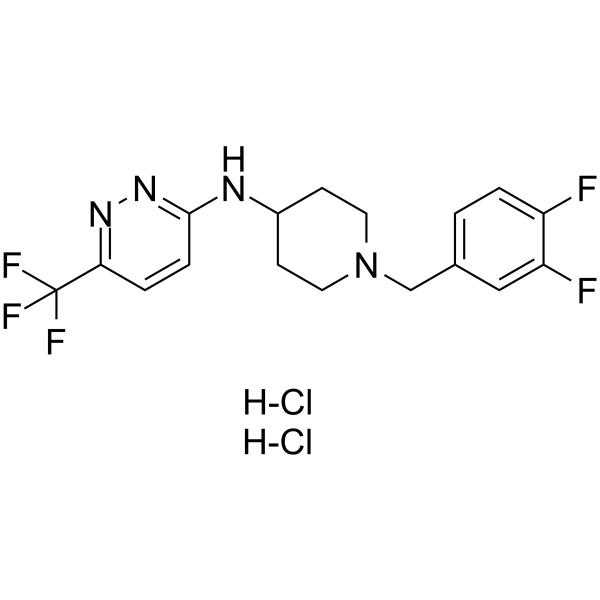
Physicochemical Properties
| Molecular Formula | C17H19CL2F5N4 |
| Molecular Weight | 445.2576 |
| Exact Mass | 444.09 |
| CAS # | 2108806-02-4 |
| Related CAS # | 935776-74-2;2108806-02-4 (2HCl); |
| PubChem CID | 91826482 |
| Appearance | Typically exists as solid at room temperature |
| Hydrogen Bond Donor Count | 3 |
| Hydrogen Bond Acceptor Count | 9 |
| Rotatable Bond Count | 4 |
| Heavy Atom Count | 28 |
| Complexity | 441 |
| Defined Atom Stereocenter Count | 0 |
| InChi Key | UOLHGUUKFNZTNS-UHFFFAOYSA-N |
| InChi Code | InChI=1S/C17H17F5N4.2ClH/c18-13-2-1-11(9-14(13)19)10-26-7-5-12(6-8-26)23-16-4-3-15(24-25-16)17(20,21)22;;/h1-4,9,12H,5-8,10H2,(H,23,25);2*1H |
| Chemical Name | N-[1-[(3,4-difluorophenyl)methyl]piperidin-4-yl]-6-(trifluoromethyl)pyridazin-3-amine;dihydrochloride |
| HS Tariff Code | 2934.99.9001 |
| Storage |
Powder-20°C 3 years 4°C 2 years In solvent -80°C 6 months -20°C 1 month Note: Please store this product in a sealed and protected environment, avoid exposure to moisture. |
| Shipping Condition | Room temperature (This product is stable at ambient temperature for a few days during ordinary shipping and time spent in Customs) |
Biological Activity
| Targets |
JNJ-37822681 dihydrochloride targets dopamine D2 receptor (Ki = 0.4 nM; dissociation half-life = 1.8 min) [1] |
| ln Vitro |
- Binding assay results showed JNJ-37822681 dihydrochloride exhibited high affinity for human dopamine D2 receptor (Ki = 0.4 nM) and rapid dissociation (t1/2 = 1.8 min) compared to reference D2 antagonists (e.g., haloperidol: t1/2 = 34.5 min). [1] - In Chinese hamster ovary (CHO) cells expressing human D2 receptors, JNJ-37822681 dihydrochloride inhibited dopamine-induced cyclic AMP (cAMP) accumulation with an IC50 of 2.3 nM. [1] - The compound showed no significant binding affinity (Ki > 1000 nM) for dopamine D1, D3, D4, D5 receptors, serotonin 5-HT1A, 5-HT2A, 5-HT2C, 5-HT3 receptors, noradrenergic α1, α2 receptors, or muscarinic M1 receptors. [1] |
| ln Vivo |
JNJ-37822681 (0.0025-40 mg/kg; ih; once) is efficacious in animal models of psychosis and inhibits D2 receptors in the rat brain at a reasonably low dose (ED50 = 0.39 mg/kg) [2]. Inducing little prolactin release at the lowest dose necessary for central D2 receptor inhibition is JNJ-37822681 (0.01-2.5 mg/kg; ih; once) [2]. - In rats, oral administration of JNJ-37822681 dihydrochloride (0.3–30 mg/kg) dose-dependently inhibited apomorphine-induced climbing behavior (ED50 = 1.2 mg/kg) and methamphetamine-induced hyperlocomotion (ED50 = 0.8 mg/kg). [1] - In the conditioned avoidance response (CAR) test in rats, JNJ-37822681 dihydrochloride (1–10 mg/kg, p.o.) dose-dependently reduced avoidance responses without significant sedative effects at effective doses. [1] - In cynomolgus monkeys, repeated oral administration of JNJ-37822681 dihydrochloride (1–30 mg/kg/day) for 4 weeks resulted in dose-related increases in plasma prolactin levels (up to 3.5-fold at 30 mg/kg/day). [2] - Sprague-Dawley rats treated with JNJ-37822681 dihydrochloride (3–30 mg/kg/day, p.o.) for 4 weeks showed no significant changes in prolactin levels or mammary gland histopathology. [2] |
| Enzyme Assay |
- Receptor binding assay: Membranes from cells expressing human dopamine receptors (D2, D1, D3, etc.) were incubated with increasing concentrations of JNJ-37822681 dihydrochloride and a radiolabeled D2 antagonist. Bound radioligand was separated by filtration, and radioactivity was measured to calculate Ki values and dissociation half-lives. [1] - cAMP accumulation assay: CHO cells expressing human D2 receptors were preincubated with JNJ-37822681 dihydrochloride for 30 min, followed by stimulation with dopamine (10 μM). Intracellular cAMP levels were quantified using a competitive binding assay to determine IC50 values. [1] |
| Animal Protocol |
Animal/Disease Models: Female SD (SD (Sprague-Dawley)) rats, apomorphine-induced, d-amphetamine-induced or phencyclidine-induced [2] Doses: 0.0025-40 mg/kg Route of Administration: subcutaneous injection; 20mg/kg . Experimental Results: Inhibition of excessive movement caused by D-amphetamine, ED50 value is 1.0 mg/kg. Inhibits apomorphine-induced stereotypy with an ED50 value of 0.19 mg/kg. Inhibits phencyclidine-induced hypermotility with an ED50 value of 4.7 mg/kg. Animal/Disease Models: Female SD (SD (Sprague-Dawley)) rat [2] Doses: 0.01, 0.02, 0.04, 0.08, 0.16, 0.31, 0.63, 1.25 and 2.5 mg/kg Route of Administration: subcutaneous injection; Experimental Results: Increased lactation in a dose-dependent manner hormone release. - Rat behavioral studies: Male Sprague-Dawley rats were acclimated for 7 days before treatment. JNJ-37822681 dihydrochloride was dissolved in a vehicle (0.5% methylcellulose + 0.1% Tween 80) and administered orally at doses of 0.3–30 mg/kg. Behavioral tests (apomorphine-induced climbing, methamphetamine-induced hyperlocomotion, CAR) were conducted 1–2 hours post-administration. [1] - Cynomolgus monkey toxicology study: Male and female cynomolgus monkeys were randomly assigned to treatment groups (1, 10, 30 mg/kg/day) or vehicle control. JNJ-37822681 dihydrochloride was administered orally once daily for 4 weeks. Blood samples were collected weekly for prolactin measurement, and necropsy was performed at study end for histopathological examination of mammary glands. [2] - Sprague-Dawley rat toxicology study: Male and female SD rats were assigned to treatment groups (3, 10, 30 mg/kg/day) or vehicle control. JNJ-37822681 dihydrochloride was given orally once daily for 4 weeks. Plasma prolactin levels were measured at weekly intervals, and mammary glands were collected for histopathological analysis after euthanasia. [2] |
| ADME/Pharmacokinetics |
- In rats, oral bioavailability of JNJ-37822681 dihydrochloride was 45% at a dose of 10 mg/kg. [1] - The compound had a plasma half-life (t1/2) of 2.3 hours in rats and 3.1 hours in cynomolgus monkeys after oral administration. [1] - JNJ-37822681 dihydrochloride was extensively metabolized in liver microsomes, with no major unchanged drug excreted in urine or feces. [1] |
| Toxicity/Toxicokinetics |
- No overt toxicity (lethality, weight loss, clinical signs) was observed in rats or cynomolgus monkeys at doses up to 30 mg/kg/day for 4 weeks. [2] - Cynomolgus monkeys showed dose-dependent prolactin elevation (statistically significant at 10 and 30 mg/kg/day) but no mammary gland abnormalities. [2] - SD rats showed no significant changes in prolactin levels or mammary histopathology across all dose groups. [2] - Plasma protein binding of JNJ-37822681 dihydrochloride was 89% in human plasma and 85% in rat plasma. [1] |
| References |
[1]. Langlois X, et, al. Pharmacology of JNJ-37822681, a specific and fast-dissociating D2 antagonist for the treatment of schizophrenia. J Pharmacol Exp Ther. 2012 Jul;342(1):91-105. [2]. de Waal EJ, et, al. Differential responses to JNJ-37822681, a specific and fast dissociating dopamine D2 receptor antagonist, in cynomolgus monkey and Sprague-Dawley rat general toxicology studies: clinical observations, prolactin levels, mammary histopat |
| Additional Infomation |
- JNJ-37822681 dihydrochloride is a specific, fast-dissociating dopamine D2 receptor antagonist developed for the treatment of schizophrenia. [1] - The rapid dissociation from D2 receptors is proposed to reduce the risk of extrapyramidal side effects (EPS) compared to conventional D2 antagonists. [1] - Differential species responses (prolactin elevation in monkeys but not rats) highlight the importance of non-human primate models for toxicological assessment of D2 antagonists. [2] |
Solubility Data
| Solubility (In Vitro) | DMSO : ~33.33 mg/mL (~74.86 mM) |
| Solubility (In Vivo) |
Solubility in Formulation 1: ≥ 2.5 mg/mL (5.61 mM) (saturation unknown) in 10% DMSO + 40% PEG300 + 5% Tween80 + 45% Saline (add these co-solvents sequentially from left to right, and one by one), clear solution. For example, if 1 mL of working solution is to be prepared, you can add 100 μL of 25.0 mg/mL clear DMSO stock solution to 400 μL PEG300 and mix evenly; then add 50 μL Tween-80 to the above solution and mix evenly; then add 450 μL normal saline to adjust the volume to 1 mL. Preparation of saline: Dissolve 0.9 g of sodium chloride in 100 mL ddH₂ O to obtain a clear solution. Solubility in Formulation 2: ≥ 2.5 mg/mL (5.61 mM) (saturation unknown) in 10% DMSO + 90% (20% SBE-β-CD in Saline) (add these co-solvents sequentially from left to right, and one by one), clear solution. For example, if 1 mL of working solution is to be prepared, you can add 100 μL of 25.0 mg/mL clear DMSO stock solution to 900 μL of 20% SBE-β-CD physiological saline solution and mix evenly. Preparation of 20% SBE-β-CD in Saline (4°C,1 week): Dissolve 2 g SBE-β-CD in 10 mL saline to obtain a clear solution. Solubility in Formulation 3: ≥ 2.5 mg/mL (5.61 mM) (saturation unknown) in 10% DMSO + 90% Corn Oil (add these co-solvents sequentially from left to right, and one by one), clear solution. For example, if 1 mL of working solution is to be prepared, you can add 100 μL of 25.0 mg/mL clear DMSO stock solution to 900 μL of corn oil and mix evenly. (Please use freshly prepared in vivo formulations for optimal results.) |
| Preparing Stock Solutions | 1 mg | 5 mg | 10 mg | |
| 1 mM | 2.2459 mL | 11.2294 mL | 22.4588 mL | |
| 5 mM | 0.4492 mL | 2.2459 mL | 4.4918 mL | |
| 10 mM | 0.2246 mL | 1.1229 mL | 2.2459 mL |