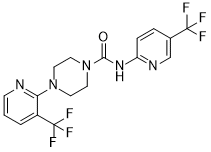
JNJ-17203212 is a novel, potent, reversible, competitive and selective TRPV1 antagonist with IC50 of 65 nM and 102 nM for human TRPV1 and rat TRPV1. JNJ-17203212 inhibits capsaicin- and H+-induced channel activation (pIC50 values are 6.32 and 7.23 respectively) and exhibits antitussive and analgesic activity in vivo. JNJ-17203212, reduces sensitivity to luminal distension in both an acute, noninflammatory and a chronic, post-inflammatory rodent model of colonic hypersensitivity. These data indicate that TRPV1 is involved in the pathogenesis of visceral hypersensitivity and that JNJ-17203212 may be a potential therapeutic agent for functional bowel disorders characterized by abdominal hypersensitivity, such as irritable bowel syndrome.
Physicochemical Properties
| Molecular Formula | C17H15F6N5O |
| Molecular Weight | 419.324323892593 |
| Exact Mass | 419.118 |
| CAS # | 821768-06-3 |
| PubChem CID | 11339118 |
| Appearance | Off-white to light yellow solid powder |
| LogP | 3.944 |
| Hydrogen Bond Donor Count | 1 |
| Hydrogen Bond Acceptor Count | 10 |
| Rotatable Bond Count | 2 |
| Heavy Atom Count | 29 |
| Complexity | 564 |
| Defined Atom Stereocenter Count | 0 |
| InChi Key | JFRYYGVYCWYIDQ-UHFFFAOYSA-N |
| InChi Code | InChI=1S/C17H15F6N5O/c18-16(19,20)11-3-4-13(25-10-11)26-15(29)28-8-6-27(7-9-28)14-12(17(21,22)23)2-1-5-24-14/h1-5,10H,6-9H2,(H,25,26,29) |
| Chemical Name | 1-Piperazinecarboxamide, 4-(3-(trifluoromethyl)-2-pyridinyl)-N-(5-(trifluoromethyl)-2-pyridinyl)- |
| Synonyms | JNJ-17203212; JNJ 17203212; JNJ17203212. |
| HS Tariff Code | 2934.99.9001 |
| Storage |
Powder-20°C 3 years 4°C 2 years In solvent -80°C 6 months -20°C 1 month |
| Shipping Condition | Room temperature (This product is stable at ambient temperature for a few days during ordinary shipping and time spent in Customs) |
Biological Activity
| Targets | In TRPV1-expressing HEK cells, imperatorin-induced TRPV1 activation (Ca2+ rise) is significantly inhibited by JNJ-17203212 (0.5 μM) [1]. |
| ln Vitro |
In TRPV1-expressing HEK cells, imperatorin-induced TRPV1 activation (Ca2+ rise) is significantly inhibited by JNJ-17203212 (0.5 μM) [1]. JNJ-17203212 (500 nM) effectively inhibited capsaicin (20 nM)-induced intracellular Ca²⁺ increases in human TRPV1-expressing HEK (TRPV1-HEK) cells.[1] JNJ-17203212 (500 nM) completely inhibited intracellular Ca²⁺ transients induced by 10 μM imperatorin in TRPV1-HEK cells.[1] The compound decreased the basal level of fluorescence in TRPV1-expressing HEK cells, indicating suppression of spontaneous TRPV1 activity in this overexpression model.[1] |
| ln Vivo |
The early gene c-fos's expression is elevated by inflammatory soup (IS) and is dose-dependently reduced by JNJ-17203212 (0.3 mg/kg; iv) [2]. JNJ-17203212, in a dose-dependent manner, fully inhibits the release of CGRP (neurotransmitter calcitonin gene-related peptide) caused by capsaicin [2]. JNJ-17203212 dose-dependently reduces inflammatory soup (IS)-induced c-fos expression in the trigeminal nucleus caudalis (TNC), with complete abolition at 30 mg/kg. [2] JNJ-17203212 dose-dependently blocks capsaicin-induced CGRP release in jugular vein blood, completely abolishing release at 30 mg/kg within 10 minutes. [2] |
| Enzyme Assay |
pIC50 values were determined using recombinant hTRPV1 in a Ca²⁺ influx assay (FLIPR). [2] pKi values were determined by radioligand binding to a broad panel of receptors, channels, and transporters. [2] |
| Cell Assay |
Fluorescence imaging experiments were performed to assess the effect of JNJ-17203212 on TRPV1-mediated Ca²⁺ influx. HEK cells transiently expressing human TRPV1 were loaded with Fura-2AM (4 μM) in a calcium- and magnesium-containing PBS buffer for 1 hour, followed by a 30-minute incubation in dye-free buffer. Single-cell intracellular Ca²⁺ changes were monitored using a fluorescence imaging system. Cells were continuously superfused with test solutions. The standard extracellular solution contained 145 mM NaCl, 2.5 mM KCl, 1.2 mM CaCl₂, 1 mM MgCl₂, 10 mM HEPES, and 5.5 mM glucose (pH 7.2). To test JNJ-17203212, cells were pretreated or co-treated with the compound (500 nM) before or during application of agonists like capsaicin or imperatorin. The inhibition of agonist-induced Ca²⁺ transients was measured.[1] |
| Animal Protocol |
Animal/Disease Models: Male SD (SD (Sprague-Dawley)) rat (260-300 g) [2] Doses: 0.3 mg/kg Route of Administration: intravenous (iv) (iv)injection Experimental Results: The increase in c-fos expression after intracisternal injection of IS was dose-dependent Influence. Male Sprague–Dawley rats (260–300 g) were anesthetized with thiopental-sodium (60 mg/kg i.p.), tracheotomized, and mechanically ventilated. Femoral artery and vein were cannulated for blood pressure monitoring and intravenous drug administration. [2] For c-fos study: A catheter was placed into the cisterna magna for inflammatory soup (IS) administration. JNJ-17203212 or vehicle was administered intravenously over 20 minutes before IS injection. Animals were perfused 2 hours post-IS for c-fos immunohistochemistry. [2] For CGRP study: The external jugular vein and carotid artery were cannulated. JNJ-17203212 was administered intravenously over 20 minutes before capsaicin injection into the carotid artery. Blood samples were taken at 5, 10, and 15 minutes post-capsaicin for CGRP measurement. [2] Doses used: 0.3, 3, and 30 mg/kg i.v. [2] |
| ADME/Pharmacokinetics |
Half-life of JNJ-17203212 is 7.4 hours. [2] Oral bioavailability exceeds that of SB-705498 by 14%. [2] |
| References |
[1]. Furanocoumarins are a novel class of modulators for the transient receptor potential vanilloid type 1 (TRPV1) channel.J Biol Chem. 2014 Apr 4; 289(14): 9600-9610. [2]. Two TRPV1 receptor antagonists are effective in two different experimental models of migraine. J Headache Pain. 2015; 16: 57. |
| Additional Infomation |
JNJ-17203212 is referred to as a specific TRPV1 antagonist in this study and was used as a pharmacological tool to confirm that the effects of the natural product imperatorin were mediated through the TRPV1 channel.[1] The study did not investigate JNJ-17203212 itself as a primary drug candidate; its data is presented in the context of characterizing imperatorin's mechanism of action.[1] |
Solubility Data
| Solubility (In Vitro) | DMSO : ≥ 100 mg/mL (~238.48 mM) |
| Solubility (In Vivo) |
Solubility in Formulation 1: ≥ 2.75 mg/mL (6.56 mM) (saturation unknown) in 10% DMSO + 40% PEG300 + 5% Tween80 + 45% Saline (add these co-solvents sequentially from left to right, and one by one), clear solution. For example, if 1 mL of working solution is to be prepared, you can add 100 μL of 27.5 mg/mL clear DMSO stock solution to 400 μL PEG300 and mix evenly; then add 50 μL Tween-80 to the above solution and mix evenly; then add 450 μL normal saline to adjust the volume to 1 mL. Preparation of saline: Dissolve 0.9 g of sodium chloride in 100 mL ddH₂ O to obtain a clear solution. Solubility in Formulation 2: ≥ 2.75 mg/mL (6.56 mM) (saturation unknown) in 10% DMSO + 90% Corn Oil (add these co-solvents sequentially from left to right, and one by one), clear solution. For example, if 1 mL of working solution is to be prepared, you can add 100 μL of 27.5 mg/mL clear DMSO stock solution to 900 μL of corn oil and mix evenly. (Please use freshly prepared in vivo formulations for optimal results.) |
| Preparing Stock Solutions | 1 mg | 5 mg | 10 mg | |
| 1 mM | 2.3848 mL | 11.9241 mL | 23.8481 mL | |
| 5 mM | 0.4770 mL | 2.3848 mL | 4.7696 mL | |
| 10 mM | 0.2385 mL | 1.1924 mL | 2.3848 mL |