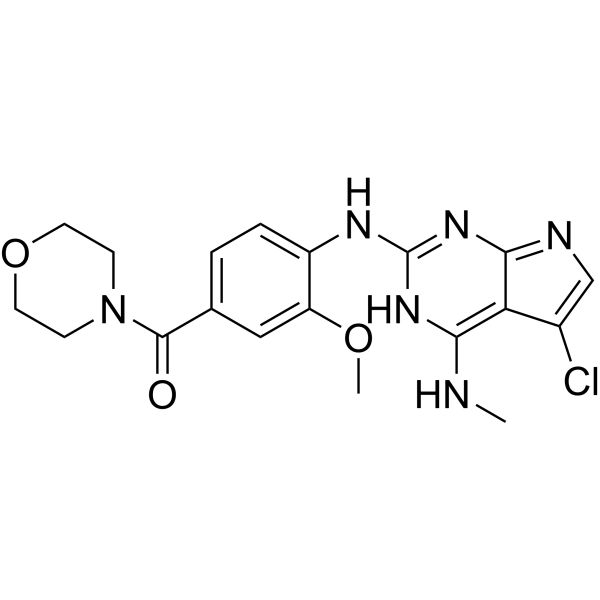
Physicochemical Properties
| Molecular Formula | C19H21CLN6O3 |
| Molecular Weight | 416.87 |
| Exact Mass | 416.136 |
| CAS # | 1700693-08-8 |
| PubChem CID | 112499966 |
| Appearance | Light yellow to yellow solid powder |
| Density | 1.5±0.1 g/cm3 |
| Boiling Point | 581.4±60.0 °C at 760 mmHg |
| Flash Point | 305.4±32.9 °C |
| Vapour Pressure | 0.0±1.6 mmHg at 25°C |
| Index of Refraction | 1.701 |
| LogP | -0.68 |
| Hydrogen Bond Donor Count | 3 |
| Hydrogen Bond Acceptor Count | 7 |
| Rotatable Bond Count | 5 |
| Heavy Atom Count | 29 |
| Complexity | 566 |
| Defined Atom Stereocenter Count | 0 |
| InChi Key | HUEKBQXFNHWTQQ-UHFFFAOYSA-N |
| InChi Code | InChI=1S/C19H21ClN6O3/c1-21-16-15-12(20)10-22-17(15)25-19(24-16)23-13-4-3-11(9-14(13)28-2)18(27)26-5-7-29-8-6-26/h3-4,9-10H,5-8H2,1-2H3,(H3,21,22,23,24,25) |
| Chemical Name | [4-[[5-chloro-4-(methylamino)-7H-pyrrolo[2,3-d]pyrimidin-2-yl]amino]-3-methoxyphenyl]-morpholin-4-ylmethanone |
| Synonyms | JH-II127; JH-II 127; JH-II-127 |
| HS Tariff Code | 2934.99.9001 |
| Storage |
Powder-20°C 3 years 4°C 2 years In solvent -80°C 6 months -20°C 1 month |
| Shipping Condition | Room temperature (This product is stable at ambient temperature for a few days during ordinary shipping and time spent in Customs) |
Biological Activity
| ln Vitro | In HEK293 cells, JH-II-127 (0.03, 0.1, 0.3, 1, 3 µM; 90 minutes) suppresses LRRK2 [1]. In mouse Swiss 3T3 cells, endogenously produced LRRK2 is inhibited by JH-II-127 (0.3, 1, 3 µM; 90 minutes) [1]. |
| ln Vivo | JH-II-127 (100 mg/kg; i.p.; single dosage) produces nearly full dephosphorylation of LRRK2 Ser935 in all tissues, including brain [1]. 1.19 Pharmacokinetic characteristics of JH-II-127 in wild-type male C57BL/6 mice [1]. Matrix route Tmax (h) C0/Cmax (ng/mL) AUCLast (h·ng/mL) AUGINF (h·ng/mL) T1/2 (h) CL (mL/min/kg) Vss (L/kg) Plasma IV (2 mg/kg) - 1604.47 532.67 535.57 0.66 62.24 1.73 Plasma PO (10 mg/kg) 1 802.72 3094.58 3867.07 - - - Brain IV (2 mg/kg) - 1343.6 239.31 246.47 0.23 1 35. 24 1.7 Brain PO (10 mg/kg) 1 247.35 688.21 762.38 - - - |
| Cell Assay |
Western Blot Analysis[1] Cell Types: HEK293 cells (expressing GFP-LRRK2, GFP-LRRK2[G2019S], GFP-LRRK2[G2019S + A2016T] and GFP-LRRK2[A2016T], respectively. Tested Concentrations: 0.03, 0.1, 0.3, 1, 3 µM Incubation Duration: 90 minutes Experimental Results: Induced dose-dependent inhibition of Ser910 and Ser935 phosphorylation in wild-type LRRK2 and LRRK2[G2019S] stably transfected into HEK293 cells. For wild-type LRRK2 and LRRK2[G2019S], at ca. Inhibits phosphorylation of Ser910 and Ser935 at 0.3 μM. Induces dephosphorylation of Ser910 and Ser935 at concentrations of 0.3-1 μM in drug-resistant LRRK2[A2016T + G2019S] and LRRK2[A2016T] mutants. Western Blot Analysis[1] Cell Types: Mouse Swiss 3T3 Cell Tested Concentrations: 0.03, 0.1, 0.3, 1, 3 µM Incubation Duration: 90 min Experimental Results: Induces similar dose-dependent Ser935 dephosphorylation of endogenous LRRK2. |
| Animal Protocol |
Animal/Disease Models: wild-type male C57BL/6 mice [1]. Doses: 2 mg/kg (intravenous (iv) (iv)injection); 10 mg/kg (oral); 10, 30, 100 mg/kg (intraperitoneal (ip) injection) Route of Administration: intravenous (iv) (iv)and intraperitoneal (ip) injection; oral administration; single. Experimental Results: intraperitoneal (ip) injection of 100 mg/kg resulted in near-complete dephosphorylation of LRRK2 Ser935 in all tissues, including the brain, and at 30 mg/kg resulted in near-complete inhibition in all tissues, but not at 10 mg/kg. There was only partial inhibition in the brain at kg doses. Exhibits good oral bioavailability. |
| References |
[1]. Discovery of a Pyrrolopyrimidine (JH-II-127), a Highly Potent, Selective, and Brain Penetrant LRRK2 Inhibitor. ACS Med Chem Lett. 2015 Apr 7;6(5):584-9. |
Solubility Data
| Solubility (In Vitro) | DMSO : ~110 mg/mL (~263.88 mM) |
| Solubility (In Vivo) |
Solubility in Formulation 1: ≥ 2.75 mg/mL (6.60 mM) (saturation unknown) in 10% DMSO + 40% PEG300 + 5% Tween80 + 45% Saline (add these co-solvents sequentially from left to right, and one by one), clear solution. For example, if 1 mL of working solution is to be prepared, you can add 100 μL of 27.5 mg/mL clear DMSO stock solution to 400 μL PEG300 and mix evenly; then add 50 μL Tween-80 to the above solution and mix evenly; then add 450 μL normal saline to adjust the volume to 1 mL. Preparation of saline: Dissolve 0.9 g of sodium chloride in 100 mL ddH₂ O to obtain a clear solution. Solubility in Formulation 2: ≥ 2.75 mg/mL (6.60 mM) (saturation unknown) in 10% DMSO + 90% Corn Oil (add these co-solvents sequentially from left to right, and one by one), clear solution. For example, if 1 mL of working solution is to be prepared, you can add 100 μL of 27.5 mg/mL clear DMSO stock solution to 900 μL of corn oil and mix evenly. (Please use freshly prepared in vivo formulations for optimal results.) |
| Preparing Stock Solutions | 1 mg | 5 mg | 10 mg | |
| 1 mM | 2.3988 mL | 11.9941 mL | 23.9883 mL | |
| 5 mM | 0.4798 mL | 2.3988 mL | 4.7977 mL | |
| 10 mM | 0.2399 mL | 1.1994 mL | 2.3988 mL |