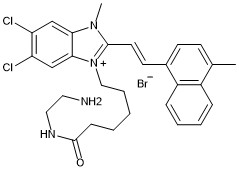
Physicochemical Properties
| Molecular Formula | C29H33BRCL2N4O |
| Molecular Weight | 604.414 |
| Exact Mass | 602.12 |
| CAS # | 1036271-52-9 |
| Related CAS # | 909715-04-4 (cation);1036271-52-9 (bromide) |
| Appearance | Typically exists as solid at room temperature |
| Synonyms | JC-D8; JC D8; |
| HS Tariff Code | 2934.99.9001 |
| Storage |
Powder-20°C 3 years 4°C 2 years In solvent -80°C 6 months -20°C 1 month |
| Shipping Condition | Room temperature (This product is stable at ambient temperature for a few days during ordinary shipping and time spent in Customs) |
Biological Activity
| Targets | Fluorescent probe for labeling of synthetic and endogenous polyP |
| ln Vitro | Inorganic polyphosphate (polyP) is a polymer composed of many orthophosphates linked together by phosphoanhydride bonds. Recent studies demonstrate that in addition to its important role in the function of microorganisms, polyP plays multiple important roles in the pathological and physiological function of higher eukaryotes, including mammalians. However, due to the dramatically lower abundance of polyP in mammalian cells when comparing to microorganisms, its investigation poses an experimental challenge. Here, we present the identification of novel fluorescent probes that allow for specific labeling of synthetic polyP in vitro as well as endogenous polyP in living cells. These probes (JC-D7, JC-D8) demonstrate high selectivity for the labeling of polyP that was not sensitive to a number of ubiquitous organic polyphosphates, notably RNA. Use of these probes allowed us to demonstrate the real time detection of polyP release from lysosomes in live cells. Furthermore, we have been able to detect the increased levels of polyP in cells with Parkinson's disease related mutations [1]. |
| ln Vivo | Using the novel indicators, we have been able to detect increased level of polyP in brain slices obtained from an animal model of Parkinson’s disease. This finding demonstrates the potential for practical use of the probes (JC-D7 and JC-D8) in live samples. However, care should be taken and specific protocols developed for each particular set of experimental conditions [1]. |
| Enzyme Assay |
Primary Screening: Fluorescence intensities were measured using a SpectraMax M2 plate reader in a 96-well plate. JC compounds were dissolved to a final concentration of 10 μM (20 mM HEPES buffer, pH 7.4, containing 1% (v/v) DMSO) and incubated with different analytes at different serial concentration in 20 mM HEPES buffer (pH 7.4). The excitation wavelength was set at 390 nm, and the emission spectra were recorded from 450 to 700 nm. The fluorescence fold increase ratios were determined by referring the maximum fluorescence intensity of JC compounds in the presence and absence of analytes.
The quantum yield of JC-D7 before and after the addition polyphosphate is 0.007 and 0.38, respectively. Whereas, the quantum yield of JC-D8 in the absence and presence of polyphosphate is 0.008 and 0.37, respectively. Because of the comparatively low quantum yield of JC-D7 than JC-D8, the earlier has slightly higher fold increase [1]. Selectivity Study: Benzimidazolium compounds were transferred to Greiner 96 well black polypropylene plates (final concentration as 10 μM) and tested against DNA and RNA 100 μg/mL, other analytes: sodium phosphate, ATP, AMP, GTP, GMP, CTP, and CMP 1 mM, and heparin sodium and polyP is 20 μg/mL in 20 mM HEPES buffer (pH = 7.4) with 1% DMSO. Fluorescent spectra were recorded on a SpectraMax M2 fluorescent plate reader with excitation at 390 nm (cutoff: 420 nm), emission 450 to 700 nm.[1] |
| Cell Assay | SHY-SY5 cells, human skin fibroblasts, whole Drosophila brains, mixed primary brain cultures, or acute brain slices were loaded for 30 min at RT with 5 μM JC-D7 or JC-D8 in a HEPES-buffered salt solution (HBSS) composed (mM): 156 NaCl, 3 KCl, 2 MgSO4, 1.25 KH2PO4, 2 CaCl2, 10 glucose, and 10 HEPES, pH adjusted to 7.35 with NaOH. Confocal images were obtained using a Zeiss 710 CLSM microscope equipped with a META detection system and a 40× oil immersion objective. JC-D7/D8 fluorescence was determined with excitation at 405 nm and emission above 450 nm. Illumination intensity was kept to a minimum (at 0.1–0.2% of laser output) to avoid phototoxicity and the pinhole set to give an optical slice of ∼2 μm. For images in experiments comparing levels of fluorescence in different cells, the imaging setting were kept at the same level. For better visual representation, the different false-color was chosen. |
| Animal Protocol | All mouse experiments were carried out in compliance with institutional ethical and welfare standards and under Home Office regulation. Slices were prepared using standard procedures, as previously described. Briefly, transverse acute brain slices (100–200 μm) were prepared from 20 to 24-week-old WT, PINK1 KO, and LRRK2 KO C57BL/6 mice. The animals were euthanized by cervical dislocation, brains were collected, and tissue was immediately sliced at 4 °C using a vibratome. The tissue slices were cut and maintained in physiological saline at RT (24 °C) for ∼1 h before imaging. |
| References | [1]. In situ investigation of mammalian inorganic polyphosphate localization using novel selective fluorescent probes JC-D7 and JC-D8. ACS Chem Biol. 2014 Sep 19;9(9):2101-10. |
Solubility Data
| Solubility (In Vitro) | May dissolve in DMSO (in most cases), if not, try other solvents such as H2O, Ethanol, or DMF with a minute amount of products to avoid loss of samples |
| Solubility (In Vivo) |
Note: Listed below are some common formulations that may be used to formulate products with low water solubility (e.g. < 1 mg/mL), you may test these formulations using a minute amount of products to avoid loss of samples. Injection Formulations (e.g. IP/IV/IM/SC) Injection Formulation 1: DMSO : Tween 80: Saline = 10 : 5 : 85 (i.e. 100 μL DMSO stock solution → 50 μL Tween 80 → 850 μL Saline) *Preparation of saline: Dissolve 0.9 g of sodium chloride in 100 mL ddH ₂ O to obtain a clear solution. Injection Formulation 2: DMSO : PEG300 :Tween 80 : Saline = 10 : 40 : 5 : 45 (i.e. 100 μL DMSO → 400 μLPEG300 → 50 μL Tween 80 → 450 μL Saline) Injection Formulation 3: DMSO : Corn oil = 10 : 90 (i.e. 100 μL DMSO → 900 μL Corn oil) Example: Take the Injection Formulation 3 (DMSO : Corn oil = 10 : 90) as an example, if 1 mL of 2.5 mg/mL working solution is to be prepared, you can take 100 μL 25 mg/mL DMSO stock solution and add to 900 μL corn oil, mix well to obtain a clear or suspension solution (2.5 mg/mL, ready for use in animals). Injection Formulation 4: DMSO : 20% SBE-β-CD in saline = 10 : 90 [i.e. 100 μL DMSO → 900 μL (20% SBE-β-CD in saline)] *Preparation of 20% SBE-β-CD in Saline (4°C,1 week): Dissolve 2 g SBE-β-CD in 10 mL saline to obtain a clear solution. Injection Formulation 5: 2-Hydroxypropyl-β-cyclodextrin : Saline = 50 : 50 (i.e. 500 μL 2-Hydroxypropyl-β-cyclodextrin → 500 μL Saline) Injection Formulation 6: DMSO : PEG300 : castor oil : Saline = 5 : 10 : 20 : 65 (i.e. 50 μL DMSO → 100 μLPEG300 → 200 μL castor oil → 650 μL Saline) Injection Formulation 7: Ethanol : Cremophor : Saline = 10: 10 : 80 (i.e. 100 μL Ethanol → 100 μL Cremophor → 800 μL Saline) Injection Formulation 8: Dissolve in Cremophor/Ethanol (50 : 50), then diluted by Saline Injection Formulation 9: EtOH : Corn oil = 10 : 90 (i.e. 100 μL EtOH → 900 μL Corn oil) Injection Formulation 10: EtOH : PEG300:Tween 80 : Saline = 10 : 40 : 5 : 45 (i.e. 100 μL EtOH → 400 μLPEG300 → 50 μL Tween 80 → 450 μL Saline) Oral Formulations Oral Formulation 1: Suspend in 0.5% CMC Na (carboxymethylcellulose sodium) Oral Formulation 2: Suspend in 0.5% Carboxymethyl cellulose Example: Take the Oral Formulation 1 (Suspend in 0.5% CMC Na) as an example, if 100 mL of 2.5 mg/mL working solution is to be prepared, you can first prepare 0.5% CMC Na solution by measuring 0.5 g CMC Na and dissolve it in 100 mL ddH2O to obtain a clear solution; then add 250 mg of the product to 100 mL 0.5% CMC Na solution, to make the suspension solution (2.5 mg/mL, ready for use in animals). Oral Formulation 3: Dissolved in PEG400 Oral Formulation 4: Suspend in 0.2% Carboxymethyl cellulose Oral Formulation 5: Dissolve in 0.25% Tween 80 and 0.5% Carboxymethyl cellulose Oral Formulation 6: Mixing with food powders Note: Please be aware that the above formulations are for reference only. InvivoChem strongly recommends customers to read literature methods/protocols carefully before determining which formulation you should use for in vivo studies, as different compounds have different solubility properties and have to be formulated differently. (Please use freshly prepared in vivo formulations for optimal results.) |
| Preparing Stock Solutions | 1 mg | 5 mg | 10 mg | |
| 1 mM | 1.6545 mL | 8.2725 mL | 16.5451 mL | |
| 5 mM | 0.3309 mL | 1.6545 mL | 3.3090 mL | |
| 10 mM | 0.1655 mL | 0.8273 mL | 1.6545 mL |