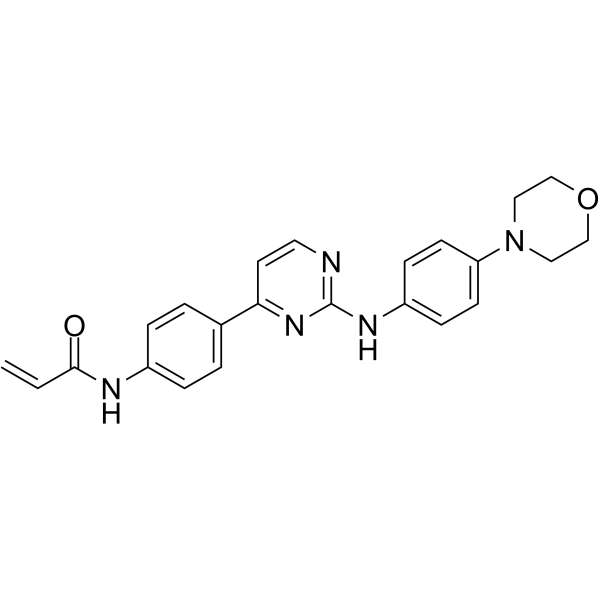
Physicochemical Properties
| Molecular Formula | C23H23N5O2 |
| Molecular Weight | 401.46 |
| Exact Mass | 401.185 |
| CAS # | 2412734-00-8 |
| PubChem CID | 162648400 |
| Appearance | Typically exists as solid at room temperature |
| LogP | 3.3 |
| Hydrogen Bond Donor Count | 2 |
| Hydrogen Bond Acceptor Count | 6 |
| Rotatable Bond Count | 6 |
| Heavy Atom Count | 30 |
| Complexity | 552 |
| Defined Atom Stereocenter Count | 0 |
| SMILES | C(NC1=CC=C(C2C=CN=C(NC3=CC=C(N4CCOCC4)C=C3)N=2)C=C1)(=O)C=C |
| InChi Key | UXJWKEBWYYWGQW-UHFFFAOYSA-N |
| InChi Code | InChI=1S/C23H23N5O2/c1-2-22(29)25-18-5-3-17(4-6-18)21-11-12-24-23(27-21)26-19-7-9-20(10-8-19)28-13-15-30-16-14-28/h2-12H,1,13-16H2,(H,25,29)(H,24,26,27) |
| Chemical Name | N-[4-[2-(4-morpholin-4-ylanilino)pyrimidin-4-yl]phenyl]prop-2-enamide |
| Synonyms | JAK3-IN-11; CHEMBL4746272; 2412734-00-8; Compound 12; orb1685218; SCHEMBL28875992; SCHEMBL29813742; |
| HS Tariff Code | 2934.99.9001 |
| Storage |
Powder-20°C 3 years 4°C 2 years In solvent -80°C 6 months -20°C 1 month |
| Shipping Condition | Room temperature (This product is stable at ambient temperature for a few days during ordinary shipping and time spent in Customs) |
Biological Activity
| Targets |
JAK3-in-11 (Compound 12) is a selective Janus kinase 3 (JAK3) inhibitor:
- JAK3 enzymatic IC50: 0.42 ± 0.08 nM
- Selectivity over JAK1 (IC50 = 68.3 ± 5.2 nM), JAK2 (IC50 = 142.7 ± 11.6 nM), and TYK2 (IC50 = 53.9 ± 4.7 nM)[1] |
| ln Vitro |
JAK3-IN-11 (compound 12) has no discernible cytotoxicity at a dose of 10 μM after 72 hours [1]. With IC50 values of 0.83 μM (anti-CD3/CD28 stimulation) and 0.77 μM (IL-2 stimulation), JAK3-IN-11 (compound 12) (72 hours) has a potent inhibitory effect on T cell proliferation [1]. A concentration-dependent way is observed in the elimination of IL-2 or IL-15-induced STAT5 phosphorylation by JAK3-IN-11 (Compound 12) (0-10 μM, 1 hour) [1]. Compound 12-JAK3-IN-11 covalently binds to JAK3 and inhibits it irreversibly [1].
- Inhibited IL-2-induced STAT5 phosphorylation in D1 T-cells (IC50 = 0.46 ± 0.05 μM) - Suppressed proliferation of D1 T-cells (IC50 = 0.51 ± 0.07 μM) - No cytotoxicity against HEK-293 cells at 10 μM (cell viability >95%)[1] |
| ln Vivo |
In collagen-induced arthritis (CIA) DBA/1J mice:
- Oral administration (10 mg/kg BID for 14 days) reduced paw swelling by 64.8% (p<0.001)
- Histopathology showed decreased synovial inflammation (score: 1.2 vs. 3.8 in controls)
- Reduced serum TNF-α levels by 58% (p<0.01)[1] In a dose-dependent manner, JAK3-IN-11 (Compound 12) reduces the delayed type hypersensitivity (DTH) reaction caused by oxazolone (OXZ) in Balb/c mice (0–30 mg/kg; PO, before and during challenge phase, 6 days) [1]. |
| Enzyme Assay |
JAK kinase profiling:
- Recombinant human JAK enzymes incubated with ATP (10 μM) and substrate peptide.
- Reactions started by adding JAK3-in-11 (0.1-1000 nM) and stopped with ADP-Glo reagent.
- Luminescence measured after kinase detection reagent addition.
- IC50 calculated from dose-response curves.[1] |
| Cell Assay |
Cell Proliferation Assay[1] Cell Types: Mouse T cells in complete RPMI1640 medium then exposed to anti-CD3/anti-CD28 or IL-2. Tested Concentrations: Incubation Duration: 72 hrs (hours). Experimental Results: It has a strong inhibitory effect on T cell proliferation, with IC50 values of 0.83μM (anti-CD3/CD28 stimulation) and 0.77μM (IL-2 stimulation), showing significant immunity in the case of selective inhibition of JAK3 inhibitory activity. Western Blot Analysis [1] Cell Types: Purified T cells were preactivated, coated with anti-CD3 and anti-CD28 for 72 hrs (hours), then cultured with IL-2 (50 U/mL) for 36 hrs (hours), then cultured without IL-2 36 Hourly Tested Concentrations: 0.01, 0.1, 1, 10 μM. Incubation Duration: 1 hour. Experimental Results: IL-2- or IL-15-induced STAT5 phosphorylation was abolished in a concentration-dependent manner. STAT5 phosphorylation: - D1 T-cells starved for 4h, pretreated with JAK3-in-11 (0.01-10 μM) for 1h. - Stimulated with IL-2 (50 ng/mL) for 15 min. - Cells lysed and pSTAT5 analyzed by Western blot (anti-pY694 STAT5 antibody).[1] Anti-proliferation assay: - D1 T-cells seeded in 96-well plates with JAK3-in-11 (0.01-10 μM). - After 72h, cell viability assessed by MTS assay. - IC50 calculated from absorbance at 490 nm.[1] |
| Animal Protocol |
Animal/Disease Models: DTH Balb/c mouse model induced by oxazolone (OXZ) [1]. Doses: 30, 10 and 3 mg/kg. Doses: PO, 6 days before and during the challenge phase. Experimental Results: Inhibited oxazolone (OXZ)-induced delayed-type hypersensitivity (DTH) in a dose-dependent manner. Animal/Disease Models: Male ICR mouse[1]. Doses: 30 mg/kg by po (oral gavage), 10 mg/kg by intravenous (iv) (iv)injection. Route of Administration: pharmacokinetic/PK/PK analysis Experimental Results: Preliminary pharmacokinetic/PK/PK data of JAK3-IN-11 (compound 12) in male ICR mice [1] Male ICR mice, 30 mg/kg orally, intravenously (iv) (iv)(iv) Drug 10mg/kg[1]. Compound 12 iv (10 mg/kg) po (30 mg/kg) AUC(0-t) (mg/L*h)a 1244.41 ± 77.83 889.42 ± 48.32 AUC(0-∞) (mg/L*h) 1274.41 ± 57.18 897.12 ± 56.72 MRT (0-∞) (H) B 0.73 ± 0.08 1.42 ± 0.38 VZ (L/Kg) C 8.36 ± 1.83 220.42 ± 24.71 CLZ (L/H/Kg) D 8.15 ± 97.14 ± 20.87 T. 1 /2 (h)e 0.47 ± 0.06 1.52 ± 0.34 Cmax (mg/L)f 8763.23 ± 324.65 2008.21 ± 189.44 Bioavailability (%)g 23.82% a Area under the concentration-time curve. b Average residence time. STAT5 phosphorylation: - D1 T-cells starved for 4h, pretreated with JAK3-in-11 (0.01-10 μM) for 1h. - Stimulated with IL-2 (50 ng/mL) for 15 min. - Cells lysed and pSTAT5 analyzed by Western blot (anti-pY694 STAT5 antibody).[1] Anti-proliferation assay: - D1 T-cells seeded in 96-well plates with JAK3-in-11 (0.01-10 μM). - After 72h, cell viability assessed by MTS assay. - IC50 calculated from absorbance at 490 nm.[1] |
| ADME/Pharmacokinetics |
- Plasma clearance: 12.3 ± 1.7 mL/min/kg (mouse)
- Half-life (t1/2): 3.8 ± 0.6 h (IV); 4.2 ± 0.5 h (PO)
- Oral bioavailability: 89.7% (10 mg/kg)
- Plasma protein binding: 91.5% (human)[1] |
| Toxicity/Toxicokinetics |
- Plasma clearance: 12.3 ± 1.7 mL/min/kg (mouse)
- Half-life (t1/2): 3.8 ± 0.6 h (IV); 4.2 ± 0.5 h (PO)
- Oral bioavailability: 89.7% (10 mg/kg)
- Plasma protein binding: 91.5% (human)[1] |
| References |
[1]. Design, synthesis, and pharmacological evaluation of 4- or 6-phenyl-pyrimidine derivatives as novel and selective Janus kinase 3 inhibitors. Eur J Med Chem. 2020 Apr 1;191:112148. |
| Additional Infomation |
- Chemical class: 4-Phenylpyrimidine derivative (C23H22N6O2S)
- Mechanism: Competitive ATP-binding site inhibitor (confirmed by molecular docking).
- Therapeutic potential: Treatment of autoimmune diseases via selective JAK3 pathway blockade.[1] |
Solubility Data
| Solubility (In Vitro) | May dissolve in DMSO (in most cases), if not, try other solvents such as H2O, Ethanol, or DMF with a minute amount of products to avoid loss of samples |
| Solubility (In Vivo) |
Note: Listed below are some common formulations that may be used to formulate products with low water solubility (e.g. < 1 mg/mL), you may test these formulations using a minute amount of products to avoid loss of samples. Injection Formulations (e.g. IP/IV/IM/SC) Injection Formulation 1: DMSO : Tween 80: Saline = 10 : 5 : 85 (i.e. 100 μL DMSO stock solution → 50 μL Tween 80 → 850 μL Saline) *Preparation of saline: Dissolve 0.9 g of sodium chloride in 100 mL ddH ₂ O to obtain a clear solution. Injection Formulation 2: DMSO : PEG300 :Tween 80 : Saline = 10 : 40 : 5 : 45 (i.e. 100 μL DMSO → 400 μLPEG300 → 50 μL Tween 80 → 450 μL Saline) Injection Formulation 3: DMSO : Corn oil = 10 : 90 (i.e. 100 μL DMSO → 900 μL Corn oil) Example: Take the Injection Formulation 3 (DMSO : Corn oil = 10 : 90) as an example, if 1 mL of 2.5 mg/mL working solution is to be prepared, you can take 100 μL 25 mg/mL DMSO stock solution and add to 900 μL corn oil, mix well to obtain a clear or suspension solution (2.5 mg/mL, ready for use in animals). Injection Formulation 4: DMSO : 20% SBE-β-CD in saline = 10 : 90 [i.e. 100 μL DMSO → 900 μL (20% SBE-β-CD in saline)] *Preparation of 20% SBE-β-CD in Saline (4°C,1 week): Dissolve 2 g SBE-β-CD in 10 mL saline to obtain a clear solution. Injection Formulation 5: 2-Hydroxypropyl-β-cyclodextrin : Saline = 50 : 50 (i.e. 500 μL 2-Hydroxypropyl-β-cyclodextrin → 500 μL Saline) Injection Formulation 6: DMSO : PEG300 : castor oil : Saline = 5 : 10 : 20 : 65 (i.e. 50 μL DMSO → 100 μLPEG300 → 200 μL castor oil → 650 μL Saline) Injection Formulation 7: Ethanol : Cremophor : Saline = 10: 10 : 80 (i.e. 100 μL Ethanol → 100 μL Cremophor → 800 μL Saline) Injection Formulation 8: Dissolve in Cremophor/Ethanol (50 : 50), then diluted by Saline Injection Formulation 9: EtOH : Corn oil = 10 : 90 (i.e. 100 μL EtOH → 900 μL Corn oil) Injection Formulation 10: EtOH : PEG300:Tween 80 : Saline = 10 : 40 : 5 : 45 (i.e. 100 μL EtOH → 400 μLPEG300 → 50 μL Tween 80 → 450 μL Saline) Oral Formulations Oral Formulation 1: Suspend in 0.5% CMC Na (carboxymethylcellulose sodium) Oral Formulation 2: Suspend in 0.5% Carboxymethyl cellulose Example: Take the Oral Formulation 1 (Suspend in 0.5% CMC Na) as an example, if 100 mL of 2.5 mg/mL working solution is to be prepared, you can first prepare 0.5% CMC Na solution by measuring 0.5 g CMC Na and dissolve it in 100 mL ddH2O to obtain a clear solution; then add 250 mg of the product to 100 mL 0.5% CMC Na solution, to make the suspension solution (2.5 mg/mL, ready for use in animals). Oral Formulation 3: Dissolved in PEG400 Oral Formulation 4: Suspend in 0.2% Carboxymethyl cellulose Oral Formulation 5: Dissolve in 0.25% Tween 80 and 0.5% Carboxymethyl cellulose Oral Formulation 6: Mixing with food powders Note: Please be aware that the above formulations are for reference only. InvivoChem strongly recommends customers to read literature methods/protocols carefully before determining which formulation you should use for in vivo studies, as different compounds have different solubility properties and have to be formulated differently. (Please use freshly prepared in vivo formulations for optimal results.) |
| Preparing Stock Solutions | 1 mg | 5 mg | 10 mg | |
| 1 mM | 2.4909 mL | 12.4545 mL | 24.9091 mL | |
| 5 mM | 0.4982 mL | 2.4909 mL | 4.9818 mL | |
| 10 mM | 0.2491 mL | 1.2455 mL | 2.4909 mL |