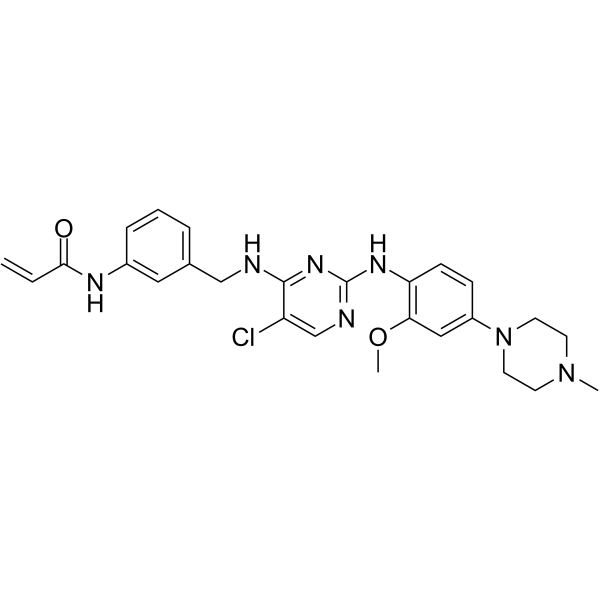
Physicochemical Properties
| Molecular Formula | C26H30CLN7O2 |
| Molecular Weight | 508.02 |
| Exact Mass | 507.214 |
| CAS # | 1805787-93-2 |
| PubChem CID | 92042864 |
| Appearance | White to off-white solid powder |
| Density | 1.3±0.1 g/cm3 |
| Index of Refraction | 1.672 |
| LogP | 2.18 |
| Hydrogen Bond Donor Count | 3 |
| Hydrogen Bond Acceptor Count | 8 |
| Rotatable Bond Count | 9 |
| Heavy Atom Count | 36 |
| Complexity | 708 |
| Defined Atom Stereocenter Count | 0 |
| InChi Key | UGXCBYVBIJACEK-UHFFFAOYSA-N |
| InChi Code | InChI=1S/C26H30ClN7O2/c1-4-24(35)30-19-7-5-6-18(14-19)16-28-25-21(27)17-29-26(32-25)31-22-9-8-20(15-23(22)36-3)34-12-10-33(2)11-13-34/h4-9,14-15,17H,1,10-13,16H2,2-3H3,(H,30,35)(H2,28,29,31,32) |
| Chemical Name | N-[3-[[[5-chloro-2-[2-methoxy-4-(4-methylpiperazin-1-yl)anilino]pyrimidin-4-yl]amino]methyl]phenyl]prop-2-enamide |
| Synonyms | JAK3 IN 1 JAK3IN1 JAK3-IN-1 |
| HS Tariff Code | 2934.99.9001 |
| Storage |
Powder-20°C 3 years 4°C 2 years In solvent -80°C 6 months -20°C 1 month |
| Shipping Condition | Room temperature (This product is stable at ambient temperature for a few days during ordinary shipping and time spent in Customs) |
Biological Activity
| ln Vitro | Treatment with JAK3-IN-1 (Compound 9; 0–5 µM; 3 hours; BMDMs cells) totally suppressed p-STAT6 elicited by IL-4 at 500 nM, but only slightly inhibited p-STAT6 induced by IFNβ at 500 nM. p-STAT1 at 5.0μM [1]. ..Several tyrosine-protein kinases (TEC) family kinases and fms-related tyrosine kinase 3 (FLT3) were shown to be possible off-targets of JAK3-IN-1 (compound 9), which most potently inhibited JAK3. The protein enzymatically inhibits the kinase TXK (TXK, IC50 = 36 nM). Enzyme assays employing Z'-lyte or LanthaScreen formats reveal detection of FLT3 (IC50 = 13 nM), TTK protein kinase (TTK, IC50 = 49 nM), BLK proto-oncogene (BLK, IC50 = 157 nM), and tyrosine. JAK3-IN-1 exhibited extremely low fractional inhibition against wild-type (WT) EGFR and other JAKs, which is in line with an IC50 against EGFRWT and TYK2 that is >180 times higher (IC50 = 409 nM and >10000, respectively). JAK3-IN-1 has an IC50 that is more than 165 times greater than that of BTK or ITK (IC50 = 794 and 1070 nM, respectively) [1]. At dosages below 3.0 μM, there is no antiproliferative impact. JAK3-IN-1(Compound 9) specifically inhibits the proliferation of JAK3-dependent Ba/F3 cells (IC50 = 69 nM) contrasted to other JAK-dependent Ba/F3 cells [1]. |
| ln Vivo | JAK3-IN-1 (compound 9) demonstrated reasonable pharmacokinetic features, with a T1/2 of 1.4 h and an area under the curve (AUC) value of 795 ng*hr/mL after an oral dosage of 10 mg/Kg. Utilization is good at 66%. After oral administration of JAK3-IN-1 (Compound 9) (75 mpk, QD) for 8 days, the number of B or T lymphocytes in the lungs and spleens of tumor-bearing mice was not altered, while NK cells were reduced [1]. |
| Cell Assay |
Western Blot Analysis[1] Cell Types: BMDMs Cell Tested Concentrations: 0 µM, 0.1 µM, 0.5 µM, 1 µM, 5 µM Incubation Duration: 3 hrs (hours) Experimental Results: Complete inhibition of IL-4-induced p-STAT6 concentration at 500 nM At 5.0 μM, it only partially inhibits IFNβ-induced p-STAT1. |
| References |
[1]. Development of Selective Covalent Janus Kinase 3 Inhibitors. J Med Chem. 2015 Aug 27;58(16):6589-6606. |
Solubility Data
| Solubility (In Vitro) | DMSO : ~100 mg/mL (~196.84 mM) |
| Solubility (In Vivo) |
Solubility in Formulation 1: ≥ 2.5 mg/mL (4.92 mM) (saturation unknown) in 10% DMSO + 40% PEG300 + 5% Tween80 + 45% Saline (add these co-solvents sequentially from left to right, and one by one), clear solution. For example, if 1 mL of working solution is to be prepared, you can add 100 μL of 25.0 mg/mL clear DMSO stock solution to 400 μL PEG300 and mix evenly; then add 50 μL Tween-80 to the above solution and mix evenly; then add 450 μL normal saline to adjust the volume to 1 mL. Preparation of saline: Dissolve 0.9 g of sodium chloride in 100 mL ddH₂ O to obtain a clear solution. Solubility in Formulation 2: 2.5 mg/mL (4.92 mM) in 10% DMSO + 90% (20% SBE-β-CD in Saline) (add these co-solvents sequentially from left to right, and one by one), suspension solution; with ultrasonication. For example, if 1 mL of working solution is to be prepared, you can add 100 μL of 25.0 mg/mL clear DMSO stock solution to 900 μL of 20% SBE-β-CD physiological saline solution and mix evenly. Preparation of 20% SBE-β-CD in Saline (4°C,1 week): Dissolve 2 g SBE-β-CD in 10 mL saline to obtain a clear solution. Solubility in Formulation 3: ≥ 2.5 mg/mL (4.92 mM) (saturation unknown) in 10% DMSO + 90% Corn Oil (add these co-solvents sequentially from left to right, and one by one), clear solution. For example, if 1 mL of working solution is to be prepared, you can add 100 μL of 25.0 mg/mL clear DMSO stock solution to 900 μL of corn oil and mix evenly. (Please use freshly prepared in vivo formulations for optimal results.) |
| Preparing Stock Solutions | 1 mg | 5 mg | 10 mg | |
| 1 mM | 1.9684 mL | 9.8421 mL | 19.6843 mL | |
| 5 mM | 0.3937 mL | 1.9684 mL | 3.9369 mL | |
| 10 mM | 0.1968 mL | 0.9842 mL | 1.9684 mL |