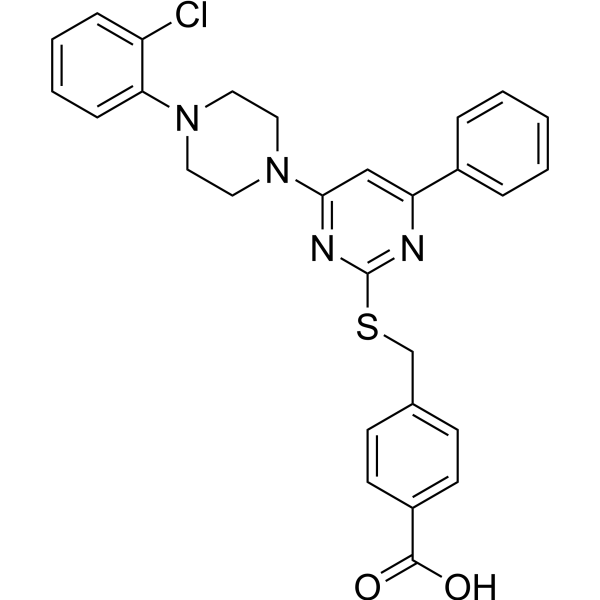
Physicochemical Properties
| Molecular Formula | C28H25CLN4O2S |
| Molecular Weight | 517.0417 |
| Exact Mass | 516.138 |
| CAS # | 1043854-13-2 |
| PubChem CID | 45987688 |
| Appearance | White to off-white solid powder |
| LogP | 6.4 |
| Hydrogen Bond Donor Count | 1 |
| Hydrogen Bond Acceptor Count | 7 |
| Rotatable Bond Count | 7 |
| Heavy Atom Count | 36 |
| Complexity | 695 |
| Defined Atom Stereocenter Count | 0 |
| SMILES | ClC1=C([H])C([H])=C([H])C([H])=C1N1C([H])([H])C([H])([H])N(C2C([H])=C(C3C([H])=C([H])C([H])=C([H])C=3[H])N=C(N=2)SC([H])([H])C2C([H])=C([H])C(C(=O)O[H])=C([H])C=2[H])C([H])([H])C1([H])[H] |
| InChi Key | RSHUJZXWKLIBRE-UHFFFAOYSA-N |
| InChi Code | InChI=1S/C28H25ClN4O2S/c29-23-8-4-5-9-25(23)32-14-16-33(17-15-32)26-18-24(21-6-2-1-3-7-21)30-28(31-26)36-19-20-10-12-22(13-11-20)27(34)35/h1-13,18H,14-17,19H2,(H,34,35) |
| Chemical Name | 4-[[4-[4-(2-chlorophenyl)piperazin-1-yl]-6-phenylpyrimidin-2-yl]sulfanylmethyl]benzoic acid |
| Synonyms | J14; J-14 |
| HS Tariff Code | 2934.99.9001 |
| Storage |
Powder-20°C 3 years 4°C 2 years In solvent -80°C 6 months -20°C 1 month |
| Shipping Condition | Room temperature (This product is stable at ambient temperature for a few days during ordinary shipping and time spent in Customs) |
Biological Activity
| ln Vitro | J14 (0-100 μM; 0-96 hours; A549 cells) treatment inhibits A549 cell growth in a concentration- and time-dependent manner; 15.7 μM is the half-inhibitory concentration [1]. Treatment (48–72 hours; A549 cells) activates caspase-3 and caspase-9 in addition to releasing cytochrome c into the cytoplasm. J14 causes mitochondrial oxidative damage, which triggers caspase-mediated cell sanitization [1]. Intracellular ROS accumulation and sulfinate peroxidase were both markedly elevated by J14 treatment. When intracellular ROS build up excessively, oxidative damage results, ultimately leading to cell death. J14 significantly and time-pullingly promotes cell death in A549 cells, with around 40% of the cells dying in 96 hours [1]. Insulation of cells and J14 sensor short circuit damage [1]. Cells |
| ln Vivo | J14 (50 mg/kg; i.p.; daily; for 16 days; BALB/c female nude mice) therapy significantly reduced mean tumor volume. Compared with the control experiment, the main tumor mass of the J14 treatment experiment |
| Cell Assay |
Cell Viability Assay [1] Cells Cell Types: A549 Cell Tested Concentrations: 0-100 μM Incubation Duration: 0 hrs (hours), 24 hrs (hours), 48 hrs (hours), 72 hrs (hours), 96 hrs (hours) Experimental Results: Inhibited the growth of A549 cells in a concentration- and time-dependent manner. Western Blot Analysis [1] Cell Types: A549 cells Tested Concentrations: 20 μM Incubation Duration: 48 hrs (hours), 72 hrs (hours) Experimental Results: Not only caused the release of cytochrome c into the cytoplasm, but also caused the activation of caspase-3 and caspase-9. |
| Animal Protocol |
Animal/Disease Models: Sixweeks old BALB/c female nude mice injected with A549 cells [1] Doses: 50 mg/kg Route of Administration: intraperitoneal (ip) injection; and weight were Dramatically reduce[1]. Routine; 16-day Experimental Results: Significant reduction in human lung tumor growth with no acute toxicity. |
| References |
[1]. Sulfiredoxin inhibitor induces preferential death of cancer cells through reactive oxygen species-mediated mitochondrial damage. Free Radic Biol Med. 2016 Feb;91:264-74. |
Solubility Data
| Solubility (In Vitro) | DMSO : ≥ 125 mg/mL (~241.76 mM) |
| Solubility (In Vivo) |
Solubility in Formulation 1: ≥ 2.17 mg/mL (4.20 mM) (saturation unknown) in 10% DMSO + 40% PEG300 + 5% Tween80 + 45% Saline (add these co-solvents sequentially from left to right, and one by one), clear solution. For example, if 1 mL of working solution is to be prepared, you can add 100 μL of 21.7 mg/mL clear DMSO stock solution to 400 μL PEG300 and mix evenly; then add 50 μL Tween-80 to the above solution and mix evenly; then add 450 μL normal saline to adjust the volume to 1 mL. Preparation of saline: Dissolve 0.9 g of sodium chloride in 100 mL ddH₂ O to obtain a clear solution. Solubility in Formulation 2: ≥ 2.17 mg/mL (4.20 mM) (saturation unknown) in 10% DMSO + 90% Corn Oil (add these co-solvents sequentially from left to right, and one by one), clear solution. For example, if 1 mL of working solution is to be prepared, you can add 100 μL of 21.7 mg/mL clear DMSO stock solution to 900 μL of corn oil and mix evenly. (Please use freshly prepared in vivo formulations for optimal results.) |
| Preparing Stock Solutions | 1 mg | 5 mg | 10 mg | |
| 1 mM | 1.9341 mL | 9.6704 mL | 19.3409 mL | |
| 5 mM | 0.3868 mL | 1.9341 mL | 3.8682 mL | |
| 10 mM | 0.1934 mL | 0.9670 mL | 1.9341 mL |