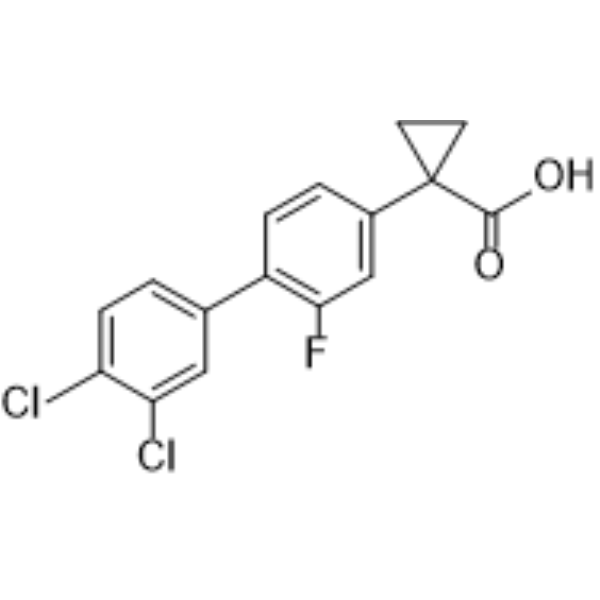
Physicochemical Properties
| Molecular Formula | C16H11CL2FO2 |
| Molecular Weight | 325.1604 |
| Exact Mass | 324.012 |
| Elemental Analysis | C, 59.10; H, 3.41; Cl, 21.80; F, 5.84; O, 9.84 |
| CAS # | 749269-83-8 |
| PubChem CID | 9996409 |
| Appearance | White to off-white solid powder |
| LogP | 4.915 |
| Hydrogen Bond Donor Count | 1 |
| Hydrogen Bond Acceptor Count | 3 |
| Rotatable Bond Count | 3 |
| Heavy Atom Count | 21 |
| Complexity | 413 |
| Defined Atom Stereocenter Count | 0 |
| SMILES | OC(C1(CC1)C(C=C2)=CC(F)=C2C3=CC=C(Cl)C(Cl)=C3)=O |
| InChi Key | LIYLTQQDABRNRX-UHFFFAOYSA-N |
| InChi Code | InChI=1S/C16H11Cl2FO2/c17-12-4-1-9(7-13(12)18)11-3-2-10(8-14(11)19)16(5-6-16)15(20)21/h1-4,7-8H,5-6H2,(H,20,21) |
| Chemical Name | 1-[4-(3,4-dichlorophenyl)-3-fluorophenyl]cyclopropane-1-carboxylic acid |
| Synonyms | CHF 5074; CHF-5074; CHF5074 |
| HS Tariff Code | 2934.99.9001 |
| Storage |
Powder-20°C 3 years 4°C 2 years In solvent -80°C 6 months -20°C 1 month |
| Shipping Condition | Room temperature (This product is stable at ambient temperature for a few days during ordinary shipping and time spent in Customs) |
Biological Activity
| ln Vitro | The suspension of APPswe in human neuroastroma cells (H4swe) is inhibited by itanapraced (0.03-100 μM), with IC50 values of 3.6 and 18.4 μM for Aβ42 and Aβ40, respectively [1]. At doses up to 15, itanapraced (5-200 μM) quantitatively controls action potential. The IC50 value of itanapraced (0-1000 μM; 30 min) is 106 μM [2]. In HEK293swe cells, itanapraced (30-100 μM) suppresses Notch processing at quantitatively adjusted μM [1]. The fluorescence of hippocampal neuron cells caused by hypoxia switch (OGD) can be greatly reduced by itanapraced (1-10 μM) [2]. |
| ln Vivo | Itanapraced (face; 375 ppm given to diet, 17 weeks) lowers Aβ42 and Aβ40 levels and brain plaque load in Tg2576 button mice [1]. |
| Animal Protocol |
Animal/Disease Models: Male and female Tg2576 transgenic mice expressing the Swedish mutant form of human APP (APPswe) [1] Doses: 375 ppm Route of Administration: Oral; 375 ppm in diet for 17 weeks Experimental Results: Aged Tg2576 mice Total brain Aβ42 and Aβ40 levels and brain plaque burden were diminished. It does not cause COX-mediated toxic effects in the gastrointestinal tract and does not cause Notch-mediated cell differentiation abnormalities in the ileum. |
| References |
[1]. 1-(3',4'-Dichloro-2-fluoro[1,1'-biphenyl]-4-yl)-cyclopropanecarboxylic acid (CHF5074), a novel gamma-secretasemodulator, reduces brain beta-amyloid pathology in a transgenic mouse model of Alzheimer's disease withoutcausing peripheral toxicity. J Pharmacol Exp Ther. 2007 Dec;323(3):822-830. [2]. Electrophysiological and metabolic effects of CHF5074 in the hippocampus: protection against in vitro ischemia. Pharmacol Res. 2014 Mar;81:83-90. |
Solubility Data
| Solubility (In Vitro) | DMSO : ~100 mg/mL (~307.54 mM) |
| Solubility (In Vivo) |
Solubility in Formulation 1: 2.5 mg/mL (7.69 mM) in 10% DMSO + 40% PEG300 + 5% Tween80 + 45% Saline (add these co-solvents sequentially from left to right, and one by one), suspension solution; with sonication. For example, if 1 mL of working solution is to be prepared, you can add 100 μL of 25.0 mg/mL clear DMSO stock solution to 400 μL PEG300 and mix evenly; then add 50 μL Tween-80 to the above solution and mix evenly; then add 450 μL normal saline to adjust the volume to 1 mL. Preparation of saline: Dissolve 0.9 g of sodium chloride in 100 mL ddH₂ O to obtain a clear solution. Solubility in Formulation 2: ≥ 2.5 mg/mL (7.69 mM) (saturation unknown) in 10% DMSO + 90% Corn Oil (add these co-solvents sequentially from left to right, and one by one), clear solution. For example, if 1 mL of working solution is to be prepared, you can add 100 μL of 25.0 mg/mL clear DMSO stock solution to 900 μL of corn oil and mix evenly. (Please use freshly prepared in vivo formulations for optimal results.) |
| Preparing Stock Solutions | 1 mg | 5 mg | 10 mg | |
| 1 mM | 3.0754 mL | 15.3770 mL | 30.7541 mL | |
| 5 mM | 0.6151 mL | 3.0754 mL | 6.1508 mL | |
| 10 mM | 0.3075 mL | 1.5377 mL | 3.0754 mL |