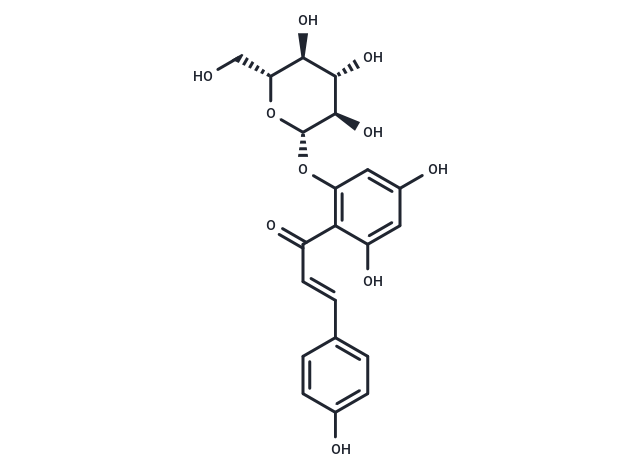
Physicochemical Properties
| Molecular Formula | C21H22O10 |
| Molecular Weight | 434.39 |
| Exact Mass | 434.1213 |
| Elemental Analysis | C, 58.06; H, 5.11; O, 36.83 |
| CAS # | 4547-85-7 |
| PubChem CID | 5318659 |
| Appearance | Typically exists as solids (or liquids in special cases) at room temperature |
| LogP | 0 |
| Hydrogen Bond Donor Count | 7 |
| Hydrogen Bond Acceptor Count | 10 |
| Rotatable Bond Count | 6 |
| Heavy Atom Count | 31 |
| Complexity | 619 |
| Defined Atom Stereocenter Count | 5 |
| SMILES | OC1C=CC(/C=C/C(C2=C(O)C=C(O)C=C2O[C@@H]2O[C@H](CO)[C@@H](O)[C@H](O)[C@H]2O)=O)=CC=1 |
| Synonyms | Isosalipurposide; Phlorizin chalcone; 4547-85-7; iso-salipurposide; CHEBI:80486; DTXSID801316840; (E)-1-[2,4-dihydroxy-6-[(2S,3R,4S,5S,6R)-3,4,5-trihydroxy-6-(hydroxymethyl)oxan-2-yl]oxyphenyl]-3-(4-hydroxyphenyl)prop-2-en-1-one; (E)-1-(2,4-dihydroxy-6-((2S,3R,4S,5S,6R)-3,4,5-trihydroxy-6-(hydroxymethyl)oxan-2-yl)oxyphenyl)-3-(4-hydroxyphenyl)prop-2-en-1-one; |
| HS Tariff Code | 2934.99.9001 |
| Storage |
Powder-20°C 3 years 4°C 2 years In solvent -80°C 6 months -20°C 1 month |
| Shipping Condition | Room temperature (This product is stable at ambient temperature for a few days during ordinary shipping and time spent in Customs) |
Biological Activity
| Targets |
Nrf2 [1] |
| ln Vitro |
- Isosalipurposide (ISPP) pretreatment (1, 5, 10, 20 μM) increased cell viability of tert-butyl hydroperoxide (t-BHP)-induced HepG2 cells in a dose-dependent manner, as determined by MTT assay. At 20 μM, cell viability was significantly higher compared to the t-BHP-treated group [1] - Isosalipurposide (5, 10, 20 μM) reduced t-BHP-induced intracellular reactive oxygen species (ROS) production in HepG2 cells, as measured by DCFH-DA fluorescence assay. ROS levels decreased with increasing concentrations of isosalipurposide [1] - Isosalipurposide (5, 10, 20 μM) upregulated the expression of Nrf2 in the nuclear fraction and increased the levels of HO-1 and NQO1 proteins in t-BHP-induced HepG2 cells, as shown by Western blot analysis. The expression levels of these proteins were elevated in a dose-dependent manner [1] - Isosalipurposide (10, 20 μM) increased the activity of antioxidant enzymes such as superoxide dismutase (SOD) and glutathione peroxidase (GPx) in t-BHP-induced HepG2 cells, while reducing malondialdehyde (MDA) levels [1] - Conversion of isosalipurposide was observed when in contact with various plant tissues (including potato tubers, carrot roots, and beet roots). The conversion process was influenced by the type of plant tissue, with different rates of transformation noted [2] |
| Enzyme Assay |
- SOD activity assay: HepG2 cells were pretreated with isosalipurposide (5, 10, 20 μM) for 1 h, then exposed to t-BHP for 6 h. Cells were lysed, and the supernatant was used to measure SOD activity using a commercial kit, based on the inhibition of pyrogallol autoxidation [1] - GPx activity assay: After treatment with isosalipurposide and t-BHP as above, cell lysates were prepared, and GPx activity was determined by measuring the oxidation of glutathione in the presence of hydrogen peroxide, using a detection kit [1] |
| Cell Assay |
- MTT assay (HepG2 cells): HepG2 cells were seeded in 96-well plates and pretreated with isosalipurposide (1, 5, 10, 20 μM) for 1 h, followed by exposure to t-BHP (200 μM) for 6 h. MTT reagent was added, and the absorbance at 570 nm was measured to calculate cell viability [1] - ROS detection: HepG2 cells were pretreated with isosalipurposide (5, 10, 20 μM) for 1 h, then treated with t-BHP (200 μM) for 30 min. DCFH-DA probe was added, and fluorescence intensity was measured using a fluorometer to assess intracellular ROS levels [1] - Western blot analysis (HepG2 cells): Cells were treated with isosalipurposide (5, 10, 20 μM) and t-BHP as above. Nuclear and cytoplasmic fractions were extracted, and proteins (Nrf2, HO-1, NQO1, Lamin B1, β-actin) were detected using specific antibodies [1] - MDA measurement: After treatment, cell lysates were prepared, and MDA levels were determined using a thiobarbituric acid reactive substances (TBARS) assay, with absorbance measured at 532 nm [1] |
| Toxicity/Toxicokinetics |
Isosalipurposide alone (up to 20 μM) did not show significant cytotoxicity in HepG2 cells under normal culture conditions, as indicated by MTT assay [1] |
| References |
[1]. The chalcone compound isosalipurposide (ISPP) exerts a cytoprotective effect against oxidative injury via Nrf2 activation. Toxicol Appl Pharmacol. 2015 Aug 15;287(1):77-85. [2]. Conversion of isosalipurposide and phloridzin during contact with various plant tissues]. Biokhimiia. 1969 Sep-Oct;34(5):891-901. |
| Additional Infomation |
- Isosalipurposide is a chalcone compound that exerts cytoprotective effects against oxidative injury by activating the Nrf2 signaling pathway, thereby upregulating antioxidant enzymes and reducing oxidative stress [1] - The conversion of isosalipurposide in contact with plant tissues suggests metabolic transformations in plant systems, though the specific products and mechanisms were not detailed [2] |
Solubility Data
| Solubility (In Vitro) | May dissolve in DMSO (in most cases), if not, try other solvents such as H2O, Ethanol, or DMF with a minute amount of products to avoid loss of samples |
| Solubility (In Vivo) |
Note: Listed below are some common formulations that may be used to formulate products with low water solubility (e.g. < 1 mg/mL), you may test these formulations using a minute amount of products to avoid loss of samples. Injection Formulations (e.g. IP/IV/IM/SC) Injection Formulation 1: DMSO : Tween 80: Saline = 10 : 5 : 85 (i.e. 100 μL DMSO stock solution → 50 μL Tween 80 → 850 μL Saline) *Preparation of saline: Dissolve 0.9 g of sodium chloride in 100 mL ddH ₂ O to obtain a clear solution. Injection Formulation 2: DMSO : PEG300 :Tween 80 : Saline = 10 : 40 : 5 : 45 (i.e. 100 μL DMSO → 400 μLPEG300 → 50 μL Tween 80 → 450 μL Saline) Injection Formulation 3: DMSO : Corn oil = 10 : 90 (i.e. 100 μL DMSO → 900 μL Corn oil) Example: Take the Injection Formulation 3 (DMSO : Corn oil = 10 : 90) as an example, if 1 mL of 2.5 mg/mL working solution is to be prepared, you can take 100 μL 25 mg/mL DMSO stock solution and add to 900 μL corn oil, mix well to obtain a clear or suspension solution (2.5 mg/mL, ready for use in animals). Injection Formulation 4: DMSO : 20% SBE-β-CD in saline = 10 : 90 [i.e. 100 μL DMSO → 900 μL (20% SBE-β-CD in saline)] *Preparation of 20% SBE-β-CD in Saline (4°C,1 week): Dissolve 2 g SBE-β-CD in 10 mL saline to obtain a clear solution. Injection Formulation 5: 2-Hydroxypropyl-β-cyclodextrin : Saline = 50 : 50 (i.e. 500 μL 2-Hydroxypropyl-β-cyclodextrin → 500 μL Saline) Injection Formulation 6: DMSO : PEG300 : castor oil : Saline = 5 : 10 : 20 : 65 (i.e. 50 μL DMSO → 100 μLPEG300 → 200 μL castor oil → 650 μL Saline) Injection Formulation 7: Ethanol : Cremophor : Saline = 10: 10 : 80 (i.e. 100 μL Ethanol → 100 μL Cremophor → 800 μL Saline) Injection Formulation 8: Dissolve in Cremophor/Ethanol (50 : 50), then diluted by Saline Injection Formulation 9: EtOH : Corn oil = 10 : 90 (i.e. 100 μL EtOH → 900 μL Corn oil) Injection Formulation 10: EtOH : PEG300:Tween 80 : Saline = 10 : 40 : 5 : 45 (i.e. 100 μL EtOH → 400 μLPEG300 → 50 μL Tween 80 → 450 μL Saline) Oral Formulations Oral Formulation 1: Suspend in 0.5% CMC Na (carboxymethylcellulose sodium) Oral Formulation 2: Suspend in 0.5% Carboxymethyl cellulose Example: Take the Oral Formulation 1 (Suspend in 0.5% CMC Na) as an example, if 100 mL of 2.5 mg/mL working solution is to be prepared, you can first prepare 0.5% CMC Na solution by measuring 0.5 g CMC Na and dissolve it in 100 mL ddH2O to obtain a clear solution; then add 250 mg of the product to 100 mL 0.5% CMC Na solution, to make the suspension solution (2.5 mg/mL, ready for use in animals). Oral Formulation 3: Dissolved in PEG400 Oral Formulation 4: Suspend in 0.2% Carboxymethyl cellulose Oral Formulation 5: Dissolve in 0.25% Tween 80 and 0.5% Carboxymethyl cellulose Oral Formulation 6: Mixing with food powders Note: Please be aware that the above formulations are for reference only. InvivoChem strongly recommends customers to read literature methods/protocols carefully before determining which formulation you should use for in vivo studies, as different compounds have different solubility properties and have to be formulated differently. (Please use freshly prepared in vivo formulations for optimal results.) |
| Preparing Stock Solutions | 1 mg | 5 mg | 10 mg | |
| 1 mM | 2.3021 mL | 11.5104 mL | 23.0208 mL | |
| 5 mM | 0.4604 mL | 2.3021 mL | 4.6042 mL | |
| 10 mM | 0.2302 mL | 1.1510 mL | 2.3021 mL |