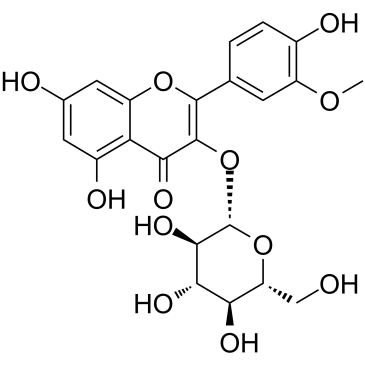
Physicochemical Properties
| Molecular Formula | C22H22O12 |
| Molecular Weight | 478.4029 |
| Exact Mass | 478.111 |
| CAS # | 5041-82-7 |
| PubChem CID | 5318645 |
| Appearance | Light yellow to yellow solid powder |
| Density | 1.8±0.1 g/cm3 |
| Boiling Point | 834.4±65.0 °C at 760 mmHg |
| Melting Point | 155-160ºC |
| Flash Point | 291.3±27.8 °C |
| Vapour Pressure | 0.0±3.2 mmHg at 25°C |
| Index of Refraction | 1.750 |
| LogP | 1.71 |
| Hydrogen Bond Donor Count | 7 |
| Hydrogen Bond Acceptor Count | 12 |
| Rotatable Bond Count | 5 |
| Heavy Atom Count | 34 |
| Complexity | 773 |
| Defined Atom Stereocenter Count | 5 |
| SMILES | COC1=C(C=CC(=C1)C2=C(C(=O)C3=C(C=C(C=C3O2)O)O)O[C@H]4[C@@H]([C@H]([C@@H]([C@H](O4)CO)O)O)O)O |
| InChi Key | CQLRUIIRRZYHHS-LFXZADKFSA-N |
| InChi Code | InChI=1S/C22H22O12/c1-31-12-4-8(2-3-10(12)25)20-21(17(28)15-11(26)5-9(24)6-13(15)32-20)34-22-19(30)18(29)16(27)14(7-23)33-22/h2-6,14,16,18-19,22-27,29-30H,7H2,1H3/t14-,16-,18+,19-,22+/m1/s1 |
| Chemical Name | 5,7-dihydroxy-2-(4-hydroxy-3-methoxyphenyl)-3-[(2S,3R,4S,5S,6R)-3,4,5-trihydroxy-6-(hydroxymethyl)oxan-2-yl]oxychromen-4-one |
| HS Tariff Code | 2934.99.9001 |
| Storage |
Powder-20°C 3 years 4°C 2 years In solvent -80°C 6 months -20°C 1 month |
| Shipping Condition | Room temperature (This product is stable at ambient temperature for a few days during ordinary shipping and time spent in Customs) |
Biological Activity
| Cell Assay |
- Human Intestinal Flora Preparation: Collect fresh fecal samples from healthy volunteers. Dilute the fecal samples with sterile physiological saline (0.9% NaCl) at a ratio of 1:10 (w/v), and homogenize the mixture. Centrifuge the homogenate at a low speed (specific speed not specified in the article) to remove large particulate matter, and the supernatant is used as the intestinal flora suspension. [1] - Incubation System Setup: Prepare the culture medium (composition includes peptone, yeast extract, glucose, and other nutrients) and sterilize it. Add the intestinal flora suspension (10% v/v) and Isorhamnetin-3-O-glucoside (final concentration not specified in the article) to the sterilized medium. Set up a control group without Isorhamnetin-3-O-glucoside for comparison. [1] - Culture and Sample Collection: Incubate the culture system at 37°C under anaerobic conditions (using an anaerobic incubator with 85% N₂, 10% H₂, and 5% CO₂). Collect 1 mL of the culture solution at different time points (0 h, 6 h, 12 h, 24 h, 48 h). Add an equal volume of methanol to the collected samples to terminate the reaction, vortex thoroughly, and centrifuge at a high speed (specific speed not specified in the article) to obtain the supernatant. [1] - Metabolite Detection: Filter the supernatant through a 0.22 μm microporous membrane. Analyze the filtered samples using UPLC/Q-TOF MS. The UPLC conditions include a C18 chromatographic column, gradient elution with mobile phases (water containing 0.1% formic acid and acetonitrile containing 0.1% formic acid), and a flow rate of 0.3 mL/min. The Q-TOF MS is operated in positive ion mode to detect and identify the metabolites of Isorhamnetin-3-O-glucoside. [1] |
| ADME/Pharmacokinetics |
- In vitro, Isorhamnetin-3-O-glucoside undergoes metabolism by human intestinal flora. The main metabolic pathways include deglycosylation (removal of the glucose moiety) to form isorhamnetin, followed by demethylation of isorhamnetin to produce quercetin, and further hydrogenation of quercetin to generate dihydroquercetin. [1] - The metabolites of Isorhamnetin-3-O-glucoside (including isorhamnetin, quercetin, and dihydroquercetin) are identified and quantified using ultraperformance liquid chromatography/quadrupole time-of-flight mass spectrometry (UPLC/Q-TOF MS). The mass spectrometry data (molecular weight, fragment ions) are used to confirm the chemical structure of each metabolite. [1] - During the 48-hour in vitro incubation with human intestinal flora, the concentration of Isorhamnetin-3-O-glucoside gradually decreases, while the concentrations of its metabolites (isorhamnetin, quercetin, dihydroquercetin) increase first and then stabilize, indicating that the metabolism of the compound reaches a dynamic balance within 48 hours. [1] |
| References |
[1]. Analysis of the Metabolites of Isorhamnetin 3-O-Glucoside Produced by Human Intestinal Flora in Vitro by Applying Ultraperformance Liquid Chromatography/Quadrupole Time-of-Flight Mass Spectrometry. J Agric Food Chem. 201462122489-2495. |
| Additional Infomation |
Isorhamnetin 3-O-beta-D-glucopyranoside is a glycosyloxyflavone that is isorhamnetin substituted at position 3 by a beta-D-glucosyl residue. It has a role as a metabolite. It is a monosaccharide derivative, a glycosyloxyflavone, a monomethoxyflavone, a trihydroxyflavone and a beta-D-glucoside. It is functionally related to an isorhamnetin and a beta-D-glucose. isorhamnetin-3-O-glucoside has been reported in Anoectochilus formosanus, Halocnemum strobilaceum, and other organisms with data available. Isorhamnetin 3-O-glucoside is a metabolite found in or produced by Saccharomyces cerevisiae. See also: Ginkgo (part of). - Isorhamnetin-3-O-glucoside is a flavonoid glycoside widely present in plants such as Ginkgo biloba, Hippophae rhamnoides, and citrus fruits. It is a natural bioactive compound that attracts attention due to its potential health benefits. [1] - The in vitro metabolism study of Isorhamnetin-3-O-glucoside by human intestinal flora is of great significance. Intestinal flora-mediated metabolism can convert the parent compound into metabolites with different biological activities, which provides a basis for further studying the in vivo absorption and biological effects of Isorhamnetin-3-O-glucoside. [1] - The UPLC/Q-TOF MS technology used in the study has high sensitivity and resolution, which can accurately identify the structure of metabolites of Isorhamnetin-3-O-glucoside and quantify their relative contents, ensuring the reliability of the metabolic analysis results. [1] |
Solubility Data
| Solubility (In Vitro) | DMSO : ~250 mg/mL (~522.58 mM) |
| Solubility (In Vivo) |
Solubility in Formulation 1: ≥ 2.08 mg/mL (4.35 mM) (saturation unknown) in 10% DMSO + 40% PEG300 + 5% Tween80 + 45% Saline (add these co-solvents sequentially from left to right, and one by one), clear solution. For example, if 1 mL of working solution is to be prepared, you can add 100 μL of 20.8 mg/mL clear DMSO stock solution to 400 μL PEG300 and mix evenly; then add 50 μL Tween-80 to the above solution and mix evenly; then add 450 μL normal saline to adjust the volume to 1 mL. Preparation of saline: Dissolve 0.9 g of sodium chloride in 100 mL ddH₂ O to obtain a clear solution. Solubility in Formulation 2: ≥ 2.08 mg/mL (4.35 mM) (saturation unknown) in 10% DMSO + 90% (20% SBE-β-CD in Saline) (add these co-solvents sequentially from left to right, and one by one), clear solution. For example, if 1 mL of working solution is to be prepared, you can add 100 μL of 20.8 mg/mL clear DMSO stock solution to 900 μL of 20% SBE-β-CD physiological saline solution and mix evenly. Preparation of 20% SBE-β-CD in Saline (4°C,1 week): Dissolve 2 g SBE-β-CD in 10 mL saline to obtain a clear solution. Solubility in Formulation 3: ≥ 2.08 mg/mL (4.35 mM) (saturation unknown) in 10% DMSO + 90% Corn Oil (add these co-solvents sequentially from left to right, and one by one), clear solution. For example, if 1 mL of working solution is to be prepared, you can add 100 μL of 20.8 mg/mL clear DMSO stock solution to 900 μL of corn oil and mix evenly. (Please use freshly prepared in vivo formulations for optimal results.) |
| Preparing Stock Solutions | 1 mg | 5 mg | 10 mg | |
| 1 mM | 2.0903 mL | 10.4515 mL | 20.9030 mL | |
| 5 mM | 0.4181 mL | 2.0903 mL | 4.1806 mL | |
| 10 mM | 0.2090 mL | 1.0452 mL | 2.0903 mL |