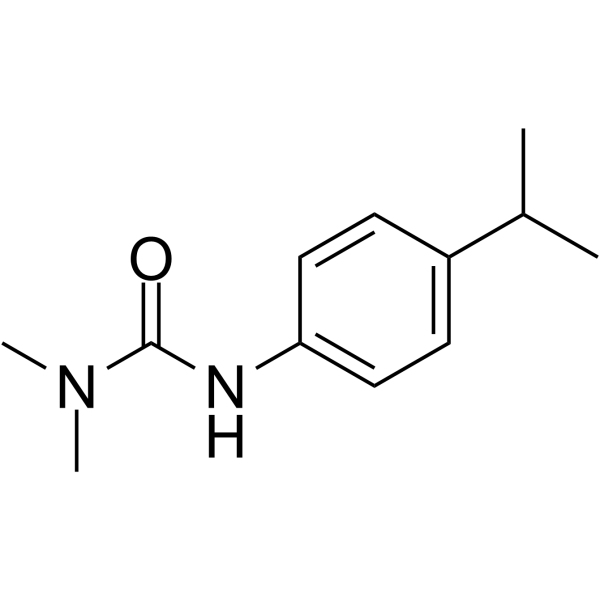
Physicochemical Properties
| Molecular Formula | C12H18N2O |
| Molecular Weight | 206.28 |
| Exact Mass | 206.141 |
| CAS # | 34123-59-6 |
| Related CAS # | Isoproturon-d3;352438-80-3 |
| PubChem CID | 36679 |
| Appearance | White to off-white solid powder |
| Density | 1.1±0.1 g/cm3 |
| Boiling Point | 353.2±25.0 °C at 760 mmHg |
| Melting Point | 155-156ºC |
| Flash Point | 167.4±23.2 °C |
| Vapour Pressure | 0.0±0.8 mmHg at 25°C |
| Index of Refraction | 1.555 |
| LogP | 2.32 |
| Hydrogen Bond Donor Count | 1 |
| Hydrogen Bond Acceptor Count | 1 |
| Rotatable Bond Count | 2 |
| Heavy Atom Count | 15 |
| Complexity | 206 |
| Defined Atom Stereocenter Count | 0 |
| InChi Key | PUIYMUZLKQOUOZ-UHFFFAOYSA-N |
| InChi Code | InChI=1S/C12H18N2O/c1-9(2)10-5-7-11(8-6-10)13-12(15)14(3)4/h5-9H,1-4H3,(H,13,15) |
| Chemical Name | 1,1-dimethyl-3-(4-propan-2-ylphenyl)urea |
| HS Tariff Code | 2934.99.9001 |
| Storage |
Powder-20°C 3 years 4°C 2 years In solvent -80°C 6 months -20°C 1 month |
| Shipping Condition | Room temperature (This product is stable at ambient temperature for a few days during ordinary shipping and time spent in Customs) |
Biological Activity
| ADME/Pharmacokinetics |
Absorption, Distribution and Excretion Toxicokinetic behavior and recoveries of isoproturon from feces, urine, and different tissues of goat were determined after 4, 5, 6, and 7 days following single oral administration at 500 mg/kg. Isoproturon was rapidly absorbed and attained blood concentration within 15 min of administration. The kinetic behavior followed a two-compartment open model. The higher half-life (beta) (9.78 +/- 0.33 hr) and V(d)()area (4.49 +/- 0.41 L/kg) associated with lower Cl(B) (0.32 +/- 0.02 L/kg/hr) suggested slow elimination from the blood. Approximately 56% of the total administered compound was recovered from feces. The rate of excretion of isoproturon through feces was maximum at 48 hr and could not be detected beyond 120 hr. The excretion pattern of isoproturon through urine resembled that of feces, and approximately 10-11% was eliminated in urine. A maximum quantity of residue was detected in all tissues of goats slaughtered after 4 days followed by a substantial decline after day 5, and nothing could be detected after day 7. Histopathological study revealed that isoproturon produced moderate cellular changes like fatty degeneration in the liver and kidney and emphysema in the lung after 7 days post administration. Metabolism / Metabolites Using ring-(14)C-labeled isoproturon (1 ug/L), the uptake into spawn and tadpoles of Bombina bombina and Bombina variegata was investigated. Two percent of the applied radioactivity was found per gram fresh weight in the embryo after 24 hr. Results indicate that the jelly mass of the spawn does not act as a sufficient physical barrier for protection against the uptake and influence of isoproturon (IPU) on the embryo. In vivo metabolism of ring-(14)C-labeled IPU by the cytochrome P-450 system was analyzed in tadpoles. Different metabolites of IPU, such as N-demethylated and C-hydroxylated derivatives, and the olefinic metabolite were detected. In tadpoles of B. variegata, the activity of microsomal and soluble glutathione-S-transferase (sGSTs) toward different model substrates was measured after treatment with IPU. Activities of sGST increased corresponding to elevated stress by IPU dependent on exposure time and dose. Compared to the pure active ingredient IPU, the commercial phenyl-urea herbicide Tolkan Flo, consisting of IPU and an emulsifier, also caused significantly elevated enzymatic response. Biological Half-Life Toxicokinetic behavior and recoveries of isoproturon from feces, urine, and different tissues of goat were determined after 4, 5, 6, and 7 days following single oral administration at 500 mg/kg. ... The higher half-life (beta) (9.78 +/- 0.33 hr) and V(d)()area (4.49 +/- 0.41 L/kg) associated with lower Cl(B) (0.32 +/- 0.02 L/kg/hr) suggested slow elimination from the blood. ... |
| Toxicity/Toxicokinetics |
Toxicity Summary IDENTIFICATION AND USE: Isoproturon is a solid. It was formerly used in the United States as pre- and post-emergence herbicide for control of annual grasses and broad-leaved weeds. HUMAN STUDIES: Micronucleus induction was observed in human lymphocytes exposed to 100 uM isoproturon. ANIMAL STUDIES: Repeated applications of isoproturon technical (IPT) and its wettable powder formulation (IPF) to the skin of male and female rats for 21 days caused mild to moderate toxic effects. IPT was more toxic to male rats as evidenced by animal mortality and enzymatic and hematological changes. The toxicity of IPF was less to both sexes. In adult male rats exposed to isoproturon, testis showed degeneration and desquamation of cells of germinal layers. Tubular lumens of testis and epididymis exhibited reduced number of spermatids and spermatozoa, respectively, indicating retardation of spermatogenesis. Effect of isoproturon (0.225, 0.45 and 0.90 g/kg/day) administered from day 6 through 15 of gestation was studied on pregnant rats and their offspring. There were no distinct clinical signs other than dose-related depression and drowsiness of pregnant rats. At higher doses, decreased maternal body weight was observed during the advanced stage of pregnancy. The litter size, fetal weight and crown-rump and transumbilical lengths were decreased. There was an increase in fetal resorption frequency and the number of fetuses with stunted growth. The genotoxic effect of isoproturon was assessed by employing in vivo chromosomal aberration, micronucleus and sperm-shape abnormality assays. A significant dose-responsive mutagenic effect was observed in chromosome aberration and sperm-shape abnormality tests whereas in micronucleus assay the effect was significant only at the highest dose (200 mg/kg). ECOTOXICITY STUDIES: Cellular volume and dry weight of Chlorella vulgaris cells were increased strongly in the presence of isoproturon. Isoproturon was found to be nontoxic to bees. In earthworm (Lumbricus terrestris), no lethal effect of isoproturon was observed even at the highest concentration tested (1.4 g/kg soil) after 60 days after treatment. The use of the growth rate of earthworms was proposed as biomarker of exposure to isoproturon. In Allium sativum, exposure to isoproturon induced root growth retardation and morphological changes like discoloration and stiffness of roots. Exposure to various experimental concentrations of isoproturon (35-280 ppm) significantly and dose-dependently inhibited the mitotic index and induced chromosome breaks/mitotic aberrations at 6 or 24 hr. Interactions Effects of three photosystem II inhibitors and of their mixture on a freshwater phytoplankton community were studied in outdoor mesocosms. Atrazine, isoproturon, and diuron were applied as 30% hazardous concentrations (HC30s) obtained from species-sensitivity distributions. Taking concentration addition into account, the mixture comprised one-third of the HC30 of each substance. Effects were investigated during a five-week period of constant concentrations and a five-month posttreatment period when the herbicides dissipated. Total abundance, species composition, and diversity and recovery of the community were evaluated. Ordination techniques, such as principal component analysis and principal response curve, were applied to compare the various treatments on the community level. The three herbicides stimulated comparable effects on total abundance and diversity of phytoplankton during the period of constant exposure because of the susceptibility of the dominant cryptophytes Chroomonas acuta and Cryptomonas erosa et ovata and the prasinophyte Nephroselmis cf. olivacea. Moreover, concentration addition described combined effects of atrazine, isoproturon, and diuron on total abundance and diversity in the constant-exposure period, because their mixture induced effects on abundance and diversity similar to those of the single substances. Principal component and principal response curve analyses revealed that the community structure of diuron- and isoproturon-treated phytoplankton recovered two weeks after constant exposure, which might be related to the fast dissipation of the phenylureas. Species compositions of mixture- and atrazine-treated communities were not comparable to that of the control community five months after the end of constant exposure. This might be explained by the slower dissipation of atrazine relative to the phenylureas and by differences in the species sensitivities, resulting in a different succession of phytoplankton. Rats were treated orally with technical hexachlorocyclohexane (HCH, 12.5, 25 and 50 mg/kg/day) and technical isoproturon (ISP 22.5. 45 and 90 mg/kg/day) daily for a period of 90 days alone and in combination. Treatment with HCH alone showed mild to severe toxicity and death. Significant changes occurred in liver weight, clinical enzyme profiles, hematological parameters and pathomorphological changes. Treatment with ISP alone did not produce such changes. The combination of HCH and ISP produced changes not suggestive of synergism. The cytogenetic effects of deltamethrin (DEL) and/or isoproturon (ISO) were examined in human lymphocytes and mouse bone marrow cells. Peripheral lymphocytes were exposed to DEL (2.5, 5, 10, or 20 uM), ISO (25, 50, 100, or 200 uM), or DEL + ISO (2.5 + 25, 5 + 50, 10 + 100, or 20 + 200 uM) and cytogenic effects were evaluated via chromosomal aberrations (CA) and the cytokinesis-block micronucleus assay (CBMN). Mice were orally gavaged to single dose of DEL (6.6 mg/kg), ISO (670 mg/kg), or DEL+ISO (6.6 + 670 mg/kg) for 24 hr or to DEL (3.3 mg/kg/day), ISO (330 mg/kg/day), or DEL + ISO (3.3 + 330 mg/kg/day) for 30 days and analyzed for CA. DEL induced a significant frequency of CA at 10 uM whereas ISO (25-100 uM) alone, or in combination with DEL, did not show any significant effect. Micronucleus (MN) induction was observed to be concentration-dependent though significant frequencies were observed at 5 uM DEL, 100 uM ISO, or 5 + 50 uM DEL + ISO. In mice, DEL inhibited the mitotic index (MI) significantly (P < 0.001) at 24 hr while ISO alone, or in combination with DEL, did not cause any statistically significant effect. Following a 24 hr exposure, DEL and ISO alone induced significant (P < 0.01) frequencies of CA, whereas DEL + ISO in combination did not. Furthermore, 30 days exposure of ISO significantly inhibited the MI (P < 0.02 or < 0.01) and induced CA while DEL alone, or in combination with ISO, resulted in no significant effect on CA or the MI. The present findings indicate that the in vitro and in vivo exposure of a commercial formulation of DEL can cause genotoxic effects in mammals. However, the coexposure of DEL and ISO did not show additive effects, but instead demonstrated somewhat reduced genotoxicity. Here, we assess the physiological effects induced by environmental concentrations of pesticides in Pacific oyster Crassostrea gigas. Oysters were exposed for 14 d to trace levels of metconazole (0.2 and 2 ug/L), isoproturon (0.1 and 1 ug/L), or both in a mixture (0.2 and 0.1 ug/L, respectively). Exposure to trace levels of pesticides had no effect on the filtration rate, growth, and energy reserves of oysters. However, oysters exposed to metconazole and isoproturon showed an overactivation of the sensing-kinase AMP-activated protein kinase alpha (AMPKalpha), a key enzyme involved in energy metabolism and more particularly glycolysis. In the meantime, these exposed oysters showed a decrease in hexokinase and pyruvate kinase activities, whereas 2-DE proteomic revealed that fructose-1,6-bisphosphatase (F-1,6-BP), a key enzyme of gluconeogenesis, was up-regulated. Activities of antioxidant enzymes were higher in oysters exposed to the highest pesticide concentrations. Both pesticides enhanced the superoxide dismutase activity of oysters. Isoproturon enhanced catalase activity, and metconazole enhanced peroxiredoxin activity. Overall, our results show that environmental concentrations of metconazole or isoproturon induced subtle changes in the energy and antioxidant metabolisms of oysters. For more Interactions (Complete) data for Isoproturon (8 total), please visit the HSDB record page. Non-Human Toxicity Values LD50 Quail oral 3042 mg/kg LD50 Pigeon oral >5 g/kg LD50 Mouse oral 3350 mg/kg LD50 Rat dermal >2 g/kg For more Non-Human Toxicity Values (Complete) data for Isoproturon (7 total), please visit the HSDB record page. |
| References |
[1]. Isoproturon-Induced Salicylic Acid Confers Arabidopsis Resistance to Isoproturon Phytotoxicity and Degradation in Plants. J Agric Food Chem. 2018 Dec 19;66(50):13073-13083. [2]. Determination of Isoproturon in Environmental Samples Using the QuEChERS Extraction-Spectrofluorimetric Method. Environ Toxicol Chem. 2019 Dec;38(12):2614-2620. |
| Additional Infomation |
Isoproturon is a member of the class of phenylureas that is 1,1-dimethylurea substituted by a p-cumenyl group at position 3. A selective, systemic herbicide used to control annual grasses and broadleaf weeds in cereals, its use within the EU has been banned after September 2017 on the grounds of potential groundwater contamination and risks to aquatic life; there have also been concerns about its endocrine-disrupting properties. It has a role as an environmental contaminant, a xenobiotic, a herbicide and an agrochemical. Mechanism of Action Inhibition of photosynthesis at photosystem II. |
Solubility Data
| Solubility (In Vitro) | May dissolve in DMSO (in most cases), if not, try other solvents such as H2O, Ethanol, or DMF with a minute amount of products to avoid loss of samples |
| Solubility (In Vivo) |
Note: Listed below are some common formulations that may be used to formulate products with low water solubility (e.g. < 1 mg/mL), you may test these formulations using a minute amount of products to avoid loss of samples. Injection Formulations (e.g. IP/IV/IM/SC) Injection Formulation 1: DMSO : Tween 80: Saline = 10 : 5 : 85 (i.e. 100 μL DMSO stock solution → 50 μL Tween 80 → 850 μL Saline) *Preparation of saline: Dissolve 0.9 g of sodium chloride in 100 mL ddH ₂ O to obtain a clear solution. Injection Formulation 2: DMSO : PEG300 :Tween 80 : Saline = 10 : 40 : 5 : 45 (i.e. 100 μL DMSO → 400 μLPEG300 → 50 μL Tween 80 → 450 μL Saline) Injection Formulation 3: DMSO : Corn oil = 10 : 90 (i.e. 100 μL DMSO → 900 μL Corn oil) Example: Take the Injection Formulation 3 (DMSO : Corn oil = 10 : 90) as an example, if 1 mL of 2.5 mg/mL working solution is to be prepared, you can take 100 μL 25 mg/mL DMSO stock solution and add to 900 μL corn oil, mix well to obtain a clear or suspension solution (2.5 mg/mL, ready for use in animals). Injection Formulation 4: DMSO : 20% SBE-β-CD in saline = 10 : 90 [i.e. 100 μL DMSO → 900 μL (20% SBE-β-CD in saline)] *Preparation of 20% SBE-β-CD in Saline (4°C,1 week): Dissolve 2 g SBE-β-CD in 10 mL saline to obtain a clear solution. Injection Formulation 5: 2-Hydroxypropyl-β-cyclodextrin : Saline = 50 : 50 (i.e. 500 μL 2-Hydroxypropyl-β-cyclodextrin → 500 μL Saline) Injection Formulation 6: DMSO : PEG300 : castor oil : Saline = 5 : 10 : 20 : 65 (i.e. 50 μL DMSO → 100 μLPEG300 → 200 μL castor oil → 650 μL Saline) Injection Formulation 7: Ethanol : Cremophor : Saline = 10: 10 : 80 (i.e. 100 μL Ethanol → 100 μL Cremophor → 800 μL Saline) Injection Formulation 8: Dissolve in Cremophor/Ethanol (50 : 50), then diluted by Saline Injection Formulation 9: EtOH : Corn oil = 10 : 90 (i.e. 100 μL EtOH → 900 μL Corn oil) Injection Formulation 10: EtOH : PEG300:Tween 80 : Saline = 10 : 40 : 5 : 45 (i.e. 100 μL EtOH → 400 μLPEG300 → 50 μL Tween 80 → 450 μL Saline) Oral Formulations Oral Formulation 1: Suspend in 0.5% CMC Na (carboxymethylcellulose sodium) Oral Formulation 2: Suspend in 0.5% Carboxymethyl cellulose Example: Take the Oral Formulation 1 (Suspend in 0.5% CMC Na) as an example, if 100 mL of 2.5 mg/mL working solution is to be prepared, you can first prepare 0.5% CMC Na solution by measuring 0.5 g CMC Na and dissolve it in 100 mL ddH2O to obtain a clear solution; then add 250 mg of the product to 100 mL 0.5% CMC Na solution, to make the suspension solution (2.5 mg/mL, ready for use in animals). Oral Formulation 3: Dissolved in PEG400 Oral Formulation 4: Suspend in 0.2% Carboxymethyl cellulose Oral Formulation 5: Dissolve in 0.25% Tween 80 and 0.5% Carboxymethyl cellulose Oral Formulation 6: Mixing with food powders Note: Please be aware that the above formulations are for reference only. InvivoChem strongly recommends customers to read literature methods/protocols carefully before determining which formulation you should use for in vivo studies, as different compounds have different solubility properties and have to be formulated differently. (Please use freshly prepared in vivo formulations for optimal results.) |
| Preparing Stock Solutions | 1 mg | 5 mg | 10 mg | |
| 1 mM | 4.8478 mL | 24.2389 mL | 48.4778 mL | |
| 5 mM | 0.9696 mL | 4.8478 mL | 9.6956 mL | |
| 10 mM | 0.4848 mL | 2.4239 mL | 4.8478 mL |