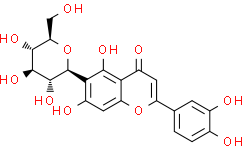
Physicochemical Properties
| Molecular Formula | C21H20O11 |
| Molecular Weight | 448.3769 |
| Exact Mass | 448.1 |
| CAS # | 4261-42-1 |
| PubChem CID | 114776 |
| Appearance | Light yellow to yellow solid powder |
| Density | 1.8±0.1 g/cm3 |
| Boiling Point | 856.7±65.0 °C at 760 mmHg |
| Melting Point | 245-246ºC |
| Flash Point | 303.2±27.8 °C |
| Vapour Pressure | 0.0±0.3 mmHg at 25°C |
| Index of Refraction | 1.767 |
| LogP | 1.58 |
| Hydrogen Bond Donor Count | 8 |
| Hydrogen Bond Acceptor Count | 11 |
| Rotatable Bond Count | 3 |
| Heavy Atom Count | 32 |
| Complexity | 729 |
| Defined Atom Stereocenter Count | 5 |
| SMILES | C1=CC(=C(C=C1C2=CC(=O)C3=C(O2)C=C(C(=C3O)[C@H]4[C@@H]([C@H]([C@@H]([C@H](O4)CO)O)O)O)O)O)O |
| InChi Key | ODBRNZZJSYPIDI-VJXVFPJBSA-N |
| InChi Code | InChI=1S/C21H20O11/c22-6-14-17(27)19(29)20(30)21(32-14)16-11(26)5-13-15(18(16)28)10(25)4-12(31-13)7-1-2-8(23)9(24)3-7/h1-5,14,17,19-24,26-30H,6H2/t14-,17-,19+,20-,21+/m1/s1 |
| Chemical Name | 2-(3,4-dihydroxyphenyl)-5,7-dihydroxy-6-[(2S,3R,4R,5S,6R)-3,4,5-trihydroxy-6-(hydroxymethyl)oxan-2-yl]chromen-4-one |
| HS Tariff Code | 2934.99.9001 |
| Storage |
Powder-20°C 3 years 4°C 2 years In solvent -80°C 6 months -20°C 1 month |
| Shipping Condition | Room temperature (This product is stable at ambient temperature for a few days during ordinary shipping and time spent in Customs) |
Biological Activity
| ln Vitro | In kudzu tubers, isoorientin is a partner of cyclooxygenase-2 (COX-2) [1]. After being cultured in the presence of isoorientin (0, 20, 40, 80, and 160 μM) for 24 hours, PANC-1 and PATU-8988 cells were treated with CCK8 solution. Significant reduction in viability was seen at doses of 20, 40, 80, and 160 μM. After incubating cells with isoorientin (0, 20, 40, 80, and 160 μM for PANC-1; 0, 20, 40, 80, 160, and 320 μM for PATU-8988) for a whole day, p-AMPK expression was observed. and Western blotting was used to evaluate AMPK. Following the administration of isoorientin, p-AMPK expression rose. Next, an 80 μM concentration of isoorientin was tested in the shRNA group to see what effect it had. Compared to the transfected negative lentivirus (NC) control group and the wild-type PC (WT) control group, the shRNA group's cellular AMPK and p-AMPK expression levels were significantly reduced [2]. |
| ln Vivo | This indicates that isoorientin can significantly reduce foot edema compared with humidity. Animals given with isoorientin at 10 mg/kg and 20 mg/kg body weight had a statistically significant reduction in paw edema, achieving mean thicknesses of 1.19 ± 0.05 mm and 1.08 ± 0.04 mm, respectively. |
| References |
[1]. Isoorientin, a Selective Inhibitor of Cyclooxygenase-2 (COX-2) from the Tubers of Pueraria tuberosa. Nat Prod Commun. 2015 Oct;10(10):1703-4. [2]. Isoorientin induces apoptosis, decreases invasiveness, and downregulates VEGF secretion by activating AMPK signaling in pancreatic cancer cells. Onco Targets Ther. 2016 Dec 12;9:7481-7492. [3]. Evaluation of Anti-Inflammatory Properties of Isoorientin Isolated from Tubers of Pueraria tuberosa. Oxid Med Cell Longev. 2017;2017:5498054. |
| Additional Infomation |
Isoorientin is a flavone C-glycoside consisting of luteolin having a beta-D-glucosyl residue at the 6-position. It has a role as a radical scavenger and an antineoplastic agent. It is a tetrahydroxyflavone and a flavone C-glycoside. It is functionally related to a luteolin. It is a conjugate acid of an isoorientin(1-). Isoorientin has been reported in Gleditsia sinensis, Cecropia hololeuca, and other organisms with data available. See also: Acai fruit pulp (part of). |
Solubility Data
| Solubility (In Vitro) | DMSO : ≥ 100 mg/mL (~223.03 mM) |
| Solubility (In Vivo) |
Solubility in Formulation 1: ≥ 2.5 mg/mL (5.58 mM) (saturation unknown) in 10% DMSO + 40% PEG300 + 5% Tween80 + 45% Saline (add these co-solvents sequentially from left to right, and one by one), clear solution. For example, if 1 mL of working solution is to be prepared, you can add 100 μL of 25.0 mg/mL clear DMSO stock solution to 400 μL PEG300 and mix evenly; then add 50 μL Tween-80 to the above solution and mix evenly; then add 450 μL normal saline to adjust the volume to 1 mL. Preparation of saline: Dissolve 0.9 g of sodium chloride in 100 mL ddH₂ O to obtain a clear solution. Solubility in Formulation 2: ≥ 2.5 mg/mL (5.58 mM) (saturation unknown) in 10% DMSO + 90% (20% SBE-β-CD in Saline) (add these co-solvents sequentially from left to right, and one by one), clear solution. For example, if 1 mL of working solution is to be prepared, you can add 100 μL of 25.0 mg/mL clear DMSO stock solution to 900 μL of 20% SBE-β-CD physiological saline solution and mix evenly. Preparation of 20% SBE-β-CD in Saline (4°C,1 week): Dissolve 2 g SBE-β-CD in 10 mL saline to obtain a clear solution. (Please use freshly prepared in vivo formulations for optimal results.) |
| Preparing Stock Solutions | 1 mg | 5 mg | 10 mg | |
| 1 mM | 2.2303 mL | 11.1513 mL | 22.3025 mL | |
| 5 mM | 0.4461 mL | 2.2303 mL | 4.4605 mL | |
| 10 mM | 0.2230 mL | 1.1151 mL | 2.2303 mL |