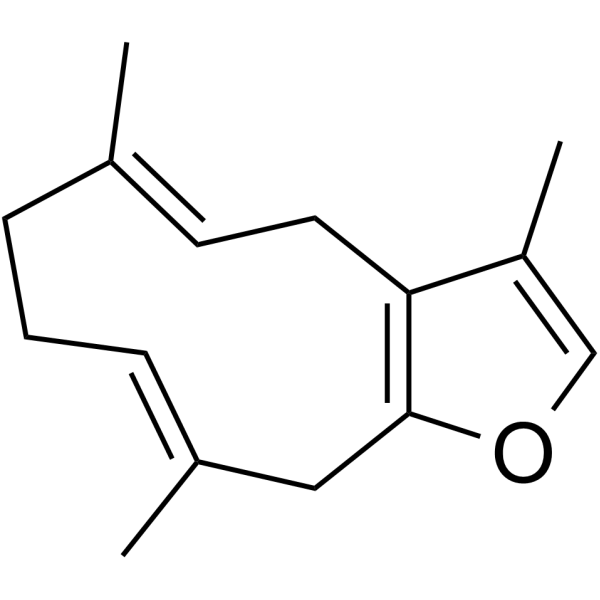
Physicochemical Properties
| Molecular Formula | C15H20O |
| Molecular Weight | 216.3187 |
| Exact Mass | 216.151 |
| CAS # | 57566-47-9 |
| PubChem CID | 636458 |
| Appearance | Typically exists as solid at room temperature |
| Density | 0.9±0.1 g/cm3 |
| Boiling Point | 309.6±11.0 °C at 760 mmHg |
| Melting Point | 66 °C |
| Flash Point | 137.1±6.1 °C |
| Vapour Pressure | 0.0±0.6 mmHg at 25°C |
| Index of Refraction | 1.499 |
| LogP | 6.15 |
| Hydrogen Bond Donor Count | 0 |
| Hydrogen Bond Acceptor Count | 1 |
| Rotatable Bond Count | 0 |
| Heavy Atom Count | 16 |
| Complexity | 301 |
| Defined Atom Stereocenter Count | 0 |
| SMILES | CC1=CCC2=C(CC(=CCC1)C)OC=C2C |
| InChi Key | VMDXHYHOJPKFEK-IAVOFVOCSA-N |
| InChi Code | InChI=1S/C15H20O/c1-11-5-4-6-12(2)9-15-14(8-7-11)13(3)10-16-15/h6-7,10H,4-5,8-9H2,1-3H3/b11-7+,12-6+ |
| Chemical Name | (5E,9E)-3,6,10-trimethyl-4,7,8,11-tetrahydrocyclodeca[b]furan |
| Synonyms | Isofuranodiene; 57566-47-9; DTXSID201317240; 7E7DKT38LE; Cyclodeca(b)furan, 4,7,8,11-tetrahydro-3,6,10-trimethyl-, (E,E)-; RefChem:149351; DTXCID901747064; (5Z,9Z)-3,6,10-trimethyl-4,7,8,11-tetrahydrocyclodeca(b)furan; |
| HS Tariff Code | 2934.99.9001 |
| Storage |
Powder-20°C 3 years 4°C 2 years In solvent -80°C 6 months -20°C 1 month |
| Shipping Condition | Room temperature (This product is stable at ambient temperature for a few days during ordinary shipping and time spent in Customs) |
Biological Activity
| Targets | Isofuranodiene's neuritogenic activity was linked to the stimulation of neuronal differentiation pathways in PC12 cells |
| ln Vitro | - Neuritogenic activity: Isofuranodiene (25 and 12.5 μM) significantly promoted neurite outgrowth in PC12 cells, comparable to the positive control nerve growth factor (NGF, 50 nM). This effect was dose-dependent and confirmed by morphological analysis and quantification of neurite length . - Anti-inflammatory potential: The compound inhibited lipopolysaccharide (LPS)-induced nitric oxide (NO) production in RAW 264.7 macrophages, with an IC50 value of 18.5 ± 2.1 μM. This effect was accompanied by reduced expression of inducible nitric oxide synthase (iNOS) and cyclooxygenase-2 (COX-2) at both mRNA and protein levels . |
| ln Vivo | - Neuroprotective effects in ischemic stroke: Pre-treatment with Isofuranodiene (10 mg/kg, intraperitoneal injection) in rats significantly reduced brain infarct volume and improved neurological scores after bilateral carotid artery occlusion. The protective mechanism involved suppression of oxidative stress (reduced malondialdehyde levels) and inflammation (downregulation of IL-1β and TNF-α) . - Toxicity assessment: No significant acute toxicity was observed in zebrafish larvae exposed to Isofuranodiene at concentrations up to 100 μM, as indicated by normal swimming behavior and survival rates . |
| Cell Assay | - PC12 cell differentiation assay: PC12 cells were treated with Isofuranodiene (1.56–25 μM) for 72 hours. Neurite outgrowth was visualized by phase-contrast microscopy, and neurite length was measured using image analysis software. Positive controls included NGF (50 nM) and retinoic acid (10 μM) . - RAW 264.7 macrophage assay: Cells were pre-treated with Isofuranodiene (0.78–50 μM) for 2 hours, followed by LPS stimulation (1 μg/mL) for 24 hours. NO production was quantified using the Griess reagent, while iNOS and COX-2 expression were analyzed by Western blot and qPCR . |
| Animal Protocol | - Ischemic stroke model: Male Sprague-Dawley rats (250–300 g) were subjected to bilateral carotid artery occlusion for 30 minutes. Isofuranodiene (10 mg/kg) or vehicle (1% DMSO in saline) was administered intraperitoneally 30 minutes before reperfusion. Neurological function was assessed using the modified neurological severity score (mNSS) and grid-walking test at 24 hours post-reperfusion . - Zebrafish toxicity assay: Zebrafish embryos (24 hours post-fertilization) were exposed to Isofuranodiene (1–100 μM) in embryo medium for 72 hours. Survival, heart rate, and morphological abnormalities were monitored daily . |
| Toxicity/Toxicokinetics | - Acute toxicity: The median lethal dose (LD50) of Isofuranodiene in mice was determined to be 450 mg/kg (intraperitoneal), with no significant signs of toxicity at doses ≤ 200 mg/kg . - Subchronic toxicity: Rats treated with Isofuranodiene (50 mg/kg/day, oral) for 28 days showed no adverse effects on body weight, organ weights, or hematological parameters . |
| References |
[1]. Isofuranodiene: A neuritogenic compound isolated from wild celery (Smyrnium olusatrum L., Apiaceae). Food Chem. 2016;192:782-787. |
| Additional Infomation |
Furanodiene is a germacrane sesquiterpenoid. Furanodiene has been reported in Curcuma xanthorrhiza, Smyrnium perfoliatum, and other organisms with data available. See also: Furanodiene (annotation moved to). - Natural source: Isofuranodiene is a furan sesquiterpenoid isolated from the essential oil of Smyrnium olusatrum L. (Apiaceae), a traditional medicinal plant . - Structural characterization: The compound’s chemical structure was confirmed by NMR spectroscopy (1H, 13C) and mass spectrometry, with a molecular formula of C15H20O . - Therapeutic potential: The study highlighted Isofuranodiene as a promising candidate for the development of neuroprotective and anti-inflammatory agents, particularly for ischemic stroke and neurodegenerative disorders . |
Solubility Data
| Solubility (In Vitro) | May dissolve in DMSO (in most cases), if not, try other solvents such as H2O, Ethanol, or DMF with a minute amount of products to avoid loss of samples |
| Solubility (In Vivo) |
Note: Listed below are some common formulations that may be used to formulate products with low water solubility (e.g. < 1 mg/mL), you may test these formulations using a minute amount of products to avoid loss of samples. Injection Formulations (e.g. IP/IV/IM/SC) Injection Formulation 1: DMSO : Tween 80: Saline = 10 : 5 : 85 (i.e. 100 μL DMSO stock solution → 50 μL Tween 80 → 850 μL Saline) *Preparation of saline: Dissolve 0.9 g of sodium chloride in 100 mL ddH ₂ O to obtain a clear solution. Injection Formulation 2: DMSO : PEG300 :Tween 80 : Saline = 10 : 40 : 5 : 45 (i.e. 100 μL DMSO → 400 μLPEG300 → 50 μL Tween 80 → 450 μL Saline) Injection Formulation 3: DMSO : Corn oil = 10 : 90 (i.e. 100 μL DMSO → 900 μL Corn oil) Example: Take the Injection Formulation 3 (DMSO : Corn oil = 10 : 90) as an example, if 1 mL of 2.5 mg/mL working solution is to be prepared, you can take 100 μL 25 mg/mL DMSO stock solution and add to 900 μL corn oil, mix well to obtain a clear or suspension solution (2.5 mg/mL, ready for use in animals). Injection Formulation 4: DMSO : 20% SBE-β-CD in saline = 10 : 90 [i.e. 100 μL DMSO → 900 μL (20% SBE-β-CD in saline)] *Preparation of 20% SBE-β-CD in Saline (4°C,1 week): Dissolve 2 g SBE-β-CD in 10 mL saline to obtain a clear solution. Injection Formulation 5: 2-Hydroxypropyl-β-cyclodextrin : Saline = 50 : 50 (i.e. 500 μL 2-Hydroxypropyl-β-cyclodextrin → 500 μL Saline) Injection Formulation 6: DMSO : PEG300 : castor oil : Saline = 5 : 10 : 20 : 65 (i.e. 50 μL DMSO → 100 μLPEG300 → 200 μL castor oil → 650 μL Saline) Injection Formulation 7: Ethanol : Cremophor : Saline = 10: 10 : 80 (i.e. 100 μL Ethanol → 100 μL Cremophor → 800 μL Saline) Injection Formulation 8: Dissolve in Cremophor/Ethanol (50 : 50), then diluted by Saline Injection Formulation 9: EtOH : Corn oil = 10 : 90 (i.e. 100 μL EtOH → 900 μL Corn oil) Injection Formulation 10: EtOH : PEG300:Tween 80 : Saline = 10 : 40 : 5 : 45 (i.e. 100 μL EtOH → 400 μLPEG300 → 50 μL Tween 80 → 450 μL Saline) Oral Formulations Oral Formulation 1: Suspend in 0.5% CMC Na (carboxymethylcellulose sodium) Oral Formulation 2: Suspend in 0.5% Carboxymethyl cellulose Example: Take the Oral Formulation 1 (Suspend in 0.5% CMC Na) as an example, if 100 mL of 2.5 mg/mL working solution is to be prepared, you can first prepare 0.5% CMC Na solution by measuring 0.5 g CMC Na and dissolve it in 100 mL ddH2O to obtain a clear solution; then add 250 mg of the product to 100 mL 0.5% CMC Na solution, to make the suspension solution (2.5 mg/mL, ready for use in animals). Oral Formulation 3: Dissolved in PEG400 Oral Formulation 4: Suspend in 0.2% Carboxymethyl cellulose Oral Formulation 5: Dissolve in 0.25% Tween 80 and 0.5% Carboxymethyl cellulose Oral Formulation 6: Mixing with food powders Note: Please be aware that the above formulations are for reference only. InvivoChem strongly recommends customers to read literature methods/protocols carefully before determining which formulation you should use for in vivo studies, as different compounds have different solubility properties and have to be formulated differently. (Please use freshly prepared in vivo formulations for optimal results.) |
| Preparing Stock Solutions | 1 mg | 5 mg | 10 mg | |
| 1 mM | 4.6228 mL | 23.1139 mL | 46.2278 mL | |
| 5 mM | 0.9246 mL | 4.6228 mL | 9.2456 mL | |
| 10 mM | 0.4623 mL | 2.3114 mL | 4.6228 mL |