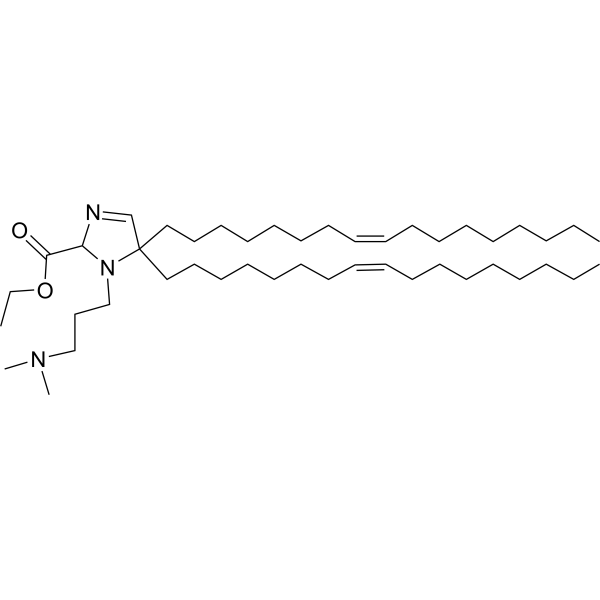
Physicochemical Properties
| Molecular Formula | C45H85N3O2 |
| Molecular Weight | 700.18 |
| Exact Mass | 699.664 |
| CAS # | 2412492-06-7 |
| PubChem CID | 146426091 |
| Appearance | Colorless to light yellow liquid |
| LogP | 16.1 |
| Hydrogen Bond Donor Count | 0 |
| Hydrogen Bond Acceptor Count | 5 |
| Rotatable Bond Count | 37 |
| Heavy Atom Count | 50 |
| Complexity | 811 |
| Defined Atom Stereocenter Count | 0 |
| SMILES | CCCCCCCC/C=C\CCCCCCCC1(N(C(N=C1)C(=O)OCC)CCCN(C)C)CCCCCCC/C=C\CCCCCCCC |
| InChi Key | KYZBKCPOKFBUSU-SXAUZNKPSA-N |
| InChi Code | InChI=1S/C45H85N3O2/c1-6-9-11-13-15-17-19-21-23-25-27-29-31-33-35-38-45(42-46-43(44(49)50-8-3)48(45)41-37-40-47(4)5)39-36-34-32-30-28-26-24-22-20-18-16-14-12-10-7-2/h21-24,42-43H,6-20,25-41H2,1-5H3/b23-21-,24-22- |
| Chemical Name | ethyl 1-[3-(dimethylamino)propyl]-5,5-bis[(Z)-heptadec-8-enyl]-2H-imidazole-2-carboxylate |
| HS Tariff Code | 2934.99.9001 |
| Storage |
Powder-20°C 3 years 4°C 2 years In solvent -80°C 6 months -20°C 1 month |
| Shipping Condition | Room temperature (This product is stable at ambient temperature for a few days during ordinary shipping and time spent in Customs) |
Biological Activity
| Targets |
The target of Iso5-2SC18 is STING (Stimulator of Interferon Genes), which activates the pathway to induce type I interferon (IFN-I) and pro-inflammatory cytokine expression, enhancing anti-tumor immune responses. [1] |
| ln Vitro |
1. Immune cell activation: Iso5-2SC18-encapsulated mRNA vaccines (LNP-mRNA) efficiently deliver to dendritic cells (DCs), inducing DC maturation via STING pathway activation, as indicated by upregulated co-stimulatory molecules (CD80, CD86) and secretion of IFN-β and TNF-α. [1] 2. Pro-inflammatory cytokine release: In murine bone marrow-derived DCs (BMDCs) and macrophages, Iso5-2SC18-LNP-mRNA significantly promotes secretion of IFN-β, IL-6, and CXCL10, with effects dependent on STING activation. [1] |
| ln Vivo |
1. Tumor inhibition: Intratumoral injection of Iso5-2SC18-LNP-mRNA in B16F10 melanoma and MC38 colon cancer mouse models significantly suppresses tumor growth and prolongs survival, associated with increased CD8+ T cell infiltration, IFN-γ expression, and reduced immunosuppressive cells (e.g., Tregs). [1] 2. Combination therapy synergy: Combination with anti-PD-L1 antibodies further enhances anti-tumor efficacy, achieving complete tumor regression in some mice without notable toxicity. [1] |
| Cell Assay |
1. DC maturation assay: Murine BMDCs were co-incubated with Iso5-2SC18-LNP-mRNA for 24 hours, and DC maturation was evaluated by flow cytometry for CD80, CD86, and MHC class II expression. Treated DCs showed significantly higher co-stimulatory molecule expression. [1] 2. Cytokine secretion detection: Cell supernatants were collected and analyzed by ELISA for IFN-β, IL-6, and CXCL10. Iso5-2SC18 treatment increased cytokine levels, which were blocked by the STING inhibitor H-151. [1] |
| Animal Protocol |
1. Tumor model establishment: B16F10 or MC38 cells were inoculated into the right flank of C57BL/6 mice. Treatment began when tumors reached ~100 mm³. [1] 2. Drug delivery: Iso5-2SC18-LNP-mRNA (10 μg/mouse) was administered intratumorally twice weekly for 3 weeks. Controls received saline or empty liposomes. [1] 3. Combination therapy: Anti-PD-L1 antibody (200 μg/mouse) was injected intraperitoneally twice weekly alongside Iso5-2SC18 to assess synergistic effects. [1] |
| Toxicity/Toxicokinetics |
1. Systemic toxicity assessment: No significant weight loss, hepatic/renal dysfunction, or histopathological damage was observed in Iso5-2SC18-treated mice, indicating good tolerability. [1] 2. Immune-related toxicity: Transient IFN-α elevation occurred in some mice but did not cause severe immune-related adverse effects (e.g., autoimmunity). [1] |
| References |
[1]. Delivery of mRNA vaccines with heterocyclic lipids increases anti-tumor efficacy by STING-mediated immune cell activation. Nat Biotechnol. 2019 Oct;37(10):1174-1185. |
| Additional Infomation |
1. Mechanism of action: Iso5-2SC18 forms LNP with mRNA, which is endocytosed by DCs. Released mRNA activates the cGAS-STING-TBK1-IRF3 pathway, inducing IFN-I and pro-inflammatory cytokines to trigger anti-tumor immunity. [1] 2. Formulation optimization: The lipid structure of Iso5-2SC18 (heterocyclic substitution and C18 fatty chain) enhances LNP stability and cellular uptake, improving vaccine immunogenicity. [1] |
Solubility Data
| Solubility (In Vitro) | May dissolve in DMSO (in most cases), if not, try other solvents such as H2O, Ethanol, or DMF with a minute amount of products to avoid loss of samples |
| Solubility (In Vivo) |
Note: Listed below are some common formulations that may be used to formulate products with low water solubility (e.g. < 1 mg/mL), you may test these formulations using a minute amount of products to avoid loss of samples. Injection Formulations (e.g. IP/IV/IM/SC) Injection Formulation 1: DMSO : Tween 80: Saline = 10 : 5 : 85 (i.e. 100 μL DMSO stock solution → 50 μL Tween 80 → 850 μL Saline) *Preparation of saline: Dissolve 0.9 g of sodium chloride in 100 mL ddH ₂ O to obtain a clear solution. Injection Formulation 2: DMSO : PEG300 :Tween 80 : Saline = 10 : 40 : 5 : 45 (i.e. 100 μL DMSO → 400 μLPEG300 → 50 μL Tween 80 → 450 μL Saline) Injection Formulation 3: DMSO : Corn oil = 10 : 90 (i.e. 100 μL DMSO → 900 μL Corn oil) Example: Take the Injection Formulation 3 (DMSO : Corn oil = 10 : 90) as an example, if 1 mL of 2.5 mg/mL working solution is to be prepared, you can take 100 μL 25 mg/mL DMSO stock solution and add to 900 μL corn oil, mix well to obtain a clear or suspension solution (2.5 mg/mL, ready for use in animals). Injection Formulation 4: DMSO : 20% SBE-β-CD in saline = 10 : 90 [i.e. 100 μL DMSO → 900 μL (20% SBE-β-CD in saline)] *Preparation of 20% SBE-β-CD in Saline (4°C,1 week): Dissolve 2 g SBE-β-CD in 10 mL saline to obtain a clear solution. Injection Formulation 5: 2-Hydroxypropyl-β-cyclodextrin : Saline = 50 : 50 (i.e. 500 μL 2-Hydroxypropyl-β-cyclodextrin → 500 μL Saline) Injection Formulation 6: DMSO : PEG300 : castor oil : Saline = 5 : 10 : 20 : 65 (i.e. 50 μL DMSO → 100 μLPEG300 → 200 μL castor oil → 650 μL Saline) Injection Formulation 7: Ethanol : Cremophor : Saline = 10: 10 : 80 (i.e. 100 μL Ethanol → 100 μL Cremophor → 800 μL Saline) Injection Formulation 8: Dissolve in Cremophor/Ethanol (50 : 50), then diluted by Saline Injection Formulation 9: EtOH : Corn oil = 10 : 90 (i.e. 100 μL EtOH → 900 μL Corn oil) Injection Formulation 10: EtOH : PEG300:Tween 80 : Saline = 10 : 40 : 5 : 45 (i.e. 100 μL EtOH → 400 μLPEG300 → 50 μL Tween 80 → 450 μL Saline) Oral Formulations Oral Formulation 1: Suspend in 0.5% CMC Na (carboxymethylcellulose sodium) Oral Formulation 2: Suspend in 0.5% Carboxymethyl cellulose Example: Take the Oral Formulation 1 (Suspend in 0.5% CMC Na) as an example, if 100 mL of 2.5 mg/mL working solution is to be prepared, you can first prepare 0.5% CMC Na solution by measuring 0.5 g CMC Na and dissolve it in 100 mL ddH2O to obtain a clear solution; then add 250 mg of the product to 100 mL 0.5% CMC Na solution, to make the suspension solution (2.5 mg/mL, ready for use in animals). Oral Formulation 3: Dissolved in PEG400 Oral Formulation 4: Suspend in 0.2% Carboxymethyl cellulose Oral Formulation 5: Dissolve in 0.25% Tween 80 and 0.5% Carboxymethyl cellulose Oral Formulation 6: Mixing with food powders Note: Please be aware that the above formulations are for reference only. InvivoChem strongly recommends customers to read literature methods/protocols carefully before determining which formulation you should use for in vivo studies, as different compounds have different solubility properties and have to be formulated differently. (Please use freshly prepared in vivo formulations for optimal results.) |
| Preparing Stock Solutions | 1 mg | 5 mg | 10 mg | |
| 1 mM | 1.4282 mL | 7.1410 mL | 14.2820 mL | |
| 5 mM | 0.2856 mL | 1.4282 mL | 2.8564 mL | |
| 10 mM | 0.1428 mL | 0.7141 mL | 1.4282 mL |