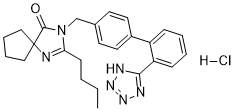
Irbesartan HCl (formerly known as SR-47436 and BMS-186295) is a novel, highly potent and specific angiotensin II type 1 (AT1) receptor antagonist with IC50 of 1.3 nM. Irbesartan is principally employed to manage hypertension. The mechanism of action involves the selective and competitive blocking of angiotensin II's binding to the angiotensin I receptor. Angiotensin II causes the adrenal cortex to produce and secrete more aldosterone, which raises potassium excretion and decreases sodium excretion. Vascular smooth muscle is another organ where angiotensin II has vasoconstrictor effects.
Physicochemical Properties
| Molecular Formula | C25H29CLN6O |
| Molecular Weight | 464.998 |
| Exact Mass | 464.209 |
| Elemental Analysis | C, 64.58; H, 6.29; Cl, 7.62; N, 18.07; O, 3.44 |
| CAS # | 329055-23-4 |
| Related CAS # | Irbesartan; 138402-11-6 |
| PubChem CID | 11568906 |
| Appearance | Solid powder |
| LogP | 4.952 |
| Hydrogen Bond Donor Count | 2 |
| Hydrogen Bond Acceptor Count | 5 |
| Rotatable Bond Count | 7 |
| Heavy Atom Count | 33 |
| Complexity | 682 |
| Defined Atom Stereocenter Count | 0 |
| SMILES | Cl.O=C1C2(CCCC2)N=C(CCCC)N1CC1C=CC(C2=CC=CC=C2C2N=NNN=2)=CC=1 |
| InChi Key | ZUYFSRQJPNUOQU-UHFFFAOYSA-N |
| InChi Code | InChI=1S/C25H28N6O.ClH/c1-2-3-10-22-26-25(15-6-7-16-25)24(32)31(22)17-18-11-13-19(14-12-18)20-8-4-5-9-21(20)23-27-29-30-28-23;/h4-5,8-9,11-14H,2-3,6-7,10,15-17H2,1H3,(H,27,28,29,30);1H |
| Chemical Name | 2-butyl-3-[[4-[2-(2H-tetrazol-5-yl)phenyl]phenyl]methyl]-1,3-diazaspiro[4.4]non-1-en-4-one;hydrochloride |
| Synonyms | SR-47436; BMS 186295; BMS186295; SR47436; Avapro; Aprovel; KarveaIrbesartan HCl; Irbesartan hydrochloride; BMS-186295; SR 47436 |
| HS Tariff Code | 2934.99.03.00 |
| Storage |
Powder-20°C 3 years 4°C 2 years In solvent -80°C 6 months -20°C 1 month |
| Shipping Condition | Room temperature (This product is stable at ambient temperature for a few days during ordinary shipping and time spent in Customs) |
Biological Activity
| ln Vitro |
Irbesartan hydrochloride (20 μM, 3 h) decreases Th22 cell chemotaxis in vitro[1]. Irbesartan hydrochloride (0 μM, 20 μM, 40 μM and 60 μM) inhibits the differentiation of Th22 cells in vitro[1]. Irbesartan hydrochloride (20 μM) inhibits the proinflammatory response of TECs related to Th22 cells in vitro[1]. |
||
| ln Vivo |
Irbesartan hydrochloride (oral gavage; 50 mg/kg/d; once daily) lowers serum IL-22 levels and Th22 lymphocytosis in Ang II-infused mice[1]. Irbesartan hydrochloride (oral gavage; 50 mg/kg/d; once daily) has clear renoprotective effects [1]. Irbesartan hydrochloride (oral gavage; 50 mg/kg/d; once daily) alleviates both systemic inflammation and renal fibrosis in hypertension mice induced by Ang II[1]. Irbesartan hydrochloride (20 μM; for 3 h) can reduce the number of Th22 cells recruited and the secretion of IL-22, possibly by preventing chemotaxis in mice with hypertensive renal injury[1]. |
||
| Enzyme Assay | Irbesartan s an extremely strong and selective antagonist of the angiotensin II type 1 (AT1) receptor with IC50 of 1.3 nM. | ||
| Cell Assay | Irbesartan treatment significantly increases the expression of the adipogenic marker gene adipose protein 2 (aP2) in 3T3-L1 cells in a concentration-dependent manner. The induction increases by 3.3 times at a concentration of 10 μM, with an EC50 of 3.5 μM. Irbesartan (10 μM) significantly increases the transcriptional activity of peroxisome proliferator-activated receptor-γ (PPARγ) by 3.4 times, even in the absence of its ability to block AT1 receptors. In rat vascular smooth muscle cells, pretreatment with irbesartan (~10 μM) reduces angiotensin II-induced apoptosis by inhibiting angiotensin II internalization in a concentration-dependent way. | ||
| Animal Protocol |
|
||
| References |
[1]. Irbesartan may relieve renal injury by suppressing Th22 cells chemotaxis and infiltration in Ang II-induced hypertension. Int Immunopharmacol . 2020 Oct:87:106789. |
||
| Additional Infomation |
Drug Indication Treatment of essential hypertension. Treatment of renal disease in patients with hypertension and type 2 diabetes mellitus as part of an antihypertensive medicinal product regimen. |
Solubility Data
| Solubility (In Vitro) | May dissolve in DMSO (in most cases), if not, try other solvents such as H2O, Ethanol, or DMF with a minute amount of products to avoid loss of samples |
| Solubility (In Vivo) |
Note: Listed below are some common formulations that may be used to formulate products with low water solubility (e.g. < 1 mg/mL), you may test these formulations using a minute amount of products to avoid loss of samples. Injection Formulations (e.g. IP/IV/IM/SC) Injection Formulation 1: DMSO : Tween 80: Saline = 10 : 5 : 85 (i.e. 100 μL DMSO stock solution → 50 μL Tween 80 → 850 μL Saline) *Preparation of saline: Dissolve 0.9 g of sodium chloride in 100 mL ddH ₂ O to obtain a clear solution. Injection Formulation 2: DMSO : PEG300 :Tween 80 : Saline = 10 : 40 : 5 : 45 (i.e. 100 μL DMSO → 400 μLPEG300 → 50 μL Tween 80 → 450 μL Saline) Injection Formulation 3: DMSO : Corn oil = 10 : 90 (i.e. 100 μL DMSO → 900 μL Corn oil) Example: Take the Injection Formulation 3 (DMSO : Corn oil = 10 : 90) as an example, if 1 mL of 2.5 mg/mL working solution is to be prepared, you can take 100 μL 25 mg/mL DMSO stock solution and add to 900 μL corn oil, mix well to obtain a clear or suspension solution (2.5 mg/mL, ready for use in animals). Injection Formulation 4: DMSO : 20% SBE-β-CD in saline = 10 : 90 [i.e. 100 μL DMSO → 900 μL (20% SBE-β-CD in saline)] *Preparation of 20% SBE-β-CD in Saline (4°C,1 week): Dissolve 2 g SBE-β-CD in 10 mL saline to obtain a clear solution. Injection Formulation 5: 2-Hydroxypropyl-β-cyclodextrin : Saline = 50 : 50 (i.e. 500 μL 2-Hydroxypropyl-β-cyclodextrin → 500 μL Saline) Injection Formulation 6: DMSO : PEG300 : castor oil : Saline = 5 : 10 : 20 : 65 (i.e. 50 μL DMSO → 100 μLPEG300 → 200 μL castor oil → 650 μL Saline) Injection Formulation 7: Ethanol : Cremophor : Saline = 10: 10 : 80 (i.e. 100 μL Ethanol → 100 μL Cremophor → 800 μL Saline) Injection Formulation 8: Dissolve in Cremophor/Ethanol (50 : 50), then diluted by Saline Injection Formulation 9: EtOH : Corn oil = 10 : 90 (i.e. 100 μL EtOH → 900 μL Corn oil) Injection Formulation 10: EtOH : PEG300:Tween 80 : Saline = 10 : 40 : 5 : 45 (i.e. 100 μL EtOH → 400 μLPEG300 → 50 μL Tween 80 → 450 μL Saline) Oral Formulations Oral Formulation 1: Suspend in 0.5% CMC Na (carboxymethylcellulose sodium) Oral Formulation 2: Suspend in 0.5% Carboxymethyl cellulose Example: Take the Oral Formulation 1 (Suspend in 0.5% CMC Na) as an example, if 100 mL of 2.5 mg/mL working solution is to be prepared, you can first prepare 0.5% CMC Na solution by measuring 0.5 g CMC Na and dissolve it in 100 mL ddH2O to obtain a clear solution; then add 250 mg of the product to 100 mL 0.5% CMC Na solution, to make the suspension solution (2.5 mg/mL, ready for use in animals). Oral Formulation 3: Dissolved in PEG400 Oral Formulation 4: Suspend in 0.2% Carboxymethyl cellulose Oral Formulation 5: Dissolve in 0.25% Tween 80 and 0.5% Carboxymethyl cellulose Oral Formulation 6: Mixing with food powders Note: Please be aware that the above formulations are for reference only. InvivoChem strongly recommends customers to read literature methods/protocols carefully before determining which formulation you should use for in vivo studies, as different compounds have different solubility properties and have to be formulated differently. (Please use freshly prepared in vivo formulations for optimal results.) |
| Preparing Stock Solutions | 1 mg | 5 mg | 10 mg | |
| 1 mM | 2.1505 mL | 10.7527 mL | 21.5054 mL | |
| 5 mM | 0.4301 mL | 2.1505 mL | 4.3011 mL | |
| 10 mM | 0.2151 mL | 1.0753 mL | 2.1505 mL |