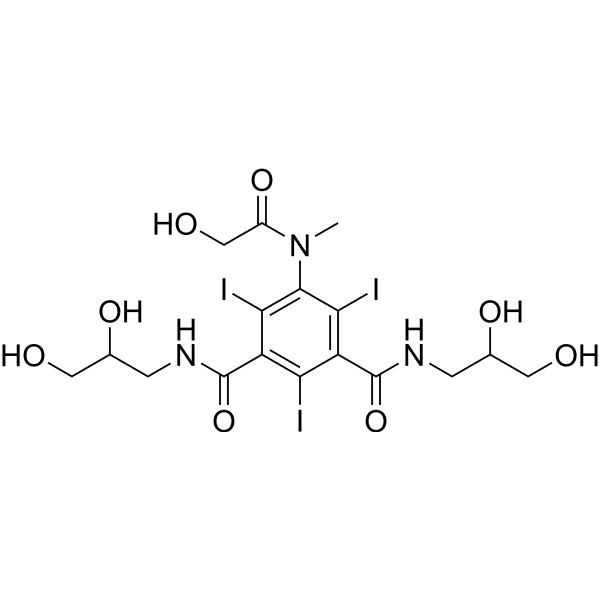
On November 27, 2024, FDA approves Iomeprol for using as a radiographic contrast agent.
Physicochemical Properties
| Molecular Formula | C17H22I3N3O8 |
| Molecular Weight | 777.09 |
| Exact Mass | 776.854 |
| Elemental Analysis | C, 26.28; H, 2.85; I, 48.99; N, 5.41; O, 16.47 |
| CAS # | 78649-41-9 |
| PubChem CID | 3731 |
| Appearance | White to off-white solid at room temperature |
| Density | 2.3±0.1 g/cm3 |
| Boiling Point | 813.2±65.0 °C at 760 mmHg |
| Melting Point | 263-265ºC |
| Flash Point | 445.6±34.3 °C |
| Vapour Pressure | 0.0±3.1 mmHg at 25°C |
| Index of Refraction | 1.735 |
| LogP | -3.08 |
| Hydrogen Bond Donor Count | 7 |
| Hydrogen Bond Acceptor Count | 8 |
| Rotatable Bond Count | 10 |
| Heavy Atom Count | 31 |
| Complexity | 591 |
| Defined Atom Stereocenter Count | 0 |
| SMILES | CN(C1=C(C(=C(C(=C1I)C(=O)NCC(CO)O)I)C(=O)NCC(CO)O)I)C(=O)CO |
| InChi Key | NJKDOADNQSYQEV-UHFFFAOYSA-N |
| InChi Code | InChI=1S/C17H22I3N3O8/c1-23(9(29)6-26)15-13(19)10(16(30)21-2-7(27)4-24)12(18)11(14(15)20)17(31)22-3-8(28)5-25/h7-8,24-28H,2-6H2,1H3,(H,21,30)(H,22,31) |
| Chemical Name | 1-N,3-N-bis(2,3-dihydroxypropyl)-5-[(2-hydroxyacetyl)-methylamino]-2,4,6-triiodobenzene-1,3-dicarboxamide |
| Synonyms | iomeprol; 78649-41-9; Iomeron; Iomeprolum; Iomeprolo; |
| HS Tariff Code | 2934.99.9001 |
| Storage |
Powder-20°C 3 years 4°C 2 years In solvent -80°C 6 months -20°C 1 month |
| Shipping Condition | Room temperature (This product is stable at ambient temperature for a few days during ordinary shipping and time spent in Customs) |
Biological Activity
| Targets | X-ray contrast agent |
| ln Vitro |
Iomeprol is a benzenedicarboxamide compound having N-substituted carbamoyl groups at the 1- and 3-positions, iodo substituents at the 2-, 4- and 6-positions and a glycoloyl(methyl)amino group at the 5-position. It has a role as a radioopaque medium, an environmental contaminant and a xenobiotic. It is a benzenedicarboxamide and an organoiodine compound.
Iomeprol is a tri-iodinated, non-ionic radiographic contrast agent for intraarterial or intravenous use. Iomeprol demonstrates low chemotoxicity, osmolality and viscosity and high water solubility. Iomeprol first appeared in the market in 1994 and is currently used in various diagnostic processes involving x-ray imaging and computed tomography (CT) scans. Iomeprol is a Radiographic Contrast Agent. The mechanism of action of iomeprol is as a X-Ray Contrast Activity. IOMEPROL is a small molecule drug with a maximum clinical trial phase of IV that was first approved in 2024. structure given in first source |
| ln Vivo |
Iomeprol is a radiographic iodinated contrast agent that opacifies the vessels and body structures where the contrast agent is present following intravenous or intra-arterial administration, permitting radiographic visualization of the internal structures through attenuation of X-ray photons. In imaging of the body, iodinated contrast agents diffuse from the vessels into the extravascular space. In normal brain with an intact blood-brain barrier, the contrast agent does not diffuse into the extravascular space and contrast enhancement is generally due to the presence of contrast within the vascular space. In patients with a disrupted blood-brain barrier, the contrast agent accumulates in the extravascular space in the region of disruption.
The degree of radiographic enhancement by iomeprol is related to the iodine concentration in the tissue of interest following the administration of iomeprol. However, the exposure-response relationships and time course of pharmacodynamic response of iomeprol have not been fully characterized. At therapeutic concentrations, iomeprol was not shown to cause significant effects on the cardiovascular, central nervous, renal, and complement systems. Intra-arterial iomeprol is indicated for: - Cerebral arteriography, including intra-arterial digital subtraction angiography (IA-DSA), in adults and pediatric patients - Visceral and peripheral arteriography and aortography, including IA-DSA, in adults and pediatric patients - Coronary arteriography and cardiac ventriculography in adults - Radiographic evaluation of cardiac chambers and related arteries in pediatric patients Intravenous iomeprol is indicated for: - Computed tomography (CT) of the head and body in adults and pediatric patients - CT angiography of intracranial, visceral, and lower extremity arteries in adults and pediatric patients - Coronary CT angiography in adults and pediatric patients - CT urography in adults and pediatric patients |
| ADME/Pharmacokinetics |
Absorption The maximum concentration (Cmax) and area under the concentration-time curve (AUC) are doseproportional across the dose range of 250 mg iodine/kg to 1,250 mg iodine/kg body weight. Route of Elimination Approximately 90% of the iomeprol dose is excreted unchanged in urine within 24 hours. Volume of Distribution The volume of distribution of iomeprol is 0.28 (0.05) L/kg. In rats, iomeprol was shown to cross the placenta and be excreted into breast milk. Clearance The total body clearance is 0.10 (0.01) L/hr/kg. Protein Binding Iomeprol does not bind to plasma proteins. Metabolism / Metabolites Iomeprol does not undergo significant metabolism. Biological Half-Life The elimination half-life of iomeprol is 1.8 (0.33) hours. |
| Toxicity/Toxicokinetics |
Effects During Pregnancy and Lactation ◉ Summary of Use during Lactation Iomeprol is not approved for marketing in the United States by the U.S. Food and Drug Administration, but is available in other countries. Labeling for the drug in the United Kingdom and guidelines developed by several professional organizations state that breastfeeding need not be disrupted after a nursing mother receives an iodine-containing contrast medium such as iomeprol. ◉ Effects in Breastfed Infants A preterm infant, born at 31 weeks 4 days, was noted at 17 days of age to have a markedly elevated thyrotropin (TSH) value of 87.6 mUI/L (normal range: 0.27 to 4.20 mUI/L). TSH had been normal at birth. Thyroglobulin was also elevated at 811 ng/mL (normal range: 3.5 to 77 ng/mL), but free T4 was normal. The infant had been breastfed (extent not stated) from birth, but also received partial parenteral nutrition until day 10 of life. The infant’s mother had received iomeprol in a dose of 350 mg/kg of iodine at day 4 postpartum and discontinued breastfeeding for 24 hours after the dose. The mother had a history of subclinical hypothyroidism and was treated with levothyroxine. The infant’s transient hypothyroidism, indicated by elevations in TSH and thyroglobulin, was probably caused by the iodine in milk from the contrast medium. ◉ Effects on Lactation and Breastmilk Relevant published information was not found as of the revision date. 3731 mouse LD50 intravenous 19700 mg/kg BEHAVIORAL: SOMNOLENCE (GENERAL DEPRESSED ACTIVITY); LUNGS, THORAX, OR RESPIRATION: OTHER CHANGES; BLOOD: HEMORRHAGE Gekkan Yakuji. Pharmaceuticals Monthly., 36(2410), 1994 3731 rat LD50 intracervical 5100 mg/kg Gekkan Yakuji. Pharmaceuticals Monthly., 36(2410), 1994 3731 rat LD50 intravenous 14300 mg/kg BEHAVIORAL: SOMNOLENCE (GENERAL DEPRESSED ACTIVITY); LUNGS, THORAX, OR RESPIRATION: OTHER CHANGES; BLOOD: HEMORRHAGE Gekkan Yakuji. Pharmaceuticals Monthly., 36(2410), 1994 3731 dog LD intravenous >12500 mg/kg BEHAVIORAL: FOOD INTAKE (ANIMAL); BEHAVIORAL: FLUID INTAKE; KIDNEY, URETER, AND BLADDER: URINE VOLUME INCREASED Gekkan Yakuji. Pharmaceuticals Monthly., 36(2410), 1994 3731 mouse LD50 intracrebral 1186 mg/kg Gekkan Yakuji. Pharmaceuticals Monthly., 36(2410), 1994 |
| References |
[1].Method for preparing iomeprol. China, CN107253918 A 2017-10-17. [2].Drugs. 2000 May;59(5):1169-86. |
| Additional Infomation |
Iomeprol is a benzenedicarboxamide compound having N-substituted carbamoyl groups at the 1- and 3-positions, iodo substituents at the 2-, 4- and 6-positions and a glycoloyl(methyl)amino group at the 5-position. It has a role as a radioopaque medium, an environmental contaminant and a xenobiotic. It is a benzenedicarboxamide and an organoiodine compound. Iomeprol has been investigated for the diagnostic of Coronary Artery Disease. Iomeprol is a nonionic, monomeric iodinated contrast medium. Unlike older ionic agents, Iomeprol offers several advantages, including low chemotoxicity, reduced osmolality, and lower viscosity, along with high water solubility. Studies have shown that most radiographs obtained with iomeprol, which contains 150 to 400 mg/ml of iodine, are of good to excellent quality. Research involving 40 to 6,127 patients undergoing various radiographic procedures indicated that the diagnostic efficacy of iomeprol is comparable to that of other nonionic agents like iopamidol, iopromide, iohexol, and iotrolan. Iomeprol also demonstrates good tolerability. Most adverse events associated with its use are transient and range from mild to moderate intensity. The overall incidence of adverse events varies from 3% to 49.7%. Common issues include localized pain (≤6%), heat sensations (8% to 45%), taste disturbances (3% to 27%), and various pseudoallergic reactions (≤20%). Iomeprol solutions come in a variety of iodine concentrations (150 to 400 mg/ml). They have received approval for numerous diagnostic procedures. The chemical stability of iomeprol eliminates the need for chelating agents. As a result, it is the first formulation in its class not to contain edetic acid (EDTA). In conclusion, as a nonionic contrast agent, iomeprol is well-suited for enhancing diagnostic imaging, contributing to improved patient outcomes and accurate diagnoses. [2] |
Solubility Data
| Solubility (In Vitro) |
H2O: ~125 mg/mL (160.9 mM)
DMSO: ~100 mg/mL (128.7 mM) |
| Solubility (In Vivo) |
Note: Listed below are some common formulations that may be used to formulate products with low water solubility (e.g. < 1 mg/mL), you may test these formulations using a minute amount of products to avoid loss of samples. Injection Formulations (e.g. IP/IV/IM/SC) Injection Formulation 1: DMSO : Tween 80: Saline = 10 : 5 : 85 (i.e. 100 μL DMSO stock solution → 50 μL Tween 80 → 850 μL Saline) *Preparation of saline: Dissolve 0.9 g of sodium chloride in 100 mL ddH ₂ O to obtain a clear solution. Injection Formulation 2: DMSO : PEG300 :Tween 80 : Saline = 10 : 40 : 5 : 45 (i.e. 100 μL DMSO → 400 μLPEG300 → 50 μL Tween 80 → 450 μL Saline) Injection Formulation 3: DMSO : Corn oil = 10 : 90 (i.e. 100 μL DMSO → 900 μL Corn oil) Example: Take the Injection Formulation 3 (DMSO : Corn oil = 10 : 90) as an example, if 1 mL of 2.5 mg/mL working solution is to be prepared, you can take 100 μL 25 mg/mL DMSO stock solution and add to 900 μL corn oil, mix well to obtain a clear or suspension solution (2.5 mg/mL, ready for use in animals). Injection Formulation 4: DMSO : 20% SBE-β-CD in saline = 10 : 90 [i.e. 100 μL DMSO → 900 μL (20% SBE-β-CD in saline)] *Preparation of 20% SBE-β-CD in Saline (4°C,1 week): Dissolve 2 g SBE-β-CD in 10 mL saline to obtain a clear solution. Injection Formulation 5: 2-Hydroxypropyl-β-cyclodextrin : Saline = 50 : 50 (i.e. 500 μL 2-Hydroxypropyl-β-cyclodextrin → 500 μL Saline) Injection Formulation 6: DMSO : PEG300 : castor oil : Saline = 5 : 10 : 20 : 65 (i.e. 50 μL DMSO → 100 μLPEG300 → 200 μL castor oil → 650 μL Saline) Injection Formulation 7: Ethanol : Cremophor : Saline = 10: 10 : 80 (i.e. 100 μL Ethanol → 100 μL Cremophor → 800 μL Saline) Injection Formulation 8: Dissolve in Cremophor/Ethanol (50 : 50), then diluted by Saline Injection Formulation 9: EtOH : Corn oil = 10 : 90 (i.e. 100 μL EtOH → 900 μL Corn oil) Injection Formulation 10: EtOH : PEG300:Tween 80 : Saline = 10 : 40 : 5 : 45 (i.e. 100 μL EtOH → 400 μLPEG300 → 50 μL Tween 80 → 450 μL Saline) Oral Formulations Oral Formulation 1: Suspend in 0.5% CMC Na (carboxymethylcellulose sodium) Oral Formulation 2: Suspend in 0.5% Carboxymethyl cellulose Example: Take the Oral Formulation 1 (Suspend in 0.5% CMC Na) as an example, if 100 mL of 2.5 mg/mL working solution is to be prepared, you can first prepare 0.5% CMC Na solution by measuring 0.5 g CMC Na and dissolve it in 100 mL ddH2O to obtain a clear solution; then add 250 mg of the product to 100 mL 0.5% CMC Na solution, to make the suspension solution (2.5 mg/mL, ready for use in animals). Oral Formulation 3: Dissolved in PEG400 Oral Formulation 4: Suspend in 0.2% Carboxymethyl cellulose Oral Formulation 5: Dissolve in 0.25% Tween 80 and 0.5% Carboxymethyl cellulose Oral Formulation 6: Mixing with food powders Note: Please be aware that the above formulations are for reference only. InvivoChem strongly recommends customers to read literature methods/protocols carefully before determining which formulation you should use for in vivo studies, as different compounds have different solubility properties and have to be formulated differently. (Please use freshly prepared in vivo formulations for optimal results.) |
| Preparing Stock Solutions | 1 mg | 5 mg | 10 mg | |
| 1 mM | 1.2869 mL | 6.4343 mL | 12.8685 mL | |
| 5 mM | 0.2574 mL | 1.2869 mL | 2.5737 mL | |
| 10 mM | 0.1287 mL | 0.6434 mL | 1.2869 mL |