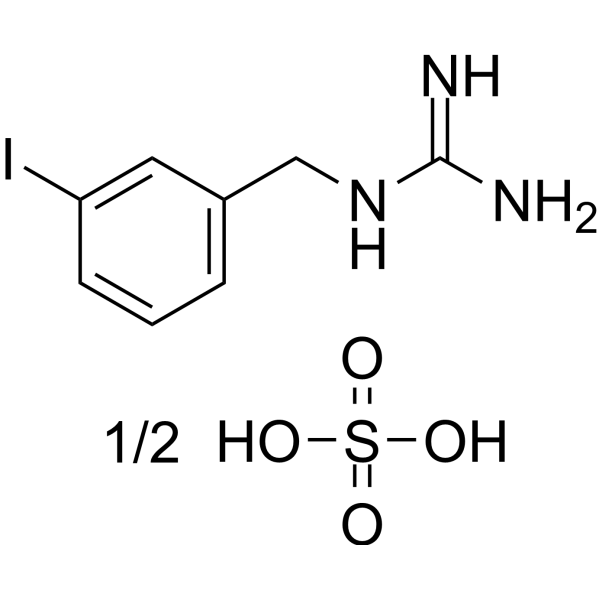
Physicochemical Properties
| Molecular Formula | 2[C8H10N3I].H2O4S |
| Molecular Weight | 648.25668 |
| Exact Mass | 647.951 |
| CAS # | 87862-25-7 |
| PubChem CID | 11957572 |
| Appearance | White to off-white solid powder |
| LogP | 5.358 |
| Hydrogen Bond Donor Count | 6 |
| Hydrogen Bond Acceptor Count | 6 |
| Rotatable Bond Count | 4 |
| Heavy Atom Count | 29 |
| Complexity | 247 |
| Defined Atom Stereocenter Count | 0 |
| SMILES | O=S(O)(O)=O.IC1C=C(CNC(N)=N)C=CC=1 |
| InChi Key | XNACDNPGABUBFR-UHFFFAOYSA-N |
| InChi Code | InChI=1S/2C8H10IN3.H2O4S/c2*9-7-3-1-2-6(4-7)5-12-8(10)11;1-5(2,3)4/h2*1-4H,5H2,(H4,10,11,12);(H2,1,2,3,4) |
| Chemical Name | 2-[(3-iodophenyl)methyl]guanidine;sulfuric acid |
| HS Tariff Code | 2934.99.9001 |
| Storage |
Powder-20°C 3 years 4°C 2 years In solvent -80°C 6 months -20°C 1 month Note: Please store this product in a sealed and protected environment, avoid exposure to moisture. |
| Shipping Condition | Room temperature (This product is stable at ambient temperature for a few days during ordinary shipping and time spent in Customs) |
Biological Activity
| ln Vitro | For a period of 72 hours, iobenguanidine sulfate (MIBG sulfate) (2–20 μg/ml) suppresses the growth of leukemia, fibrosarcoma, melanoma, and neuroblastoma cell lines in humans and mice [1]. Iobenguanidine sulfate, also known as MIBG sulfate, functions in the μM concentration range and is a strong modulator of endogenous mono(ADP-ribosyl)transferase in human and turkey erythrocyte membranes [2]. |
| ln Vivo | Antitumor activity has been demonstrated for iobenguanidine sulfate (MIBG hemisulfate) (20 mg/kg; i.p.; daily on days 3-6) [1]. Following N1E115 neuroblastoma inoculation, male AF mice were treated using the NIH new drug trial methodology, which involved injecting iodine sulfate (40 mg/kg) nine times a day. This greatly extended the mice's survival duration, but no discernible cure was found [1]. Male AF (N1Ell5) mice were injected five times a day with iobenguanidine sulfate in order to investigate its toxicity on the testicles. All animals died at 50 mg/kg body weight after 1–4 doses, while 4/16 animals died at 44 mg/kg [1]. |
| Cell Assay |
Cell proliferation assay[1] Cell Types: 3T3, 3T3-Tl3, BHK, Py-BHK, K562, L1210, RIF1, M5A, B16, LAN-1, N1E115, CHP212 Cell Tested Concentrations: 2, 20μg/ml Incubation Duration: 72 Experimental Results: Inhibition of 3T3, 3T3-Tl3, BHK, Py-BHK, K562, L1210, RIF1, M5A, B16, LAN-1, N1E115 and CHP212 cell growth. |
| Animal Protocol |
Animal/Disease Models: DBA/2 (L1210)) mice [1] Doses: intraperitoneal (ip) injection; one time/day on days 3-6: 20 mg/kg Experimental Results: Survival was Dramatically prolonged and some cures were achieved. |
| Toxicity/Toxicokinetics |
Effects During Pregnancy and Lactation ◉ Summary of Use during Lactation Information in this record refers to the use of iobenguane I 123 (I 123 meta-iodobenzylguanidine; I 123 MIBG) as a diagnostic agent. The manufacturer recommends that mothers should pump and discard milk for at least 6 days based on the physical half-life of I 123, although discontinuation for 3.5 days would be more consistent with the effective half-life. However, a US Nuclear Regulatory Commission subcommittee has recommended that nursing need not be discontinued with doses up to 11 mCi. If breastfeeding is discontinued and the mother has expressed and saved milk prior to the examination, she can feed it to the infant during the period of nursing interruption. The milk that is pumped by the mother during the time of breastfeeding interruption can either be discarded or stored refrigerated and given to the infant after 10 physical half-lives, or about 5.5 days, have elapsed. Mothers concerned about the level of radioactivity in their milk could ask to have it tested at a nuclear medicine facility at their hospital. When the radioactivity is at a safe level, she may resume breastfeeding. A method for measuring milk radioactivity and determining the time when a mother can safely resume breastfeeding has been published. ◉ Effects in Breastfed Infants Relevant published information was not found as of the revision date. ◉ Effects on Lactation and Breastmilk Relevant published information was not found as of the revision date. |
| References | [1]. Loesberg C, et al. Meta-iodobenzylguanidine (MIBG), a novel high-affinity substrate for cholera toxin that interferes with cellular mono(ADP-ribosylation). Biochim Biophys Acta. 1990 Jan 19;1037(1):92-9. |
| Additional Infomation | A guanidine analog with specific affinity for tissues of the sympathetic nervous system and related tumors. The radiolabeled forms are used as antineoplastic agents and radioactive imaging agents. (Merck Index, 12th ed) MIBG serves as a neuron-blocking agent which has a strong affinity for, and retention in, the adrenal medulla and also inhibits ADP-ribosyltransferase. |
Solubility Data
| Solubility (In Vitro) | DMSO : ~100 mg/mL (~308.52 mM) |
| Solubility (In Vivo) |
Solubility in Formulation 1: ≥ 2.5 mg/mL (7.71 mM) (saturation unknown) in 10% DMSO + 40% PEG300 + 5% Tween80 + 45% Saline (add these co-solvents sequentially from left to right, and one by one), clear solution. For example, if 1 mL of working solution is to be prepared, you can add 100 μL of 25.0 mg/mL clear DMSO stock solution to 400 μL PEG300 and mix evenly; then add 50 μL Tween-80 to the above solution and mix evenly; then add 450 μL normal saline to adjust the volume to 1 mL. Preparation of saline: Dissolve 0.9 g of sodium chloride in 100 mL ddH₂ O to obtain a clear solution. Solubility in Formulation 2: ≥ 2.5 mg/mL (7.71 mM) (saturation unknown) in 10% DMSO + 90% (20% SBE-β-CD in Saline) (add these co-solvents sequentially from left to right, and one by one), clear solution. For example, if 1 mL of working solution is to be prepared, you can add 100 μL of 25.0 mg/mL clear DMSO stock solution to 900 μL of 20% SBE-β-CD physiological saline solution and mix evenly. Preparation of 20% SBE-β-CD in Saline (4°C,1 week): Dissolve 2 g SBE-β-CD in 10 mL saline to obtain a clear solution. Solubility in Formulation 3: ≥ 2.5 mg/mL (7.71 mM) (saturation unknown) in 10% DMSO + 90% Corn Oil (add these co-solvents sequentially from left to right, and one by one), clear solution. For example, if 1 mL of working solution is to be prepared, you can add 100 μL of 25.0 mg/mL clear DMSO stock solution to 900 μL of corn oil and mix evenly. (Please use freshly prepared in vivo formulations for optimal results.) |
| Preparing Stock Solutions | 1 mg | 5 mg | 10 mg | |
| 1 mM | 1.5426 mL | 7.7130 mL | 15.4259 mL | |
| 5 mM | 0.3085 mL | 1.5426 mL | 3.0852 mL | |
| 10 mM | 0.1543 mL | 0.7713 mL | 1.5426 mL |