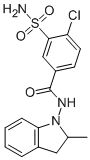
Indapamide (Natrilix, Noranat, Fludex, Tertensif) is a potent thiazide-like diuretic used in the treatment of hypertension, as well as decompensated cardiac failure.
Physicochemical Properties
| Molecular Formula | C16H16CLN3O3S |
| Molecular Weight | 365.8345 |
| Exact Mass | 365.06 |
| CAS # | 26807-65-8 |
| Related CAS # | (rac)-Indapamide-d3;1217052-38-4 |
| PubChem CID | 3702 |
| Appearance | White to off-white solid powder |
| Density | 1.5±0.1 g/cm3 |
| Melting Point | 160-162°C |
| Index of Refraction | 1.694 |
| LogP | 2.1 |
| Hydrogen Bond Donor Count | 2 |
| Hydrogen Bond Acceptor Count | 5 |
| Rotatable Bond Count | 3 |
| Heavy Atom Count | 24 |
| Complexity | 580 |
| Defined Atom Stereocenter Count | 0 |
| InChi Key | NDDAHWYSQHTHNT-UHFFFAOYSA-N |
| InChi Code | InChI=1S/C16H16ClN3O3S/c1-10-8-11-4-2-3-5-14(11)20(10)19-16(21)12-6-7-13(17)15(9-12)24(18,22)23/h2-7,9-10H,8H2,1H3,(H,19,21)(H2,18,22,23) |
| Chemical Name | 4-chloro-N-(2-methyl-2,3-dihydroindol-1-yl)-3-sulfamoylbenzamide |
| HS Tariff Code | 2934.99.9001 |
| Storage |
Powder-20°C 3 years 4°C 2 years In solvent -80°C 6 months -20°C 1 month |
| Shipping Condition | Room temperature (This product is stable at ambient temperature for a few days during ordinary shipping and time spent in Customs) |
Biological Activity
| ln Vitro | In the isolated perfused rat pancreas, indapamide (0.1-500 mg/L; 20 minutes) decreases the total insulin secretory response to glucose infusion [2]. Indapamide (1-100 μM) inhibits bone resorption and promotes osteoblast growth [3]. |
| ln Vivo | In spontaneously hypertensive rats (SHR), indapamide (1 mg/kg/d; gavage for 8 weeks) lowers blood pressure [4]. Rats that receive 10 mg/kg/d of indapamide had a decreased pressor response to oxytremorine, norepinephrine, and tyramine [1]. |
| Animal Protocol |
Animal/Disease Models: Male spontaneously hypertensive rats (11 weeks) [4] Doses: 1 mg/kg Route of Administration: Daily gavage for 8 weeks Experimental Results: Blood pressure diminished by 16.9 mm Hg. Increased dp/dtmax, ejection fraction (EF) and fractional shortening (FS). |
| References |
[1]. Indapamide. Drugs 28, 189–235 (1984). [2]. A further examination of the possible effects of indapamide on glucose tolerance and insulin secretion in the rat and mouse. J Pharm Pharmacol. 1981 Nov;33(11):735-7. [3]. Indapamide, a thiazide-like diuretic, decreases bone resorption in vitro. J Bone Miner Res. 2001 Feb;16(2):361-70. [4]. Indapamide lowers blood pressure by increasing production of epoxyeicosatrienoic acids in the kidney. Mol Pharmacol. 2013 Aug;84(2):286-95. |
| Additional Infomation |
Pharmacodynamics Classified as a sulfonamide diuretic, indapamide is an effective antihypertensive agent and by extension, has shown efficacy in the prevention of target organ damage. Administration of indapamide produces water and electrolyte loss, with higher doses associated with increased diuresis. Severe and clinically significant electrolyte disturbances may occur with indapamide use - for example, hypokalemia resulting from renal potassium loss may lead to QTc prolongation. Further electrolyte imbalances may occur due to renal excretion of sodium, chloride, and magnesium. Other indapamide induced changes include increases in plasma renin and aldosterone, and reduced calcium excretion in the urine. In many studies investigating the effects of indapamide in both non-diabetic and diabetic hypertensive patients, glucose tolerance was not significantly altered. However, additional studies are necessary to assess the long term metabolic impacts of indapamide, since thiazide related impaired glucose tolerance can take several years to develop in non-diabetic patients. |
Solubility Data
| Solubility (In Vitro) |
DMSO : ≥ 100 mg/mL (~273.35 mM) H2O : ~0.67 mg/mL (~1.83 mM) |
| Solubility (In Vivo) |
Solubility in Formulation 1: ≥ 2.5 mg/mL (6.83 mM) (saturation unknown) in 10% DMSO + 40% PEG300 + 5% Tween80 + 45% Saline (add these co-solvents sequentially from left to right, and one by one), clear solution. For example, if 1 mL of working solution is to be prepared, you can add 100 μL of 25.0 mg/mL clear DMSO stock solution to 400 μL PEG300 and mix evenly; then add 50 μL Tween-80 to the above solution and mix evenly; then add 450 μL normal saline to adjust the volume to 1 mL. Preparation of saline: Dissolve 0.9 g of sodium chloride in 100 mL ddH₂ O to obtain a clear solution. Solubility in Formulation 2: ≥ 2.5 mg/mL (6.83 mM) (saturation unknown) in 10% DMSO + 90% (20% SBE-β-CD in Saline) (add these co-solvents sequentially from left to right, and one by one), clear solution. For example, if 1 mL of working solution is to be prepared, you can add 100 μL of 25.0 mg/mL clear DMSO stock solution to 900 μL of 20% SBE-β-CD physiological saline solution and mix evenly. Preparation of 20% SBE-β-CD in Saline (4°C,1 week): Dissolve 2 g SBE-β-CD in 10 mL saline to obtain a clear solution. Solubility in Formulation 3: ≥ 2.5 mg/mL (6.83 mM) (saturation unknown) in 10% DMSO + 90% Corn Oil (add these co-solvents sequentially from left to right, and one by one), clear solution. For example, if 1 mL of working solution is to be prepared, you can add 100 μL of 25.0 mg/mL clear DMSO stock solution to 900 μL of corn oil and mix evenly. (Please use freshly prepared in vivo formulations for optimal results.) |
| Preparing Stock Solutions | 1 mg | 5 mg | 10 mg | |
| 1 mM | 2.7335 mL | 13.6676 mL | 27.3351 mL | |
| 5 mM | 0.5467 mL | 2.7335 mL | 5.4670 mL | |
| 10 mM | 0.2734 mL | 1.3668 mL | 2.7335 mL |