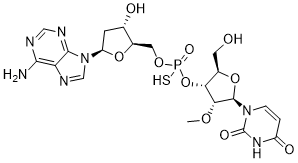
Inarigivir (formerly also known as ORI-9020; SB-9000) is a novel and potent dinucleotide which can significantly reduce liver HBV DNA in transgenic mice expressing hepatitis B virus. It was evaluated in transgenic mice expressing hepatitis B virus (HBV), significantly reduced liver HBV DNA (P
Physicochemical Properties
| Molecular Formula | C20H26N7O10PS |
| Molecular Weight | 587.500103473663 |
| Exact Mass | 587.119 |
| CAS # | 475650-36-3 |
| Related CAS # | Inarigivir ammonium;2172788-92-8 |
| PubChem CID | 6912016 |
| Appearance | White to off-white solid powder |
| LogP | -1.8 |
| Hydrogen Bond Donor Count | 5 |
| Hydrogen Bond Acceptor Count | 15 |
| Rotatable Bond Count | 9 |
| Heavy Atom Count | 39 |
| Complexity | 1010 |
| Defined Atom Stereocenter Count | 7 |
| SMILES | S=P(O)(OCC1C(CC(N2C=NC3C(N)=NC=NC2=3)O1)O)OC1C(CO)OC(C1OC)N1C=CC(NC1=O)=O |
| InChi Key | LYMICVBGNUEHGE-FUQPUAIBSA-N |
| InChi Code | InChI=1S/C20H26N7O10PS/c1-33-16-15(10(5-28)36-19(16)26-3-2-12(30)25-20(26)31)37-38(32,39)34-6-11-9(29)4-13(35-11)27-8-24-14-17(21)22-7-23-18(14)27/h2-3,7-11,13,15-16,19,28-29H,4-6H2,1H3,(H,32,39)(H2,21,22,23)(H,25,30,31)/t9-,10+,11+,13+,15+,16+,19+,38?/m0/s1 |
| Chemical Name | O-(((2R,3S,5R)-5-(6-amino-9H-purin-9-yl)-3-hydroxytetrahydrofuran-2-yl)methyl) O-((2R,3R,4R,5R)-5-(2,4-dioxo-3,4-dihydropyrimidin-1(2H)-yl)-2-(hydroxymethyl)-4-methoxytetrahydrofuran-3-yl) S-hydrogen phosphorothioate |
| Synonyms | Inarigivir soproxil; ORI-9020; ORI 9020; ORI9020; SB-40; SB-9000; SB9000, SB-9000. |
| HS Tariff Code | 2934.99.9001 |
| Storage |
Powder-20°C 3 years 4°C 2 years In solvent -80°C 6 months -20°C 1 month |
| Shipping Condition | Room temperature (This product is stable at ambient temperature for a few days during ordinary shipping and time spent in Customs) |
Biological Activity
| Targets |
ORI-9020 is a novel phosphorothioate dinucleotide. Its proposed mode of antiviral action is direct interference with hepatitis B virus (HBV) replication at the level of the HBV reverse transcriptase and/or DNA polymerase, at an early step (at or prior to the production of the first strand of HBV DNA). (No specific IC50, Ki, or EC50 values for enzyme inhibition are provided in this article.) [1] |
| ln Vitro |
The nucleos(t)ide analogs authorized for the treatment of chronic hepatitis B are all susceptible to resistance markers when it comes to HBV variations that are active against inarigivir (SB 9200) [2]. Inarigivir showed antiviral activity against a panel of nucleos(t)ide analogue-resistant HBV variants (rtL180M/rtM204V, rtM204I, rtA181V/rtN236T, and rtL180M/rtT184G/rtS202I/rtM204V) in transiently transfected Huh7 cells. Dose-dependent inhibition of HBV DNA replicative intermediate single strand (SS) was observed, with inhibition exceeding 20% compared to untreated controls. [2] Inarigivir also exhibited antiviral activity against HBV core protein assembly modifier (CpAM)-resistant variants (cT33I, cY109A, cT118F, cV124A, cY132A) and the precore stop codon variant G1896A in Huh7 cells. All tested variants remained sensitive to Inarigivir treatment. [2] |
| ln Vivo |
Inarigivir (100 mg/kg/day, i.p.) shown anti-HBV efficacy and markedly decreased the amount of viral DNA in the liver. Treatment has no effect on the level of serum HBV DNA. Serum HBeAg levels, mean HBsAg titers, and liver HBV RNA levels were all unaffected by inarigivir. Based on liver HBV DNA levels, the lowest effective dose is 1.6 to 0.5 mg/kg/day [1]. In a transgenic mouse model expressing HBV, intraperitoneal (i.p.) administration of ORI-9020 at 100 mg/kg/day for 14 days significantly reduced viral DNA in the liver (P ≤ 0.001) compared to vehicle controls. This anti-HBV activity was similar to that of the positive control, adefovir dipivoxil (10 mg/kg/day). [1] Treatment with ORI-9020 did not significantly reduce serum HBV DNA levels, liver HBV RNA levels, serum HBeAg, serum HBsAg, or liver HBeAg levels. [1] The minimal effective dosage of ORI-9020 administered i.p. was determined to be between 1.6 and 0.5 mg/kg/day, based on the reduction of HBV DNA in the liver. This activity range was similar to the previously determined minimal effective oral dose of adefovir dipivoxil (1.0 - 0.3 mg/kg/day) in the same model. [1] |
| Cell Assay |
Huh7 cells were transiently transfected with replication-competent HBV clones carrying resistance mutations to nucleos(t)ide analogues or core protein substitutions. Cells were treated with Inarigivir at concentrations of 50, 25, and 2.0 µM for 5 days. After treatment, cells were harvested, core preparations were made, DNA was extracted, and Southern blot analysis was performed to detect HBV DNA replicative intermediates. Antiviral activity was scored as sensitive if a dose-response was observed and inhibition exceeded 20% compared to untreated controls. [2] |
| Animal Protocol |
Animal/Disease Models: Mice[1] Doses: 100 mg/kg. Management: IP, daily. Experimental Results: Viral DNA was Dramatically diminished in the liver and demonstrated anti-HBV activity similar to the ADV positive control. Experiment 1 (Efficacy): Male transgenic HBV mice were block-randomized based on serum HBeAg titers. ORI-9020 was prepared fresh daily at a dose of 100 mg/kg/day and administered by intraperitoneal (i.p.) injection once daily for 14 days. The drug was formulated in either a cremaphor-ethanol-saline (CES) vehicle (10:10:80) or physiological saline. Adefovir dipivoxil (10 mg/kg/day in CES) and vehicle-only groups served as controls. Necropsy was performed at least 2 hours after the last dose to collect liver and serum samples. [1] Experiment 2 (Minimal Effective Dose): Female transgenic HBV mice received i.p. injections of ORI-9020 prepared in sterile saline at one-half-log serial dilutions ranging from 50 to 0.05 mg/kg/day. The injection volume was 0.1 ml. Animals were treated once daily, and necropsy was performed as in Experiment 1. Liver HBV DNA levels were used to determine the minimal effective dose. [1] |
| Toxicity/Toxicokinetics |
In the transgenic mouse studies, weight gain and survival rates were monitored. [1] |
| References |
[1]. Anti-hepatitis B virus activity of ORI-9020, a novel phosphorothioate dinucleotide, in a transgenic mouse model. Antimicrob Agents Chemother. 2004 Jun;48(6):2318-20. [2]. The Novel Antiviral Agent Inarigivir Inhibits Both Nucleos(t)ide Analogue and Capsid Assembly Inhibitor Resistant HBV in vitro. |
| Additional Infomation |
Inarigivir is under investigation in clinical trial NCT03434353 (Study to Evaluate the Antiviral Activity of Inarigivir (GS-9992) Plus Tenofovir Alafenamide (TAF) for 12 Weeks in Adults With Chronic Hepatitis B (CHB)). ORI-9020 is described as a novel phosphorothioate dinucleotide. [1] In Southern blot analysis, ORI-9020 treatment appeared to indiscriminately diminish all HBV DNA species in the liver, unlike adefovir dipivoxil which typically left low-molecular-weight viral DNA bands. This suggests a potentially different mechanism of action for reducing viral DNA in the liver. [1] The study concludes that the anti-HBV activity of intraperitoneally administered ORI-9020 in this transgenic mouse model is similar to the oral activity of adefovir dipivoxil. [1] |
Solubility Data
| Solubility (In Vitro) | DMSO : ~200 mg/mL (~340.43 mM) |
| Solubility (In Vivo) |
Solubility in Formulation 1: ≥ 2.5 mg/mL (4.26 mM) (saturation unknown) in 5% DMSO + 40% PEG300 + 5% Tween80 + 50% Saline (add these co-solvents sequentially from left to right, and one by one), clear solution. Preparation of saline: Dissolve 0.9 g of sodium chloride in 100 mL ddH₂ O to obtain a clear solution. Solubility in Formulation 2: ≥ 2.5 mg/mL (4.26 mM) (saturation unknown) in 5% DMSO + 95% (20% SBE-β-CD in Saline) (add these co-solvents sequentially from left to right, and one by one), clear solution. Preparation of 20% SBE-β-CD in Saline (4°C,1 week): Dissolve 2 g SBE-β-CD in 10 mL saline to obtain a clear solution. Solubility in Formulation 3: ≥ 0.25 mg/mL (0.43 mM) (saturation unknown) in 1% DMSO 99% Saline (add these co-solvents sequentially from left to right, and one by one), clear solution. Preparation of saline: Dissolve 0.9 g of sodium chloride in 100 mL ddH₂ O to obtain a clear solution. (Please use freshly prepared in vivo formulations for optimal results.) |
| Preparing Stock Solutions | 1 mg | 5 mg | 10 mg | |
| 1 mM | 1.7021 mL | 8.5106 mL | 17.0213 mL | |
| 5 mM | 0.3404 mL | 1.7021 mL | 3.4043 mL | |
| 10 mM | 0.1702 mL | 0.8511 mL | 1.7021 mL |