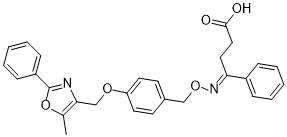
Description: Imiglitazar (also known as TAK559; proposed tradename Pargluva) is a novel, potent and dual human peroxisome proliferator-activated receptor PPARα and PPARγ1 agonist with EC50 values of 67 and 31 nM and with hypoglycemic activity. Muraglitazar had completed phase III clinical trials, however in May, 2006 Bristol-Myers Squibb announced that it had discontinued further development.. Data on muraglitazar isrelatively sparse due to the recent introduction of this agent.
Physicochemical Properties
| Molecular Formula | C28H26N2O5 |
| Molecular Weight | 470.516447544098 |
| Exact Mass | 470.184 |
| CAS # | 250601-04-8 |
| PubChem CID | 9890879 |
| Appearance | Typically exists as solid at room temperature |
| LogP | 6.014 |
| Hydrogen Bond Donor Count | 1 |
| Hydrogen Bond Acceptor Count | 7 |
| Rotatable Bond Count | 11 |
| Heavy Atom Count | 35 |
| Complexity | 666 |
| Defined Atom Stereocenter Count | 0 |
| SMILES | CC(OC(C1=CC=CC=C1)=N2)=C2COC(C=C3)=CC=C3CO/N=C(CCC(O)=O)/C4=CC=CC=C4 |
| InChi Key | ULVDFHLHKNJICZ-QCWLDUFUSA-N |
| InChi Code | InChI=1S/C28H26N2O5/c1-20-26(29-28(35-20)23-10-6-3-7-11-23)19-33-24-14-12-21(13-15-24)18-34-30-25(16-17-27(31)32)22-8-4-2-5-9-22/h2-15H,16-19H2,1H3,(H,31,32)/b30-25+ |
| Chemical Name | Benzenebutanoic acid, gamma-(((4-((5-methyl-2-phenyl-4-oxazolyl)methoxy)phenyl)methoxy)imino)-, (gammaE)- |
| Synonyms | TAK 559; TAK-559; TAK559. |
| HS Tariff Code | 2934.99.9001 |
| Storage |
Powder-20°C 3 years 4°C 2 years In solvent -80°C 6 months -20°C 1 month |
| Shipping Condition | Room temperature (This product is stable at ambient temperature for a few days during ordinary shipping and time spent in Customs) |
Biological Activity
| ln Vitro | Approximately 68% of the maximal activation of rosiglitazone, a recognized PPARγ agonist, is exhibited by TAK-559, a partial agonist of hPPARg1. When TAK-559 is present at high doses (10 μM), PPARγ is markedly activated. TAK-559 directly binds to each hPPAR isoform, transactivating all of the isoforms, as shown by competition binding experiments with radiolabeled ligands. Additionally, TAK-559 dissociates the corepressor NCoR from hPPARγ1 and hPPARα and recruits the coactivator SRC-1 to hPPARγ1 and hPPARα [1]. In the presence of 10 μM TAK-559, TNFα or IL-1β-induced THP-1 cell adhesion to cultivated endothelium cells was dramatically inhibited. When 10 μM TAK-559 was present, endothelial cells secreted 36% less monocyte chemoattractant protein-1 (MCP-1), which was followed by a decrease in intracellular mRNA expression. TAK-559 dramatically inhibits the migration and proliferation of cultured smooth muscle cells [2]. |
| ln Vivo | High-density lipoprotein (HDL) cholesterol levels significantly increased after receiving TAK-559 treatment; this rise was accompanied by a decrease in tiny dense HDL particles and an increase in large HDL particles. Apolipoprotein AI levels rose and plasma triglyceride and apolipoprotein B-100 levels fell during TAK-559 treatment. The highest dose of 3.0 mg/kg per day was shown to significantly address insulin resistance and hyperinsulinemia in these prediabetic monkeys. Moreover, during the study period, no negative effects were noted on typical liver function measures [3]. |
| References |
[1]. A novel oxyiminoalkanoic acid derivative, TAK-559, activates human peroxisome proliferator-activated receptor subtypes. Eur J Pharmacol. 2004 Jul 8;495(1):17-26. [2]. A potent activator of PPARalpha and gamma reduces the vascular cell recruitment and inhibits the intimal thickning in hypercholesterolemic rabbits. Atherosclerosis. 2005 Jan;178(1):1-7. [3]. A novel peroxisome proliferator--activated receptor alpha/gamma dual agonist ameliorates dyslipidemia and insulin resistance in prediabetic rhesus monkeys. Metabolism. 2007 Oct;56(10):1334-9. |
| Additional Infomation |
Imiglitazar has been used in trials studying the treatment of Diabetes Mellitus. Imiglitazar is a dual peroxisome proliferator-activated receptor (PPAR) alpha and gamma agonist, with hypoglycemic activity. Imiglitazar causes hepatotoxicity, and has never been marketed. |
Solubility Data
| Solubility (In Vitro) | May dissolve in DMSO (in most cases), if not, try other solvents such as H2O, Ethanol, or DMF with a minute amount of products to avoid loss of samples |
| Solubility (In Vivo) |
Note: Listed below are some common formulations that may be used to formulate products with low water solubility (e.g. < 1 mg/mL), you may test these formulations using a minute amount of products to avoid loss of samples. Injection Formulations (e.g. IP/IV/IM/SC) Injection Formulation 1: DMSO : Tween 80: Saline = 10 : 5 : 85 (i.e. 100 μL DMSO stock solution → 50 μL Tween 80 → 850 μL Saline) *Preparation of saline: Dissolve 0.9 g of sodium chloride in 100 mL ddH ₂ O to obtain a clear solution. Injection Formulation 2: DMSO : PEG300 :Tween 80 : Saline = 10 : 40 : 5 : 45 (i.e. 100 μL DMSO → 400 μLPEG300 → 50 μL Tween 80 → 450 μL Saline) Injection Formulation 3: DMSO : Corn oil = 10 : 90 (i.e. 100 μL DMSO → 900 μL Corn oil) Example: Take the Injection Formulation 3 (DMSO : Corn oil = 10 : 90) as an example, if 1 mL of 2.5 mg/mL working solution is to be prepared, you can take 100 μL 25 mg/mL DMSO stock solution and add to 900 μL corn oil, mix well to obtain a clear or suspension solution (2.5 mg/mL, ready for use in animals). Injection Formulation 4: DMSO : 20% SBE-β-CD in saline = 10 : 90 [i.e. 100 μL DMSO → 900 μL (20% SBE-β-CD in saline)] *Preparation of 20% SBE-β-CD in Saline (4°C,1 week): Dissolve 2 g SBE-β-CD in 10 mL saline to obtain a clear solution. Injection Formulation 5: 2-Hydroxypropyl-β-cyclodextrin : Saline = 50 : 50 (i.e. 500 μL 2-Hydroxypropyl-β-cyclodextrin → 500 μL Saline) Injection Formulation 6: DMSO : PEG300 : castor oil : Saline = 5 : 10 : 20 : 65 (i.e. 50 μL DMSO → 100 μLPEG300 → 200 μL castor oil → 650 μL Saline) Injection Formulation 7: Ethanol : Cremophor : Saline = 10: 10 : 80 (i.e. 100 μL Ethanol → 100 μL Cremophor → 800 μL Saline) Injection Formulation 8: Dissolve in Cremophor/Ethanol (50 : 50), then diluted by Saline Injection Formulation 9: EtOH : Corn oil = 10 : 90 (i.e. 100 μL EtOH → 900 μL Corn oil) Injection Formulation 10: EtOH : PEG300:Tween 80 : Saline = 10 : 40 : 5 : 45 (i.e. 100 μL EtOH → 400 μLPEG300 → 50 μL Tween 80 → 450 μL Saline) Oral Formulations Oral Formulation 1: Suspend in 0.5% CMC Na (carboxymethylcellulose sodium) Oral Formulation 2: Suspend in 0.5% Carboxymethyl cellulose Example: Take the Oral Formulation 1 (Suspend in 0.5% CMC Na) as an example, if 100 mL of 2.5 mg/mL working solution is to be prepared, you can first prepare 0.5% CMC Na solution by measuring 0.5 g CMC Na and dissolve it in 100 mL ddH2O to obtain a clear solution; then add 250 mg of the product to 100 mL 0.5% CMC Na solution, to make the suspension solution (2.5 mg/mL, ready for use in animals). Oral Formulation 3: Dissolved in PEG400 Oral Formulation 4: Suspend in 0.2% Carboxymethyl cellulose Oral Formulation 5: Dissolve in 0.25% Tween 80 and 0.5% Carboxymethyl cellulose Oral Formulation 6: Mixing with food powders Note: Please be aware that the above formulations are for reference only. InvivoChem strongly recommends customers to read literature methods/protocols carefully before determining which formulation you should use for in vivo studies, as different compounds have different solubility properties and have to be formulated differently. (Please use freshly prepared in vivo formulations for optimal results.) |
| Preparing Stock Solutions | 1 mg | 5 mg | 10 mg | |
| 1 mM | 2.1253 mL | 10.6265 mL | 21.2531 mL | |
| 5 mM | 0.4251 mL | 2.1253 mL | 4.2506 mL | |
| 10 mM | 0.2125 mL | 1.0627 mL | 2.1253 mL |