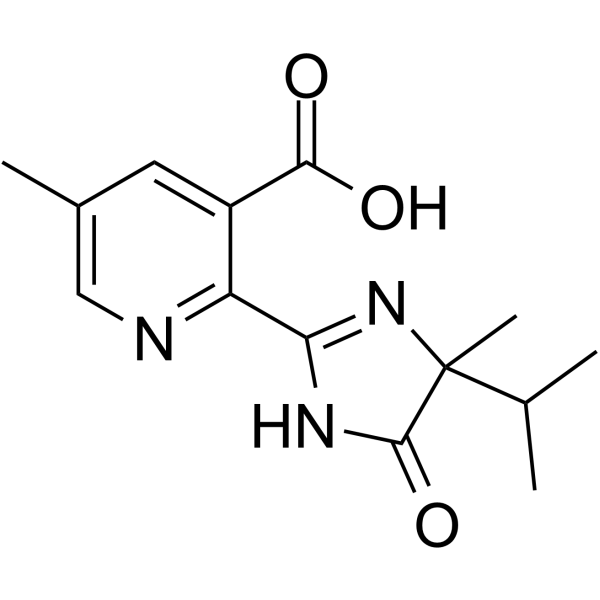
Physicochemical Properties
| Molecular Formula | C14H20N4O3 |
| Molecular Weight | 292.33 |
| Exact Mass | 275.126 |
| CAS # | 104098-48-8 |
| PubChem CID | 91770 |
| Appearance | White to off-white solid powder |
| Density | 1.3±0.1 g/cm3 |
| Boiling Point | 434.2ºC at 760 mmHg |
| Melting Point | 208 °C |
| Flash Point | 216.4ºC |
| Vapour Pressure | 5.72E-10mmHg at 25°C |
| Index of Refraction | 1.621 |
| LogP | 0.97 |
| Hydrogen Bond Donor Count | 2 |
| Hydrogen Bond Acceptor Count | 5 |
| Rotatable Bond Count | 3 |
| Heavy Atom Count | 20 |
| Complexity | 461 |
| Defined Atom Stereocenter Count | 0 |
| InChi Key | PVSGXWMWNRGTKE-UHFFFAOYSA-N |
| InChi Code | InChI=1S/C14H17N3O3/c1-7(2)14(4)13(20)16-11(17-14)10-9(12(18)19)5-8(3)6-15-10/h5-7H,1-4H3,(H,18,19)(H,16,17,20) |
| Chemical Name | 5-methyl-2-(4-methyl-5-oxo-4-propan-2-yl-1H-imidazol-2-yl)pyridine-3-carboxylic acid |
| HS Tariff Code | 2934.99.9001 |
| Storage |
Powder-20°C 3 years 4°C 2 years In solvent -80°C 6 months -20°C 1 month |
| Shipping Condition | Room temperature (This product is stable at ambient temperature for a few days during ordinary shipping and time spent in Customs) |
Biological Activity
| ADME/Pharmacokinetics |
Absorption, Distribution and Excretion Imazapic does not bioaccumulate in animals; if ingested, then rapidly excreted through urine and feces. 5 Crl:CD BR rats/sex/group received a single dose of (14)C- Imazapic (CL 263,222) by oral gavage or intravenous injection at 10 or 1000 mg/kg. One group received 14 consecutive non-radiolabelled daily oral doses followed by one (14)C labelled oral dose (10 mg/kg). After dosing with radiolabel, animals were housed in individual metabolism cages and sacrificed 7 days later. Feces, urine, cage wash/rinse, cage wipes (methanol extracted), blood, fat, heart, spleen, ovaries, uterus, bone (femur), brain, kidney, liver, lungs, muscle (thigh), testes, and the residual carcass were analyzed for radioactivity by liquid scintillation counting (LSC). Metabolite profiles in urine, dissolved urine precipitate, and feces extract (ethyl ether) were determined using thin-layer chromatography (TLC) and high-performance liquid chromatography (HPLC). The major elimination route for dosed radioactivity was in urine. The mean percent of total dose (including cage wash and cage wipe) ranged from 94.0% to 102% (males) and 94.5% to 102% (females). The mean percent of total dose excreted in feces ranged from 0.79% to 3.44% (males) and 0.59% to 3.50% (females). The majority of radioactivity was excreted during 6 hours post-dosing. Mean radioactivity concentrations in blood 7 days after a single dose at 10 mg/kg were not detectable. At 1000 mg/kg, concentrations were 0.127 ppm for males and <0.1 ppm for females. Mean radioactivity concentrations in tissues were generally not detectable (<0.01 ppm) at 10 and 1000 mg/kg. Residual radioactivity in the carcass ranged from <0.001 ppm to 0.043 ppm. The unchanged test article, (14)C- Imazapic, accounted for >/= 93.5% and >/= 65.9% of the total radioactivity in urine (94% to 102% of total administered dose) and feces (0.59% to 3.50% of total administered dose) respectively.... Metabolism / Metabolites 5 Crl:CD BR rats per sex per group received a single dose of (14)C- Imazapic (CL 263,222) by oral gavage or intravenous injection at 10 or 1000 mg/kg. One group received 14 consecutive non-radiolabelled daily oral doses followed by one (14)C labelled oral dose (10 mg/kg). After dosing with radiolabel, animals were housed in individual metabolism cages and sacrificed 7 days later.... Metabolites designated CL 303,459 and CL 263,284 ... and several minor radioactive components were also detected in small amounts (< 5% combined of the total radioactivity in the sample). In feces, metabolites CL 303,459 (4.29% (males) to 5.38% (females) of radioactivity in the sample), CL 263,284 (1.96% (males) and 0.85% (females)), and CL 290,610 (0.69% (males) and 0.70% (females)) were detected. The absolute amount of each of these corresponded to <0.2% of the administered dose. Several unknown metabolites accounted for less than 6% of total radioactivity in feces samples. The proposed metabolic pathway of (14)C- Imazapic ... was based on components identified in the excreta. Oxidation of the methyl group on the pyridine ring of (14)C- Imazapic produced metabolite CL 263,284. The presence of CL 303,459 suggested the initial step of ring closure, reduction to intermediate CL 280,442, followed by hydrolysis to CL 303,459 and further hydrolysis to CL 290,610. |
| Toxicity/Toxicokinetics |
Non-Human Toxicity Values LD50 Rabbit dermal >2000 mg/kg LD50 Rat oral >5000 mg/kg |
| Additional Infomation |
5-methyl-2-[4-methyl-5-oxo-4-(propan-2-yl)-4,5-dihydro-1H-imidazol-2-yl]pyridine-3-carboxylic acid is a pyridinemonocarboxylic acid that is 5-methylpyridine-3-carboxylic acid which is substituted at position 2 by a 4,5-dihydro-imidazol-2-yl group, which in turn is substituted at positions 4, 4, and 5 by isopropyl, methyl, and oxo groups, respectively. It is a pyridinemonocarboxylic acid, an imidazolone, a member of imidazolines and a member of methylpyridines. Imazapic is a chemical used as an herbicide. It controls many broad leaf weeds and controls or suppresses some grasses in pasture, rangeland and certain types of turf. It has a half-life of around 120 days in soil. Mechanism of Action Imazapyr (IMZR), Imazapic (IMZC), Imazethapyr (IMZT), Imazamox (IMZX) and Imazaquin (IMZQ) ... are classified as imidazolinone (IMI) herbicides and their mode of action is to inhibit acetohydroxyacid synthase (AHAS), an enzyme involved in the biosynthesis of the amino acids leucine, isoleucine and valine. ... |
Solubility Data
| Solubility (In Vitro) | DMSO : ≥ 100 mg/mL (~363.24 mM) |
| Solubility (In Vivo) |
Solubility in Formulation 1: ≥ 2.5 mg/mL (9.08 mM) (saturation unknown) in 10% DMSO + 40% PEG300 + 5% Tween80 + 45% Saline (add these co-solvents sequentially from left to right, and one by one), clear solution. For example, if 1 mL of working solution is to be prepared, you can add 100 μL of 25.0 mg/mL clear DMSO stock solution to 400 μL PEG300 and mix evenly; then add 50 μL Tween-80 to the above solution and mix evenly; then add 450 μL normal saline to adjust the volume to 1 mL. Preparation of saline: Dissolve 0.9 g of sodium chloride in 100 mL ddH₂ O to obtain a clear solution. Solubility in Formulation 2: ≥ 2.5 mg/mL (9.08 mM) (saturation unknown) in 10% DMSO + 90% (20% SBE-β-CD in Saline) (add these co-solvents sequentially from left to right, and one by one), clear solution. For example, if 1 mL of working solution is to be prepared, you can add 100 μL of 25.0 mg/mL clear DMSO stock solution to 900 μL of 20% SBE-β-CD physiological saline solution and mix evenly. Preparation of 20% SBE-β-CD in Saline (4°C,1 week): Dissolve 2 g SBE-β-CD in 10 mL saline to obtain a clear solution. Solubility in Formulation 3: ≥ 2.5 mg/mL (9.08 mM) (saturation unknown) in 10% DMSO + 90% Corn Oil (add these co-solvents sequentially from left to right, and one by one), clear solution. For example, if 1 mL of working solution is to be prepared, you can add 100 μL of 25.0 mg/mL clear DMSO stock solution to 900 μL of corn oil and mix evenly. (Please use freshly prepared in vivo formulations for optimal results.) |
| Preparing Stock Solutions | 1 mg | 5 mg | 10 mg | |
| 1 mM | 3.4208 mL | 17.1040 mL | 34.2079 mL | |
| 5 mM | 0.6842 mL | 3.4208 mL | 6.8416 mL | |
| 10 mM | 0.3421 mL | 1.7104 mL | 3.4208 mL |