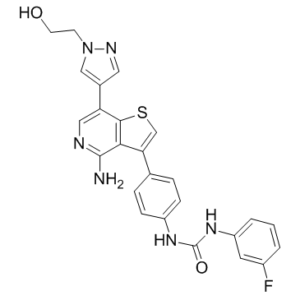
Ilorasertib (also known as ABT-348) is a potent, novel, orally bioavailable and ATP-competitive multi-kinase inhibitor with IC50s for inhibiting binding Aurora B (7 nM), C (1 nM), and A (120 nM), and also inhibits RET tyrosine kinase, PDGFRβ, and Flt1 with IC50s of 7 nM, 3 nM and 32 nM. ABT 348 was assessed and found to be efficacious in representative solid tumor (HT1080 and MiaPaCa, tumor stasis) and hematological malignancy (RS4;11, regression) xenografts due to its distinct spectrum of activity. The rationale behind evaluating ABT-348 clinically as a therapeutic agent for cancer treatment is provided by these findings.
Physicochemical Properties
| Molecular Formula | C25H21N6O2FS |
| Molecular Weight | 488.537 |
| Exact Mass | 488.143 |
| Elemental Analysis | C, 61.46; H, 4.33; F, 3.89; N, 17.20; O, 6.55; S, 6.56 |
| CAS # | 1227939-82-3 |
| Related CAS # | Ilorasertib hydrochloride;1847485-91-9 |
| PubChem CID | 46207586 |
| Appearance | Off-white to brown solid powder |
| Density | 1.5±0.1 g/cm3 |
| Boiling Point | 675.7±55.0 °C at 760 mmHg |
| Flash Point | 362.4±31.5 °C |
| Vapour Pressure | 0.0±2.2 mmHg at 25°C |
| Index of Refraction | 1.735 |
| LogP | 5.5 |
| Hydrogen Bond Donor Count | 4 |
| Hydrogen Bond Acceptor Count | 7 |
| Rotatable Bond Count | 6 |
| Heavy Atom Count | 35 |
| Complexity | 713 |
| Defined Atom Stereocenter Count | 0 |
| SMILES | O=C(NC1=CC=CC(F)=C1)NC2=CC=C(C3=CSC4=C3C(N)=NC=C4C5=CN(CCO)N=C5)C=C2 |
| InChi Key | WPHKIQPVPYJNAX-UHFFFAOYSA-N |
| InChi Code | InChI=1S/C25H21FN6O2S/c26-17-2-1-3-19(10-17)31-25(34)30-18-6-4-15(5-7-18)21-14-35-23-20(12-28-24(27)22(21)23)16-11-29-32(13-16)8-9-33/h1-7,10-14,33H,8-9H2,(H2,27,28)(H2,30,31,34) |
| Chemical Name | 1-[4-[4-amino-7-[1-(2-hydroxyethyl)pyrazol-4-yl]thieno[3,2-c]pyridin-3-yl]phenyl]-3-(3-fluorophenyl)urea |
| Synonyms | Abbott-968660; Ilorasertib; ABT348; ABT-348; ABT 348; Abbott 968660 |
| HS Tariff Code | 2934.99.9001 |
| Storage |
Powder-20°C 3 years 4°C 2 years In solvent -80°C 6 months -20°C 1 month |
| Shipping Condition | Room temperature (This product is stable at ambient temperature for a few days during ordinary shipping and time spent in Customs) |
Biological Activity
| Targets | Aurora C (IC50 = 1 nM); Aurora B (IC50 = 7 nM); Aurora B (Y156H) (IC50 = 12 nM); Aurora A (IC50 = 120 nM); PDGFRα (IC50 = 11 nM); PDGFRβ (IC50 = 13 nM); VEGFR1 (IC50 = 1 nM); VEGFR2 (IC50 = 2 nM); VEGFR3 (IC50 = 43 nM); FLT3 (IC50 = 1 nM); CSF-1R (IC50 = 3 nM); c-KIT (IC50 = 20 nM) |
| ln Vitro |
Ilorasertib (0, 3, 10, 30 nM; 24 h) causes an increase in H1299, H460 cell extent and number that is concentration-dependent[2]. Ilorasertib (1-1000 nM) demonstrates antiproliferative properties [2]. |
| ln Vivo |
Ilorasertib (6.25, 12.5, 25 mg/kg; p.o.) demonstrates anti-tumor activity in SCID mice bearing MV-4-11 tumors, with TGI values of 80%, 86%, and 94% at 6.25, 12.5, and 25 mg/kg, respectively[1]. Ilorasertib (6.25, 12.5, 25 mg/kg; p.o.) demonstrates antitumor activity in SCID mice bearing SKM-1 tumors, with TGI values of 38%, 59%, and 80% at 6.25, 12.5, and 25 mg/kg, respectively[1]. Ilorasertib (0, 3.75, 7.5, 15 mg/kg; i.p.) inhibits the phosphorylation of histone H3 in blood-borne tumor cells between 4 and 8 hours[2]. Ilorasertib (0.2 mg/kg; i.v.) exhibits anti-VEGF activity in mice[2]. Ilorasertib (20 mg/kg; p.o.;once weekly for 3 weeks) exhibits antitumor activity in mouse[2]. |
| Cell Assay |
Cell Line: H1299, H460 cells Concentration: 0, 3, 10, 30 nM Incubation Time: 24 h Result: Induced a concentration-dependent increase in the extent and number of cells exhibiting polyploidy with EC50S of 5, 10 nM for H1299, H460 cells, respectively. |
| Animal Protocol |
Female SCID/beige mice[2] 25 mg/kg Subcutaneous minipump; 24 h |
| References |
[1]. Abstract 858: Potent in vivo activity of the aurora kinase inhibitor ABT-348 in human acute myeloid leukemia and myelodysplastic syndrome xenograft models. Cancer Res (2012) 72 (8_Supplement): 858. [2]. Preclinical characterization of ABT-348, a kinase inhibitor targeting the aurora, vascular endothelial growth factor receptor/platelet-derived growth factor receptor, and Src kinase families. J Pharmacol Exp Ther. 2012 Dec;343(3):617-27. |
| Additional Infomation |
Ilorasertib has been used in trials studying the treatment of Myelodysplasia, Solid Neoplasm, Advanced Cancers, Advanced Solid Tumors, and Acute Myelogenous Leukemia, among others. Ilorasertib is an orally bioavailable, adenosine triphospate mimetic, and inhibitor of Aurora kinases, vascular endothelial growth factor receptors (VEGFRs) and platelet-derived growth factor receptor (PDGFRs), with potential antineoplastic activity. Upon administration, ilorasertib selectively binds to and inhibits Aurora kinases A, B and C, which may disrupt both the assembly of the mitotic spindle apparatus and chromosome segregation, and inhibit both cellular division and proliferation in Aurora kinase-overexpressing tumor cells. In addition, ilorasertib selectively binds to and inhibits VEGFRs and PDGFRs, which may result in the inhibition of both angiogenesis and tumor cell proliferation in VEGFR/PDGFR-overexpressing tumor cells. This agent also inhibits the Src family of cytoplasmic tyrosine kinases. Aurora kinases A, B and C, are serine/threonine kinases that play essential roles in mitotic checkpoint control and are overexpressed by a wide variety of tumor cell types. Both VEGFRs and PDGFRs are receptor tyrosine kinase families whose members may be upregulated in various tumor cell types. |
Solubility Data
| Solubility (In Vitro) | DMSO: ~41.7 mg/mL (~85.3 mM) |
| Solubility (In Vivo) |
Solubility in Formulation 1: ≥ 2.08 mg/mL (4.26 mM) (saturation unknown) in 10% DMSO + 40% PEG300 + 5% Tween80 + 45% Saline (add these co-solvents sequentially from left to right, and one by one), clear solution. For example, if 1 mL of working solution is to be prepared, you can add 100 μL of 20.8 mg/mL clear DMSO stock solution to 400 μL PEG300 and mix evenly; then add 50 μL Tween-80 to the above solution and mix evenly; then add 450 μL normal saline to adjust the volume to 1 mL. Preparation of saline: Dissolve 0.9 g of sodium chloride in 100 mL ddH₂ O to obtain a clear solution. Solubility in Formulation 2: 2.08 mg/mL (4.26 mM) in 10% DMSO + 90% (20% SBE-β-CD in Saline) (add these co-solvents sequentially from left to right, and one by one), suspension solution; with ultrasonication. For example, if 1 mL of working solution is to be prepared, you can add 100 μL of 20.8 mg/mL clear DMSO stock solution to 900 μL of 20% SBE-β-CD physiological saline solution and mix evenly. Preparation of 20% SBE-β-CD in Saline (4°C,1 week): Dissolve 2 g SBE-β-CD in 10 mL saline to obtain a clear solution. (Please use freshly prepared in vivo formulations for optimal results.) |
| Preparing Stock Solutions | 1 mg | 5 mg | 10 mg | |
| 1 mM | 2.0469 mL | 10.2346 mL | 20.4692 mL | |
| 5 mM | 0.4094 mL | 2.0469 mL | 4.0938 mL | |
| 10 mM | 0.2047 mL | 1.0235 mL | 2.0469 mL |