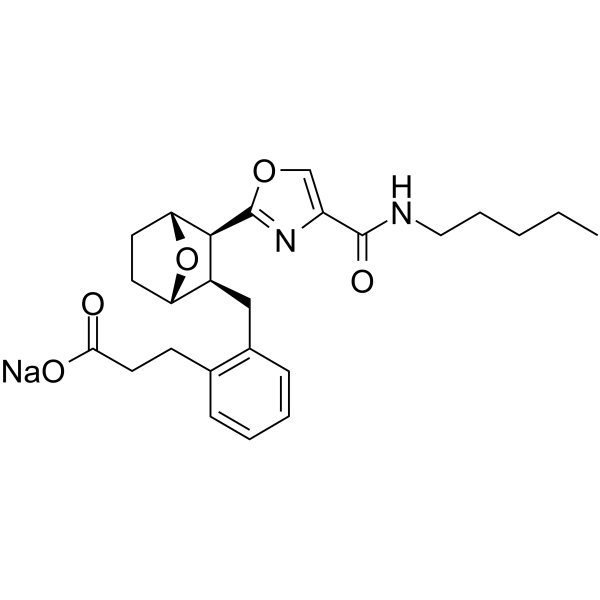
Physicochemical Properties
| Molecular Formula | C25H31N2O5- |
| Molecular Weight | 439.52404 |
| Exact Mass | 462.213 |
| CAS # | 156715-37-6 |
| Related CAS # | Ifetroban;143443-90-7 |
| PubChem CID | 23663994 |
| Appearance | White to off-white solid powder |
| LogP | 3.171 |
| Hydrogen Bond Donor Count | 1 |
| Hydrogen Bond Acceptor Count | 6 |
| Rotatable Bond Count | 11 |
| Heavy Atom Count | 33 |
| Complexity | 650 |
| Defined Atom Stereocenter Count | 4 |
| SMILES | CCCCCNC(=O)C1=COC(=N1)[C@@H]2[C@H]3CC[C@@H]([C@@H]2CC4=CC=CC=C4CCC(=O)[O-])O3.[Na+] |
| InChi Key | WOHSQDNIXPEQAE-QBKVZTCDSA-M |
| InChi Code | InChI=1S/C25H32N2O5.Na/c1-2-3-6-13-26-24(30)19-15-31-25(27-19)23-18(20-10-11-21(23)32-20)14-17-8-5-4-7-16(17)9-12-22(28)29;/h4-5,7-8,15,18,20-21,23H,2-3,6,9-14H2,1H3,(H,26,30)(H,28,29);/q;+1/p-1/t18-,20-,21+,23-;/m0./s1 |
| Chemical Name | sodium;3-[2-[[(1S,2R,3S,4R)-3-[4-(pentylcarbamoyl)-1,3-oxazol-2-yl]-7-oxabicyclo[2.2.1]heptan-2-yl]methyl]phenyl]propanoate |
| HS Tariff Code | 2934.99.9001 |
| Storage |
Powder-20°C 3 years 4°C 2 years In solvent -80°C 6 months -20°C 1 month Note: (1). This product requires protection from light (avoid light exposure) during transportation and storage.(2). Please store this product in a sealed and protected environment (e.g. under nitrogen), avoid exposure to moisture. |
| Shipping Condition | Room temperature (This product is stable at ambient temperature for a few days during ordinary shipping and time spent in Customs) |
Biological Activity
| ln Vitro | In 4T1 cells (mouse breast cancer), ifetrobanodium (CPI211) (100 nM; 48 h) inhibits Tpr and efficiently prevents the spontaneous metastasis of primary tumors without influencing tumor cell proliferation, motility, or tumor growth [2]. In human umbilical vein endothelial cells (HUVEC), ifetroban sodium (100 nM; 6 hours) significantly suppresses PKC substrate phosphorylation and prevents agonist (U46619)-induced decrease of TPr [2]. |
| ln Vivo | Although it hasn't been observed in mouse models, ifetroban sodium (50 mg/kg/d; oral; 2 days prior to to 28 days following tumor injection) decreases hematogenous metastasis in a variety of cancer types [2]. In 4T1 (mouse mammary carcinoma) mice, ifetroban sodium (50 mg/kg/d; oral; 12 days) decreases tumor vasculature but has no effect on primary tumor growth [2]. In monkeys, ifetroban sodium (BMS 180,291; 1 and 3 mg/kg, orally) antagonizes TP receptors and prevents aggregation. In anesthetized African green monkeys, intravenous ifetroban sodium (3 mg/kg) only has a slight and temporary hemodynamic effect [3]. |
| Cell Assay |
Western Blot analysis [2] Cell Types: Mouse pulmonary microvascular endothelial cells (MPMECs) and human umbilical vein endothelial cells (HUVECs) Tested Concentrations: 100 nM Incubation Duration: 6 hrs (hours) Experimental Results: Reduce Tpr protein levels and inhibit PKC substrate phosphorylation. Immunofluorescence[2] Cell Types: Mouse Pulmonary Microvascular Endothelial Cells (MPMEC) and Human Umbilical Vein Endothelial Cells (HUVEC) Tested Concentrations: 100 nM Incubation Duration: 6 hrs (hours) Experimental Results: Shows GFP+ 4T1 and MDA-MB-231 across mouse MPMEC Transendothelial migration and human HUVEC. |
| Animal Protocol |
Animal/Disease Models: Athymic (nu/nu) Balb/C female mice injected with tumor cells: 4T1 (mouse breast cancer), MDA-MB-231 (human breast cancer), MiaPaCa2 (human pancreatic cancer) and A549 (human lung cancer) ) ) Model [2] Doses: 50 mg/kg; administered via 25 μL of vehicle (4% sucrose in sterile water): po (oral gavage); pretreatment 2 days before, treatment after 28 days Experimental Results: MDA-MB-231 Lung The percentage of mice with metastasis diminished from 90% to 20%, and the percentage of mice with A549 lung metastasis diminished from 60% to 10%. |
| References |
[1]. Effect of ifetroban, a thromboxane A2 receptor antagonist, in stroke-prone spontaneously hypertensive rats. Clin Exp Hypertens. 1996 Feb;18(2):171-88. [2]. Repurposing of a Thromboxane Receptor Inhibitor Based on a Novel Role in Metastasis Identified by Phenome-Wide Association Study. Mol Cancer Ther. 2020 Dec;19(12):2454-2464. [3]. Antiplatelet activity of the long-acting thromboxane receptor antagonist BMS 180,291 in monkeys. Prostaglandins. 1992 Nov;44(5):389-97. [4]. Ifetroban sodium: an effective TxA2/PGH2 receptor antagonist. Cardiovasc Drug Rev. 2001 Summer;19(2):97-115. |
| Additional Infomation | Ifetroban Sodium is the sodium salt form of ifetroban, an orally bioavailable thromboxane (TxA2) and prostaglandin H2 (PGH2) (TP) receptor antagonist, with anti-thrombotic, anti-hypertensive, anti-asthmatic and potential anti-metastatic activities. Upon administration, ifetroban targets and binds to TxA2 and PGH2 receptors, thereby preventing the activity of both TxA2 and PGH2 and disrupting their downstream signaling pathways. This prevents platelet activation, aggregation and thrombosis. It also prevents vascular constriction and causes vasodilation. In addition, as cancer cells use platelets to metastasize to different parts of the body, ifetroban can reduce the stickiness of the platelets and prevent metastasis. TxA2 causes vascular contraction and platelet activation. |
Solubility Data
| Solubility (In Vitro) | DMSO : ~130 mg/mL (~281.08 mM) |
| Solubility (In Vivo) |
Note: Listed below are some common formulations that may be used to formulate products with low water solubility (e.g. < 1 mg/mL), you may test these formulations using a minute amount of products to avoid loss of samples. Injection Formulations (e.g. IP/IV/IM/SC) Injection Formulation 1: DMSO : Tween 80: Saline = 10 : 5 : 85 (i.e. 100 μL DMSO stock solution → 50 μL Tween 80 → 850 μL Saline) *Preparation of saline: Dissolve 0.9 g of sodium chloride in 100 mL ddH ₂ O to obtain a clear solution. Injection Formulation 2: DMSO : PEG300 :Tween 80 : Saline = 10 : 40 : 5 : 45 (i.e. 100 μL DMSO → 400 μLPEG300 → 50 μL Tween 80 → 450 μL Saline) Injection Formulation 3: DMSO : Corn oil = 10 : 90 (i.e. 100 μL DMSO → 900 μL Corn oil) Example: Take the Injection Formulation 3 (DMSO : Corn oil = 10 : 90) as an example, if 1 mL of 2.5 mg/mL working solution is to be prepared, you can take 100 μL 25 mg/mL DMSO stock solution and add to 900 μL corn oil, mix well to obtain a clear or suspension solution (2.5 mg/mL, ready for use in animals). Injection Formulation 4: DMSO : 20% SBE-β-CD in saline = 10 : 90 [i.e. 100 μL DMSO → 900 μL (20% SBE-β-CD in saline)] *Preparation of 20% SBE-β-CD in Saline (4°C,1 week): Dissolve 2 g SBE-β-CD in 10 mL saline to obtain a clear solution. Injection Formulation 5: 2-Hydroxypropyl-β-cyclodextrin : Saline = 50 : 50 (i.e. 500 μL 2-Hydroxypropyl-β-cyclodextrin → 500 μL Saline) Injection Formulation 6: DMSO : PEG300 : castor oil : Saline = 5 : 10 : 20 : 65 (i.e. 50 μL DMSO → 100 μLPEG300 → 200 μL castor oil → 650 μL Saline) Injection Formulation 7: Ethanol : Cremophor : Saline = 10: 10 : 80 (i.e. 100 μL Ethanol → 100 μL Cremophor → 800 μL Saline) Injection Formulation 8: Dissolve in Cremophor/Ethanol (50 : 50), then diluted by Saline Injection Formulation 9: EtOH : Corn oil = 10 : 90 (i.e. 100 μL EtOH → 900 μL Corn oil) Injection Formulation 10: EtOH : PEG300:Tween 80 : Saline = 10 : 40 : 5 : 45 (i.e. 100 μL EtOH → 400 μLPEG300 → 50 μL Tween 80 → 450 μL Saline) Oral Formulations Oral Formulation 1: Suspend in 0.5% CMC Na (carboxymethylcellulose sodium) Oral Formulation 2: Suspend in 0.5% Carboxymethyl cellulose Example: Take the Oral Formulation 1 (Suspend in 0.5% CMC Na) as an example, if 100 mL of 2.5 mg/mL working solution is to be prepared, you can first prepare 0.5% CMC Na solution by measuring 0.5 g CMC Na and dissolve it in 100 mL ddH2O to obtain a clear solution; then add 250 mg of the product to 100 mL 0.5% CMC Na solution, to make the suspension solution (2.5 mg/mL, ready for use in animals). Oral Formulation 3: Dissolved in PEG400 Oral Formulation 4: Suspend in 0.2% Carboxymethyl cellulose Oral Formulation 5: Dissolve in 0.25% Tween 80 and 0.5% Carboxymethyl cellulose Oral Formulation 6: Mixing with food powders Note: Please be aware that the above formulations are for reference only. InvivoChem strongly recommends customers to read literature methods/protocols carefully before determining which formulation you should use for in vivo studies, as different compounds have different solubility properties and have to be formulated differently. (Please use freshly prepared in vivo formulations for optimal results.) |
| Preparing Stock Solutions | 1 mg | 5 mg | 10 mg | |
| 1 mM | 2.2752 mL | 11.3760 mL | 22.7521 mL | |
| 5 mM | 0.4550 mL | 2.2752 mL | 4.5504 mL | |
| 10 mM | 0.2275 mL | 1.1376 mL | 2.2752 mL |