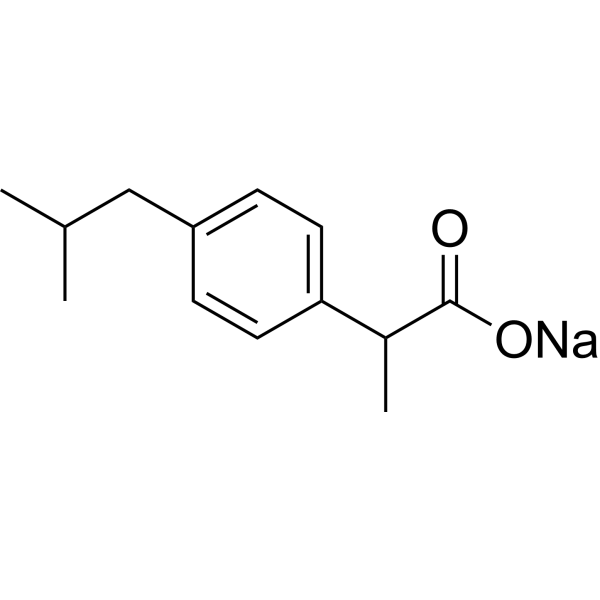
Physicochemical Properties
| Molecular Formula | C13H17O2-.NA+ |
| Molecular Weight | 228.26268 |
| Exact Mass | 228.113 |
| CAS # | 31121-93-4 |
| Related CAS # | Ibuprofen;15687-27-1;(S)-(+)-Ibuprofen;51146-56-6;(S)-(+)-Ibuprofen-d3;1329643-44-8;(R)-(-)-Ibuprofen;51146-57-7;Ibuprofen-d3 sodium;1219805-09-0;Ibuprofen-d3;121662-14-4 |
| PubChem CID | 5338317 |
| Appearance | White to off-white solid powder |
| Density | 1.029g/cm3 |
| Boiling Point | 319.6ºC at 760 mmHg |
| Melting Point | 75-77ºC |
| Flash Point | 216.7ºC |
| LogP | 1.738 |
| Hydrogen Bond Donor Count | 0 |
| Hydrogen Bond Acceptor Count | 2 |
| Rotatable Bond Count | 4 |
| Heavy Atom Count | 16 |
| Complexity | 208 |
| Defined Atom Stereocenter Count | 0 |
| InChi Key | PTTPUWGBPLLBKW-UHFFFAOYSA-M |
| InChi Code | InChI=1S/C13H18O2.Na/c1-9(2)8-11-4-6-12(7-5-11)10(3)13(14)15;/h4-7,9-10H,8H2,1-3H3,(H,14,15);/q;+1/p-1 |
| Chemical Name | sodium;2-[4-(2-methylpropyl)phenyl]propanoate |
| HS Tariff Code | 2934.99.9001 |
| Storage |
Powder-20°C 3 years 4°C 2 years In solvent -80°C 6 months -20°C 1 month Note: Please store this product in a sealed and protected environment, avoid exposure to moisture. |
| Shipping Condition | Room temperature (This product is stable at ambient temperature for a few days during ordinary shipping and time spent in Customs) |
Biological Activity
| ln Vitro | With IC50 values of 13 μM and 370 μM, respectively, ibuprofen sodium (24 h) suppresses the activities of COX-1 and COX-2[1]. In AGS cells (a gastric cancer cell line), 500 μM sodium ibuprofen for 48 hours causes apoptosis and suppresses angiogenesis [2]. In AGS cells, 500 μM sodium ibuprofen administered over 48 hours suppresses the transcription of Akt, VEGF-A, PCNA, Bcl2, OCT3/4, and CD44 genes while increasing the RNA levels of wild-type P53 and Bax genes [2]. In a cystic fibrosis (CF) cell model and primary CF nasal epithelial cells, sodium ibuprofen (500 μM, 24 h) restored microtubule remodeling, microtubule-dependent intracellular cholesterol transport, and stimulated microtubule migration. Peripheral cell extension [3]. Through a photosensitizing mechanism, sodium ibuprofen (500 μM, 24 hours) increases UV-induced cell death in MCF-7 and MDA-MB-231 cells [4]. |
| ln Vivo | In a postpartum breast cancer model, ibuprofen sodium (300 mg/kg in animal feed for 14 days) decreases overall tumor growth and improves anti-tumor immune properties without causing detrimental autoimmune responses [5]. In a rat model of oxaliplatin-induced chronic peripheral neuropathy, ibuprofen sodium (subcutaneous injection, 60 mg/kg, every other day for 15 days) lowers the risk of neuropathy [6]. Oral administration of ibuprofen sodium (20 mg/kg, every 12 hours for 5 doses) decreases muscle growth (mean muscle fiber cross-sectional area) while leaving the supraspinatus tendon unaffected in terms of its adaptation to exercise [7]. In a rat model of chronic lung infection, ibuprofen sodium (35 mg/kg, twice daily) decreases the inflammatory response to Pseudomonas aeruginosa [8]. |
| Cell Assay |
Cell viability assay [2] Cell Types: AGS Cell Tested Concentrations: 100-1000 μM Incubation Duration: 24 hrs (hours), 48 hrs (hours) Experimental Results: Inhibited AGS cell viability, IC50 value was 630 μM (Trypan blue staining, 24 hrs (hours)), 456 μM ( neutral) red assay, 24 hrs (hours)), 549 μM (trypan blue staining, 48 hrs (hours)), and 408 μM (neutral red assay, 48 hrs (hours)). |
| Animal Protocol |
Animal/Disease Models: PPBC syngeneic (D2A1) orthotopic Balb/c mouse model (postpartum) [5] Doses: 300 mg/kg, daily for 14 days Route of Administration: Feed with animal feed (add to crushed standard feed and Mix dry, then mix with water to form feed pellets and dry thoroughly) Experimental Results: inhibit tumor growth, reduce the presence of immature monocytes and increase the number of T cells. Enhances Th1-related cytokines and promotes tumor border accumulation of T cells. Animal/Disease Models: Oxaliplatin-induced peripheral neuropathy [6] Doses: 60 mg/kg, once every other day for 15 days Route of Administration: subcutaneous injection Experimental Results: diminished sensory nerve conduction velocity (SNCV). |
| References |
[1]. Development of a radiochemical cyclooxygenase-1 and -2 in vitro assay for identification of natural products as inhibitors of prostaglandin biosynthesis. J Nat Prod. 1998 Jan;61(1):2-7. [2]. Inhibitory effect of ibuprofen on tumor survival and angiogenesis in gastric cancer cell. Tumour Biol. 2015 May;36(5):3237-43. [3]. Ibuprofen regulation of microtubule dynamics in cystic fibrosis epithelial cells. Am J Physiol Lung Cell Mol Physiol. 2016 Aug 1;311(2):L317-27. [4]. Ibuprofen and ketoprofen potentiate UVA-induced cell death by a photosensitization process. Sci Rep. 2017 Aug 21;7(1):8885. [5]. Ibuprofen supports macrophage differentiation, T cell recruitment, and tumor suppression in a model of postpartum breast cancer. J Immunother Cancer. 2018 Oct 1;6(1):98. [6]. Protective effect of ibuprofen in a rat model of chronic oxaliplatin-induced peripheral neuropathy. Exp Brain Res. 2019 Oct;237(10):2645-2651. [7]. Ibuprofen Differentially Affects Supraspinatus Muscle and Tendon Adaptations to Exercise in a Rat Model. Am J Sports Med. 2016 Sep;44(9):2237-45. [8]. Ibuprofen attenuates the inflammatory response to Pseudomonas aeruginosa in a rat model of chronic pulmonary infection. Implications for antiinflammatory therapy in cystic fibrosis. Am Rev Respir Dis. 1990 Jan;141(1):186-92. |
| Additional Infomation |
Ibuprofen Sodium is the sodium salt form of ibuprofen, a propionic acid derivate and nonsteroidal anti-inflammatory drug (NSAID) with anti-inflammatory, analgesic, and antipyretic activities. Upon administration, ibuprofen inhibits the activity of cyclo-oxygenase I and II, resulting in a decreased formation of precursors of prostaglandins and thromboxanes. This leads to decreased prostaglandin synthesis, by prostaglandin synthase, the main physiologic effect of ibuprofen. Ibuprofen also causes a decrease in the formation of thromboxane A2 synthesis, by thromboxane synthase, thereby inhibiting platelet aggregation. See also: Ibuprofen (has active moiety). |
Solubility Data
| Solubility (In Vitro) |
H2O : ≥ 100 mg/mL (~438.10 mM) DMSO : ~20.83 mg/mL (~91.26 mM) |
| Solubility (In Vivo) |
Note: Listed below are some common formulations that may be used to formulate products with low water solubility (e.g. < 1 mg/mL), you may test these formulations using a minute amount of products to avoid loss of samples. Injection Formulations (e.g. IP/IV/IM/SC) Injection Formulation 1: DMSO : Tween 80: Saline = 10 : 5 : 85 (i.e. 100 μL DMSO stock solution → 50 μL Tween 80 → 850 μL Saline) *Preparation of saline: Dissolve 0.9 g of sodium chloride in 100 mL ddH ₂ O to obtain a clear solution. Injection Formulation 2: DMSO : PEG300 :Tween 80 : Saline = 10 : 40 : 5 : 45 (i.e. 100 μL DMSO → 400 μLPEG300 → 50 μL Tween 80 → 450 μL Saline) Injection Formulation 3: DMSO : Corn oil = 10 : 90 (i.e. 100 μL DMSO → 900 μL Corn oil) Example: Take the Injection Formulation 3 (DMSO : Corn oil = 10 : 90) as an example, if 1 mL of 2.5 mg/mL working solution is to be prepared, you can take 100 μL 25 mg/mL DMSO stock solution and add to 900 μL corn oil, mix well to obtain a clear or suspension solution (2.5 mg/mL, ready for use in animals). Injection Formulation 4: DMSO : 20% SBE-β-CD in saline = 10 : 90 [i.e. 100 μL DMSO → 900 μL (20% SBE-β-CD in saline)] *Preparation of 20% SBE-β-CD in Saline (4°C,1 week): Dissolve 2 g SBE-β-CD in 10 mL saline to obtain a clear solution. Injection Formulation 5: 2-Hydroxypropyl-β-cyclodextrin : Saline = 50 : 50 (i.e. 500 μL 2-Hydroxypropyl-β-cyclodextrin → 500 μL Saline) Injection Formulation 6: DMSO : PEG300 : castor oil : Saline = 5 : 10 : 20 : 65 (i.e. 50 μL DMSO → 100 μLPEG300 → 200 μL castor oil → 650 μL Saline) Injection Formulation 7: Ethanol : Cremophor : Saline = 10: 10 : 80 (i.e. 100 μL Ethanol → 100 μL Cremophor → 800 μL Saline) Injection Formulation 8: Dissolve in Cremophor/Ethanol (50 : 50), then diluted by Saline Injection Formulation 9: EtOH : Corn oil = 10 : 90 (i.e. 100 μL EtOH → 900 μL Corn oil) Injection Formulation 10: EtOH : PEG300:Tween 80 : Saline = 10 : 40 : 5 : 45 (i.e. 100 μL EtOH → 400 μLPEG300 → 50 μL Tween 80 → 450 μL Saline) Oral Formulations Oral Formulation 1: Suspend in 0.5% CMC Na (carboxymethylcellulose sodium) Oral Formulation 2: Suspend in 0.5% Carboxymethyl cellulose Example: Take the Oral Formulation 1 (Suspend in 0.5% CMC Na) as an example, if 100 mL of 2.5 mg/mL working solution is to be prepared, you can first prepare 0.5% CMC Na solution by measuring 0.5 g CMC Na and dissolve it in 100 mL ddH2O to obtain a clear solution; then add 250 mg of the product to 100 mL 0.5% CMC Na solution, to make the suspension solution (2.5 mg/mL, ready for use in animals). Oral Formulation 3: Dissolved in PEG400 Oral Formulation 4: Suspend in 0.2% Carboxymethyl cellulose Oral Formulation 5: Dissolve in 0.25% Tween 80 and 0.5% Carboxymethyl cellulose Oral Formulation 6: Mixing with food powders Note: Please be aware that the above formulations are for reference only. InvivoChem strongly recommends customers to read literature methods/protocols carefully before determining which formulation you should use for in vivo studies, as different compounds have different solubility properties and have to be formulated differently. (Please use freshly prepared in vivo formulations for optimal results.) |
| Preparing Stock Solutions | 1 mg | 5 mg | 10 mg | |
| 1 mM | 4.3810 mL | 21.9048 mL | 43.8097 mL | |
| 5 mM | 0.8762 mL | 4.3810 mL | 8.7619 mL | |
| 10 mM | 0.4381 mL | 2.1905 mL | 4.3810 mL |