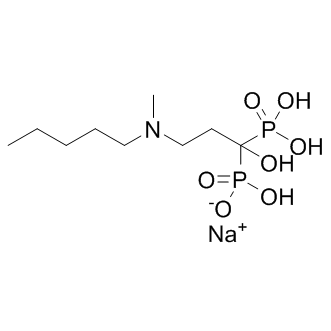
Ibandronate sodium (Bonviva Sodium), the sodium salt of ibandronate, is a potent inhibitor of FDPS (farnesyl diphosphate synthase) with an IC50 of 20 nM. It is a bisphosphonate drug used in the prevention and treatment of osteoporosis and metastasis-associated skeletal fractures in people with cancer. Ibandronate may also be used to treat hypercalcemia (elevated blood calcium levels). In May 2003, the U.S. Food and Drug Administration (FDA) approved Ibandronate as a daily treatment for post-menopausal osteoporosis.
Physicochemical Properties
| Molecular Formula | C9H22NNAO7P2 |
| Molecular Weight | 341.2108 |
| Exact Mass | 341.076 |
| CAS # | 138844-81-2 |
| Related CAS # | Ibandronate Sodium Monohydrate;138926-19-9;Ibandronic acid;114084-78-5 |
| PubChem CID | 23670359 |
| Appearance | Typically exists as solid at room temperature |
| Boiling Point | 587.8ºC at 760 mmHg |
| Flash Point | 309.3ºC |
| Vapour Pressure | 2.88E-16mmHg at 25°C |
| LogP | 0.938 |
| Hydrogen Bond Donor Count | 4 |
| Hydrogen Bond Acceptor Count | 8 |
| Rotatable Bond Count | 9 |
| Heavy Atom Count | 20 |
| Complexity | 377 |
| Defined Atom Stereocenter Count | 0 |
| SMILES | P(C(C([H])([H])C([H])([H])N(C([H])([H])[H])C([H])([H])C([H])([H])C([H])([H])C([H])([H])C([H])([H])[H])(O[H])P(=O)(O[H])O[H])(=O)(O[H])[O-].[Na+] |
| InChi Key | LXLBEOAZMZAZND-UHFFFAOYSA-M |
| InChi Code | InChI=1S/C9H23NO7P2.Na/c1-3-4-5-7-10(2)8-6-9(11,18(12,13)14)19(15,16)17;/h11H,3-8H2,1-2H3,(H2,12,13,14)(H2,15,16,17);/q;+1/p-1 |
| Chemical Name | sodium;hydroxy-[1-hydroxy-3-[methyl(pentyl)amino]-1-phosphonopropyl]phosphinate |
| HS Tariff Code | 2934.99.9001 |
| Storage |
Powder-20°C 3 years 4°C 2 years In solvent -80°C 6 months -20°C 1 month |
| Shipping Condition | Room temperature (This product is stable at ambient temperature for a few days during ordinary shipping and time spent in Customs) |
Biological Activity
| Toxicity/Toxicokinetics |
Effects During Pregnancy and Lactation ◉ Summary of Use during Lactation Ibandronate is poorly absorbed orally (average in adults 6% on an empty stomach, negligible with food), so absorption of ibandronate by a breastfed infant is unlikely. However, since no information is available on the use of ibandronate during breastfeeding, an alternate drug may be preferred, especially while nursing a newborn or preterm infant. ◉ Effects in Breastfed Infants Relevant published information was not found as of the revision date. ◉ Effects on Lactation and Breastmilk Relevant published information was not found as of the revision date. |
| Additional Infomation |
Ibandronate Sodium is the sodium salt form of ibandronic acid, a synthetic nitrogen-containing bisphosphonate. Ibandronic acid inhibits farnesyl pyrophosphate synthase, resulting in a reduction in geranylgeranyl GTPase signaling proteins and apoptosis of osteoclasts. This agent increases bone mineral density, decreases bone remodeling, inhibits osteoclast-mediated bone resorption, and reduces metastases-related and corticosteroid-related bone pain. Aminobisphosphonate that is a potent inhibitor of BONE RESORPTION. It is used in the treatment of HYPERCALCEMIA associated with malignancy, for the prevention of fracture and bone complications in patients with breast cancer and bone metastases, and for the treatment and prevention of POSTMENOPAUSAL OSTEOPOROSIS. See also: Ibandronic Acid (has active moiety). Drug Indication Treatment of osteoporosis in postmenopausal women at increased risk of fracture (see section 5. 1). A reduction in the risk of vertebral fractures has been demonstrated, efficacy on femoral neck fractures has not been established. Bondronat is indicated for: prevention of skeletal events (pathological fractures, bone complications requiring radiotherapy or surgery) in patients with breast cancer and bone metastases; treatment of tumour-induced hypercalcaemia with or without metastases. |
Solubility Data
| Solubility (In Vitro) | May dissolve in DMSO (in most cases), if not, try other solvents such as H2O, Ethanol, or DMF with a minute amount of products to avoid loss of samples |
| Solubility (In Vivo) |
Note: Listed below are some common formulations that may be used to formulate products with low water solubility (e.g. < 1 mg/mL), you may test these formulations using a minute amount of products to avoid loss of samples. Injection Formulations (e.g. IP/IV/IM/SC) Injection Formulation 1: DMSO : Tween 80: Saline = 10 : 5 : 85 (i.e. 100 μL DMSO stock solution → 50 μL Tween 80 → 850 μL Saline) *Preparation of saline: Dissolve 0.9 g of sodium chloride in 100 mL ddH ₂ O to obtain a clear solution. Injection Formulation 2: DMSO : PEG300 :Tween 80 : Saline = 10 : 40 : 5 : 45 (i.e. 100 μL DMSO → 400 μLPEG300 → 50 μL Tween 80 → 450 μL Saline) Injection Formulation 3: DMSO : Corn oil = 10 : 90 (i.e. 100 μL DMSO → 900 μL Corn oil) Example: Take the Injection Formulation 3 (DMSO : Corn oil = 10 : 90) as an example, if 1 mL of 2.5 mg/mL working solution is to be prepared, you can take 100 μL 25 mg/mL DMSO stock solution and add to 900 μL corn oil, mix well to obtain a clear or suspension solution (2.5 mg/mL, ready for use in animals). Injection Formulation 4: DMSO : 20% SBE-β-CD in saline = 10 : 90 [i.e. 100 μL DMSO → 900 μL (20% SBE-β-CD in saline)] *Preparation of 20% SBE-β-CD in Saline (4°C,1 week): Dissolve 2 g SBE-β-CD in 10 mL saline to obtain a clear solution. Injection Formulation 5: 2-Hydroxypropyl-β-cyclodextrin : Saline = 50 : 50 (i.e. 500 μL 2-Hydroxypropyl-β-cyclodextrin → 500 μL Saline) Injection Formulation 6: DMSO : PEG300 : castor oil : Saline = 5 : 10 : 20 : 65 (i.e. 50 μL DMSO → 100 μLPEG300 → 200 μL castor oil → 650 μL Saline) Injection Formulation 7: Ethanol : Cremophor : Saline = 10: 10 : 80 (i.e. 100 μL Ethanol → 100 μL Cremophor → 800 μL Saline) Injection Formulation 8: Dissolve in Cremophor/Ethanol (50 : 50), then diluted by Saline Injection Formulation 9: EtOH : Corn oil = 10 : 90 (i.e. 100 μL EtOH → 900 μL Corn oil) Injection Formulation 10: EtOH : PEG300:Tween 80 : Saline = 10 : 40 : 5 : 45 (i.e. 100 μL EtOH → 400 μLPEG300 → 50 μL Tween 80 → 450 μL Saline) Oral Formulations Oral Formulation 1: Suspend in 0.5% CMC Na (carboxymethylcellulose sodium) Oral Formulation 2: Suspend in 0.5% Carboxymethyl cellulose Example: Take the Oral Formulation 1 (Suspend in 0.5% CMC Na) as an example, if 100 mL of 2.5 mg/mL working solution is to be prepared, you can first prepare 0.5% CMC Na solution by measuring 0.5 g CMC Na and dissolve it in 100 mL ddH2O to obtain a clear solution; then add 250 mg of the product to 100 mL 0.5% CMC Na solution, to make the suspension solution (2.5 mg/mL, ready for use in animals). Oral Formulation 3: Dissolved in PEG400 Oral Formulation 4: Suspend in 0.2% Carboxymethyl cellulose Oral Formulation 5: Dissolve in 0.25% Tween 80 and 0.5% Carboxymethyl cellulose Oral Formulation 6: Mixing with food powders Note: Please be aware that the above formulations are for reference only. InvivoChem strongly recommends customers to read literature methods/protocols carefully before determining which formulation you should use for in vivo studies, as different compounds have different solubility properties and have to be formulated differently. (Please use freshly prepared in vivo formulations for optimal results.) |
| Preparing Stock Solutions | 1 mg | 5 mg | 10 mg | |
| 1 mM | 2.9307 mL | 14.6537 mL | 29.3075 mL | |
| 5 mM | 0.5861 mL | 2.9307 mL | 5.8615 mL | |
| 10 mM | 0.2931 mL | 1.4654 mL | 2.9307 mL |