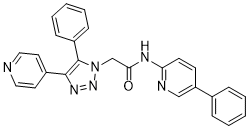
IWP-O1 is a novel and potent porcn (acyltransferase Porcupine) inhibitor with an EC50 value of 80 pM in a cultured cell reporter assay of Wnt signaling. It effectively suppresses the phosphorylation of Dvl2/3 in HeLa cells. The acyltransferase Porcupine (Porcn) is essential for the secretion of Wnt proteins which contribute to embryonic development, tissue regeneration, and tumorigenesis. Additionally, IWP-O1 has significantly improved metabolic stability over our previously reported Porcn inhibitors.
Physicochemical Properties
| Molecular Formula | C26H20N6O | |
| Molecular Weight | 432.47660446167 | |
| CAS # | 2074607-48-8 | |
| Related CAS # |
|
|
| PubChem CID | 134154594 | |
| Appearance | Light yellow to yellow solid powder | |
| Hydrogen Bond Donor Count | 1 | |
| Hydrogen Bond Acceptor Count | 5 | |
| Rotatable Bond Count | 6 | |
| Heavy Atom Count | 33 | |
| Complexity | 614 | |
| Defined Atom Stereocenter Count | 0 | |
| SMILES | O=C(CN1C(C2C=CC=CC=2)=C(C2C=CN=CC=2)N=N1)NC1C=CC(=CN=1)C1C=CC=CC=1 |
|
| Chemical Name |
|
|
| Synonyms |
|
|
| HS Tariff Code | 2934.99.9001 | |
| Storage |
Powder-20°C 3 years 4°C 2 years In solvent -80°C 6 months -20°C 1 month Note: This product requires protection from light (avoid light exposure) during transportation and storage. |
|
| Shipping Condition | Room temperature (This product is stable at ambient temperature for a few days during ordinary shipping and time spent in Customs) |
Biological Activity
| Targets | IWP-O1 (17) is 2.5 times more active than the experimental medication LGK974 and suppresses Wnt signaling in L-Wnt-STF cells with an EC50 value of 80 pM [1]. |
| ln Vitro |
IWP-O1 (17) is 2.5 times more active than the experimental medication LGK974 and suppresses Wnt signaling in L-Wnt-STF cells with an EC50 value of 80 pM [1]. IWP-O1 inhibited Wnt signaling in L-Wnt-STF cells with an EC₅₀ of 80 pM, which is 2.5 times more potent than the investigational Porcn inhibitor LGK974 (EC₅₀ = 0.2 nM)[1] IWP-O1 suppressed phosphorylation of Dishevelled (Dvl2/3) and low-density lipoprotein receptor-related protein 6 (LRP6) in HeLa cells, indicating inhibition of both β-catenin-dependent and -independent Wnt signaling pathways[1] |
| Cell Assay |
Wnt signaling inhibition was assessed using L-Wnt-STF cells, which stably express a Wnt-responsive luciferase reporter. Cells were treated with compounds, and luciferase activity was measured to determine EC₅₀ values[1] Western blot analysis was performed in HeLa cells treated with IWP-O1 or LGK974 for 24 hours. Cell lysates were probed with antibodies against phosphorylated Dvl2/3, total Dvl2/3, phosphorylated LRP6, total LRP6, and actin as a loading control[1] |
| ADME/Pharmacokinetics |
IWP-O1 exhibited significantly improved metabolic stability compared to earlier Porcn inhibitors. In murine liver S9 fractions, IWP-O1 remained stable with no degradation observed after 4 hours of incubation[1] In murine plasma, IWP-O1 had a half-life of 130 minutes[1] |
| References |
[1]. Development of a triazole class of highly potent Porcn inhibitors. Bioorg Med Chem Lett. 2016 Dec 15;26(24):5891-5895. |
| Additional Infomation |
IWP-O1 belongs to a triazole class of Porcn inhibitors designed based on a general scaffold identified from four earlier inhibitor classes[1] The compound functions by preventing the secretion of Wnt proteins, thereby inhibiting Wnt signaling pathways involved in embryogenesis, tissue homeostasis, and tumorigenesis[1] IWP-O1 features a 1,2,3-triazole core, which contributes to its high metabolic stability, making it suitable for in vivo model studies in mice[1] |
Solubility Data
| Solubility (In Vitro) |
|
|||
| Solubility (In Vivo) |
Solubility in Formulation 1: ≥ 2.08 mg/mL (4.81 mM) (saturation unknown) in 10% DMSO + 40% PEG300 + 5% Tween80 + 45% Saline (add these co-solvents sequentially from left to right, and one by one), clear solution. For example, if 1 mL of working solution is to be prepared, you can add 100 μL of 20.8 mg/mL clear DMSO stock solution to 400 μL PEG300 and mix evenly; then add 50 μL Tween-80 to the above solution and mix evenly; then add 450 μL normal saline to adjust the volume to 1 mL. Preparation of saline: Dissolve 0.9 g of sodium chloride in 100 mL ddH₂ O to obtain a clear solution. Solubility in Formulation 2: ≥ 2.08 mg/mL (4.81 mM) (saturation unknown) in 10% DMSO + 90% Corn Oil (add these co-solvents sequentially from left to right, and one by one), clear solution. For example, if 1 mL of working solution is to be prepared, you can add 100 μL of 20.8 mg/mL clear DMSO stock solution to 900 μL of corn oil and mix evenly. (Please use freshly prepared in vivo formulations for optimal results.) |
| Preparing Stock Solutions | 1 mg | 5 mg | 10 mg | |
| 1 mM | 2.3122 mL | 11.5612 mL | 23.1225 mL | |
| 5 mM | 0.4624 mL | 2.3122 mL | 4.6245 mL | |
| 10 mM | 0.2312 mL | 1.1561 mL | 2.3122 mL |