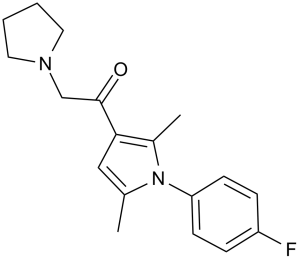
IU1 (IU-1; IU 1) is a cell-permeable, reversible and selective proteasome inhibitor of human USP14 with the potential to be used for treating neurodegenerative disease. It inhibits USP14 with an IC50 of 4.7 μ M, and shows 25-fold higher selectivity against IsoT. USP14 is a proteasome-associated deubiquitinating enzyme that can inhibit the degradation of ubiquitin-protein conjugates both in vitro and in cells. IU1 prevents ventilator-induced lung injury in rats and can inhibit the catalytic activity of proteasome-associated USP14 in vitro with IC50 < 4 μM. Treatment of cultured cells with IU1 enhanced degradation of several proteasome substrates that have been implicated in neurodegenerative disease. USP14 inhibition accelerated the degradation of oxidized proteins and enhanced resistance to oxidative stress. Enhancement of proteasome activity through inhibition of USP14 may offer a strategy to reduce the levels of aberrant proteins in cells under proteotoxic stress.
Physicochemical Properties
| Molecular Formula | C18H21FN2O | |
| Molecular Weight | 300.37 | |
| Exact Mass | 300.163 | |
| Elemental Analysis | C, 71.98; H, 7.05; F, 6.32; N, 9.33; O, 5.33 | |
| CAS # | 314245-33-5 | |
| Related CAS # |
|
|
| PubChem CID | 675434 | |
| Appearance | Light yellow to yellow solid powder | |
| Density | 1.2±0.1 g/cm3 | |
| Boiling Point | 437.0±45.0 °C at 760 mmHg | |
| Flash Point | 218.1±28.7 °C | |
| Vapour Pressure | 0.0±1.0 mmHg at 25°C | |
| Index of Refraction | 1.585 | |
| LogP | 4.07 | |
| Hydrogen Bond Donor Count | 0 | |
| Hydrogen Bond Acceptor Count | 3 | |
| Rotatable Bond Count | 4 | |
| Heavy Atom Count | 22 | |
| Complexity | 389 | |
| Defined Atom Stereocenter Count | 0 | |
| SMILES | CC1=CC(C(CN2CCCC2)=O)=C(C)N1C3=CC=C(F)C=C3 |
|
| InChi Key | JUWDSDKJBMFLHE-UHFFFAOYSA-N | |
| InChi Code | InChI=1S/C18H21FN2O/c1-13-11-17(18(22)12-20-9-3-4-10-20)14(2)21(13)16-7-5-15(19)6-8-16/h5-8,11H,3-4,9-10,12H2,1-2H3 | |
| Chemical Name | 1-(1-(4-fluorophenyl)-2,5-dimethyl-1H-pyrrol-3-yl)-2-(pyrrolidin-1-yl)ethan-1-one | |
| Synonyms |
|
|
| HS Tariff Code | 2934.99.9001 | |
| Storage |
Powder-20°C 3 years 4°C 2 years In solvent -80°C 6 months -20°C 1 month |
|
| Shipping Condition | Room temperature (This product is stable at ambient temperature for a few days during ordinary shipping and time spent in Customs) |
Biological Activity
| Targets |
Usp14(IC50= 4-5 μM) IU1 is a selective inhibitor of ubiquitin-specific protease 14 (USP14), a deubiquitinating enzyme associated with the proteasome complex. It acts by binding to the USP14 active site and blocking its deubiquitinating activity, thereby enhancing proteasomal degradation of polyubiquitinated proteins [1] |
| ln Vitro |
IU1 is a cell-permeable, reversible and selective proteasome inhibitor of human USP14 with IC50 of 4.7 μ M, it is 25-fold more selective against IsoT. USP14 is a proteasome-associated deubiquitinating enzyme that can inhibit the degradation of ubiquitin-protein conjugates both in vitro and in cells. IU1 can inhibit the catalytic activity of proteasome-associated USP14 in vitro with IC50 < 4 μM. Treatment of cultured cells with IU1 enhanced degradation of several proteasome substrates that have been implicated in neurodegenerative disease. USP14 inhibition accelerated the degradation of oxidized proteins and enhanced resistance to oxidative stress. Enhancement of proteasome activity through inhibition of USP14 may offer a strategy to reduce the levels of aberrant proteins in cells under proteotoxic stress. IU1 binds specifically to the activated form of USP14. IU1 can potentially inhibit USP14 by preventing its docking on the proteasome, exhibiting little or no activity toward 8 other DUBs, IsoT, UCH37, BAP1, UCH-L1, UCH-L3, USP15, USP2, USP7. USP14 inhibition is rapidly established upon addition of IU1 and rapidly reversed upon its removal. IU1 inhibits USP14 induced chain trimming and decreases electrophoretic mobility of Ub-CCNB species. IU1 enhances proteasomal degradation of Ub-CCNB in the presence of USP14. IU1 promots degradation of tau and depletes TDP-43, ATXN3, and glial fibrillary acidic protein (GFAP) in proteotoxic mechanisms. In recombinant USP14 enzyme assays, IU1 dose-dependently inhibited USP14-mediated deubiquitination of model substrates (e.g., ubiquitin-AMC). The inhibition led to accumulation of polyubiquitinated proteins in cell lysates, indicating functional blockade of USP14 [1] - In HEK293T cells transfected with a ubiquitin-GFP reporter construct, IU1 (10 μM) increased GFP-positive puncta (ubiquitin aggregates) by 2.8-fold compared to vehicle control, confirming inhibition of deubiquitination in live cells [1] - Treatment of HeLa cells with IU1 (5-20 μM) for 24 hours induced a dose-dependent increase in proteasomal chymotrypsin-like activity (up to 1.7-fold vs. control), as measured by Suc-LLVY-AMC cleavage assay [1] - In primary mouse embryonic fibroblasts (MEFs), IU1 (15 μM) reduced levels of misfolded proteins (e.g., mutant huntingtin fragments) by 40-60% after 48 hours, suggesting improved protein quality control [1] |
| ln Vivo | IU1 prevents ventilator-induced lung injury in rats |
| Enzyme Assay |
Screening is conducted at the ICCB-Longwood screening facility. 10 μL of recombinant USP14 protein are dispensed into each well of a 384-well low volume plate in duplicate, using a Wellmate plate dispenser. 33.3 nL of compound from the library are pin-transferred into the wells using a Seiko pin transfer robotic system, followed by pre-incubation for about 30 min. The last two columns of each plate are used for positive and negative controls for the assay. To initiate the enzyme reaction, 10 μL of VS-proteasome plus Ub-AMC mixture are added to each well, using a Wellmate dispenser. Samples are then incubated for another 45 min. Ub-AMC hydrolysis is measured at Ex355/Em460 using an Envision plate reader. The final concentrations of USP14, VS-proteasome and Ub-AMC are 15 nM, 1 nM and 0.8 μM, respectively. The final concentration of test compound is approximately 17 μM. Enzymes and substrates are prepared in Ub-AMC assay buffer (50 mM Tris-HCl (pH 7.5), 1 mM EDTA, 1 mM ATP, 5 mM MgCl2, 1 mM DTT, and 1 mg/Ml ovalbumin). USP14 deubiquitination assay: Purified recombinant USP14 was incubated with ubiquitin-AMC (10 μM) and IU1 (0.1-100 μM) in assay buffer (50 mM Tris-HCl, pH 7.5, 150 mM NaCl, 1 mM DTT) at 37°C for 60 minutes. Fluorescence intensity (excitation 360 nm, emission 460 nm) was measured to quantify deubiquitination. IU1 caused dose-dependent inhibition, with an IC50 of ~12 μM [1] - Proteasome activity assay: 20S proteasome isolated from bovine erythrocytes was incubated with Suc-LLVY-AMC (50 μM) and IU1 (1-50 μM) at 37°C for 30 minutes. Fluorescence was measured to assess chymotrypsin-like activity. IU1 did not directly activate proteasome but enhanced its activity indirectly by inhibiting USP14 [1] |
| Cell Assay |
MTT assay Ubiquitin-GFP reporter assay: HEK293T cells were transfected with a plasmid encoding ubiquitin-GFP and treated with IU1 (10 μM) for 24 hours. Cells were fixed with 4% paraformaldehyde, stained with DAPI, and analyzed by fluorescence microscopy. GFP puncta were counted manually to quantify ubiquitin accumulation [1] - Proteasome activity measurement: HeLa cells were treated with IU1 (5-20 μM) for 24 hours, then lysed in buffer containing protease inhibitors. Proteasomal chymotrypsin-like activity was measured using Suc-LLVY-AMC as a substrate, with fluorescence read at 460 nm. Activity was normalized to total protein content [1] - Misfolded protein clearance assay: Primary MEFs expressing mutant huntingtin fragments (Q72) were treated with IU1 (15 μM) for 48 hours. Cell lysates were analyzed by Western blot using anti-huntingtin antibodies to quantify aggregated proteins [1] |
| Animal Protocol |
Rats Drosophila melanogaster model: IU1 was dissolved in DMSO and mixed with fly food at concentrations of 0.1-1 mM. Wild-type Drosophila were fed IU1-containing food from adulthood. Lifespan analysis showed a 15-20% increase in median lifespan compared to DMSO controls. Flight muscle function was assessed by climbing assay, with IU1-treated flies exhibiting improved performance [1] - Mouse model: C57BL/6 mice were administered IU1 (20 mg/kg) via intraperitoneal injection daily for 7 days. Brains were harvested, and proteasomal activity was measured in cortical lysates using Suc-LLVY-AMC. IU1 treatment increased proteasomal activity by 1.4-fold compared to vehicle controls [1] |
| References |
[1]. Enhancement of proteasome activity by a small-molecule inhibitor of USP14. Nature. 2010 Sep 9;467(7312):179-84. |
| Additional Infomation |
IU1 is a small-molecule inhibitor developed to target USP14 and enhance proteasomal function. Its mechanism involves disrupting the USP14-proteasome interaction, leading to increased degradation of ubiquitinated substrates [1] - In preclinical studies, IU1 showed efficacy in reducing protein aggregates associated with neurodegenerative diseases (e.g., Huntington’s disease) both in vitro and in vivo. It represents a novel approach to improve protein quality control [1] - The compound has been used as a tool compound to study the role of USP14 in proteasomal regulation and protein homeostasis. Its selectivity for USP14 over other deubiquitinating enzymes (e.g., USP5, USP7) makes it a valuable research reagent [1] |
Solubility Data
| Solubility (In Vitro) |
DMSO : 41.67~60 mg/mL ( 138.73~199.75 mM ) Ethanol : ~60 mg/mL |
| Solubility (In Vivo) |
Solubility in Formulation 1: ≥ 1.67 mg/mL (5.56 mM) (saturation unknown) in 10% DMSO + 40% PEG300 + 5% Tween80 + 45% Saline (add these co-solvents sequentially from left to right, and one by one), clear solution. For example, if 1 mL of working solution is to be prepared, you can add 100 μL of 16.7 mg/mL clear DMSO stock solution to 400 μL PEG300 and mix evenly; then add 50 μL Tween-80 to the above solution and mix evenly; then add 450 μL normal saline to adjust the volume to 1 mL. Preparation of saline: Dissolve 0.9 g of sodium chloride in 100 mL ddH₂ O to obtain a clear solution. Solubility in Formulation 2: ≥ 1.67 mg/mL (5.56 mM) (saturation unknown) in 10% DMSO + 90% (20% SBE-β-CD in Saline) (add these co-solvents sequentially from left to right, and one by one), clear solution. For example, if 1 mL of working solution is to be prepared, you can add 100 μL of 16.7 mg/mL clear DMSO stock solution to 900 μL of 20% SBE-β-CD physiological saline solution and mix evenly. Preparation of 20% SBE-β-CD in Saline (4°C,1 week): Dissolve 2 g SBE-β-CD in 10 mL saline to obtain a clear solution. Solubility in Formulation 3: ≥ 1.67 mg/mL (5.56 mM) (saturation unknown) in 10% DMSO + 90% Corn Oil (add these co-solvents sequentially from left to right, and one by one), clear solution. For example, if 1 mL of working solution is to be prepared, you can add 100 μL of 16.7 mg/mL clear DMSO stock solution to 900 μL of corn oil and mix evenly. Solubility in Formulation 4: 5% DMSO+40% PEG300+5% Tween80+50% ddH2O: 3mg/ml (Please use freshly prepared in vivo formulations for optimal results.) |
| Preparing Stock Solutions | 1 mg | 5 mg | 10 mg | |
| 1 mM | 3.3292 mL | 16.6461 mL | 33.2923 mL | |
| 5 mM | 0.6658 mL | 3.3292 mL | 6.6585 mL | |
| 10 mM | 0.3329 mL | 1.6646 mL | 3.3292 mL |