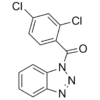
ITSA-1 is a novel, potent, cell-membrane permeable and specific HDAC (Histone deacetylase) activator that suppresses TSA inhibition of HDAC (histone deacetylase), but not other HDAC inhibitors. ITSA-1 may prove to be valuable probes of many biological processes. HDAC inhibitors are being developed as new clinical agents in cancer therapy, in part because they interrupt cell cycle progression in transformed cell lines.
Physicochemical Properties
| Molecular Formula | C13H7N3OCL2 |
| Molecular Weight | 292.12018 |
| Exact Mass | 290.997 |
| CAS # | 200626-61-5 |
| PubChem CID | 771910 |
| Appearance | White to off-white solid powder |
| Density | 1.51g/cm3 |
| Boiling Point | 483.4ºC at 760 mmHg |
| Flash Point | 246.2ºC |
| Vapour Pressure | 1.68E-09mmHg at 25°C |
| Index of Refraction | 1.706 |
| LogP | 3.426 |
| Hydrogen Bond Donor Count | 0 |
| Hydrogen Bond Acceptor Count | 3 |
| Rotatable Bond Count | 1 |
| Heavy Atom Count | 19 |
| Complexity | 355 |
| Defined Atom Stereocenter Count | 0 |
| InChi Key | UVNLAUGZMOPBPR-UHFFFAOYSA-N |
| InChi Code | InChI=1S/C13H7Cl2N3O/c14-8-5-6-9(10(15)7-8)13(19)18-12-4-2-1-3-11(12)16-17-18/h1-7H |
| Chemical Name | (1H-benzo[d][1,2,3]triazol-1-yl)(2,4-dichlorophenyl)methanone |
| Synonyms | ITSA-1; ITSA 1; ITSA1. |
| HS Tariff Code | 2934.99.9001 |
| Storage |
Powder-20°C 3 years 4°C 2 years In solvent -80°C 6 months -20°C 1 month |
| Shipping Condition | Room temperature (This product is stable at ambient temperature for a few days during ordinary shipping and time spent in Customs) |
Biological Activity
| ln Vitro | Treatment with ITSA-1 (50 μM; A549 cells) returned the cell population collected by TSA to a normal cell cycle distribution. Additionally, ITSA-1 has a long duration of cell cycle rescue capability [1]. TSA-treated cells have less apoptotic cells when treated with ITSA-1 (50 μM; 5 hours; A549 cells) [1]. The treatment of A549 and murine ES cells with ITSA-1 (50 μM) for two hours prevented TSA-induced histone acetylation. Crucially, acetylation levels were only inhibited when ITSA1 was introduced either concurrently with or following TSA treatment [1]. TSA-activated transcription in murine ES cells is inhibited by ITSA-1 (50 μM; 30 min) [1]. |
| ln Vivo | ITSA-1 (0.5 mg/kg; intraperitoneal; three times weekly; for eight weeks; CBS+/? mice) attenuates inflammatory signaling that is dependent on histone acetylation by balancing deacetylation activity and inhibiting the production of TNF-α and IL-6 [2]. |
| Cell Assay |
Cell Cycle Analysis[1] Cell Types: Mouse ES Cells Tested Concentrations: 50 μM Incubation Duration: Experimental Results: Used to restore the TSA-captured population to normal cell cycle distribution. Apoptosis analysis[1] Cell Types: A549 Cell Tested Concentrations: 50 μM Incubation Duration: 5 hrs (hours) Experimental Results: diminished number of apoptotic cells. Western Blot Analysis[1] Cell Types: A549 and mouse ES cells Tested Concentrations: 50 μM Incubation Duration: 2 hrs (hours) Experimental Results: Histone acetylation diminished to baseline levels. RT-PCR[1] Cell Types: Mouse ES cells Tested Concentrations: 50 μM Incubation Duration: 30 minutes Experimental Results: Inhibition of TSA-activated transcription. |
| Animal Protocol |
Animal/Disease Models: CBS+/- mice [2] Doses: 0.5 mg/kg Route of Administration: intraperitoneal (ip) injection; 3 times a week; for 8 weeks Experimental Results: Balance deacetylation activity and inhibit IL-6 and TNF-α expression. |
| References |
[1]. Chemical genetic modifier screens: small molecule trichostatin suppressors as probes of intracellular histoneand tubulin acetylation. Chem Biol. 2003 May;10(5):397-410. [2]. Hydrogen Sulfide Promotes Bone Homeostasis by Balancing Inflammatory Cytokine Signaling in CBS-Deficient Mice through an Epigenetic Mechanism. Sci Rep. 2018 Oct 15;8(1):15226. |
| Additional Infomation | 1-(2,4-dichlorobenzoyl)-1H-1,2,3-benzotriazole is a member of the class of benzamides that is obtained by the formal condensation of 2,4-dichlorobenzoic acid and benzotriazole. It acts as an inhibitor for tubulin acetylation mediated by trichostatin A. It has a role as an inhibitor. It is a member of benzotriazoles, a member of benzamides and a dichlorobenzene. It is functionally related to a 2,4-dichlorobenzoic acid and a benzotriazole. |
Solubility Data
| Solubility (In Vitro) | DMSO : ≥ 32 mg/mL (~109.54 mM) |
| Solubility (In Vivo) |
Solubility in Formulation 1: ≥ 2.5 mg/mL (8.56 mM) (saturation unknown) in 10% DMSO + 40% PEG300 + 5% Tween80 + 45% Saline (add these co-solvents sequentially from left to right, and one by one), clear solution. For example, if 1 mL of working solution is to be prepared, you can add 100 μL of 25.0 mg/mL clear DMSO stock solution to 400 μL PEG300 and mix evenly; then add 50 μL Tween-80 to the above solution and mix evenly; then add 450 μL normal saline to adjust the volume to 1 mL. Preparation of saline: Dissolve 0.9 g of sodium chloride in 100 mL ddH₂ O to obtain a clear solution. Solubility in Formulation 2: 2.5 mg/mL (8.56 mM) in 10% DMSO + 90% (20% SBE-β-CD in Saline) (add these co-solvents sequentially from left to right, and one by one), suspension solution; with ultrasonication. For example, if 1 mL of working solution is to be prepared, you can add 100 μL of 25.0 mg/mL clear DMSO stock solution to 900 μL of 20% SBE-β-CD physiological saline solution and mix evenly. Preparation of 20% SBE-β-CD in Saline (4°C,1 week): Dissolve 2 g SBE-β-CD in 10 mL saline to obtain a clear solution. Solubility in Formulation 3: ≥ 2.5 mg/mL (8.56 mM) (saturation unknown) in 10% DMSO + 90% Corn Oil (add these co-solvents sequentially from left to right, and one by one), clear solution. For example, if 1 mL of working solution is to be prepared, you can add 100 μL of 25.0 mg/mL clear DMSO stock solution to 900 μL of corn oil and mix evenly. (Please use freshly prepared in vivo formulations for optimal results.) |
| Preparing Stock Solutions | 1 mg | 5 mg | 10 mg | |
| 1 mM | 3.4233 mL | 17.1163 mL | 34.2325 mL | |
| 5 mM | 0.6847 mL | 3.4233 mL | 6.8465 mL | |
| 10 mM | 0.3423 mL | 1.7116 mL | 3.4233 mL |