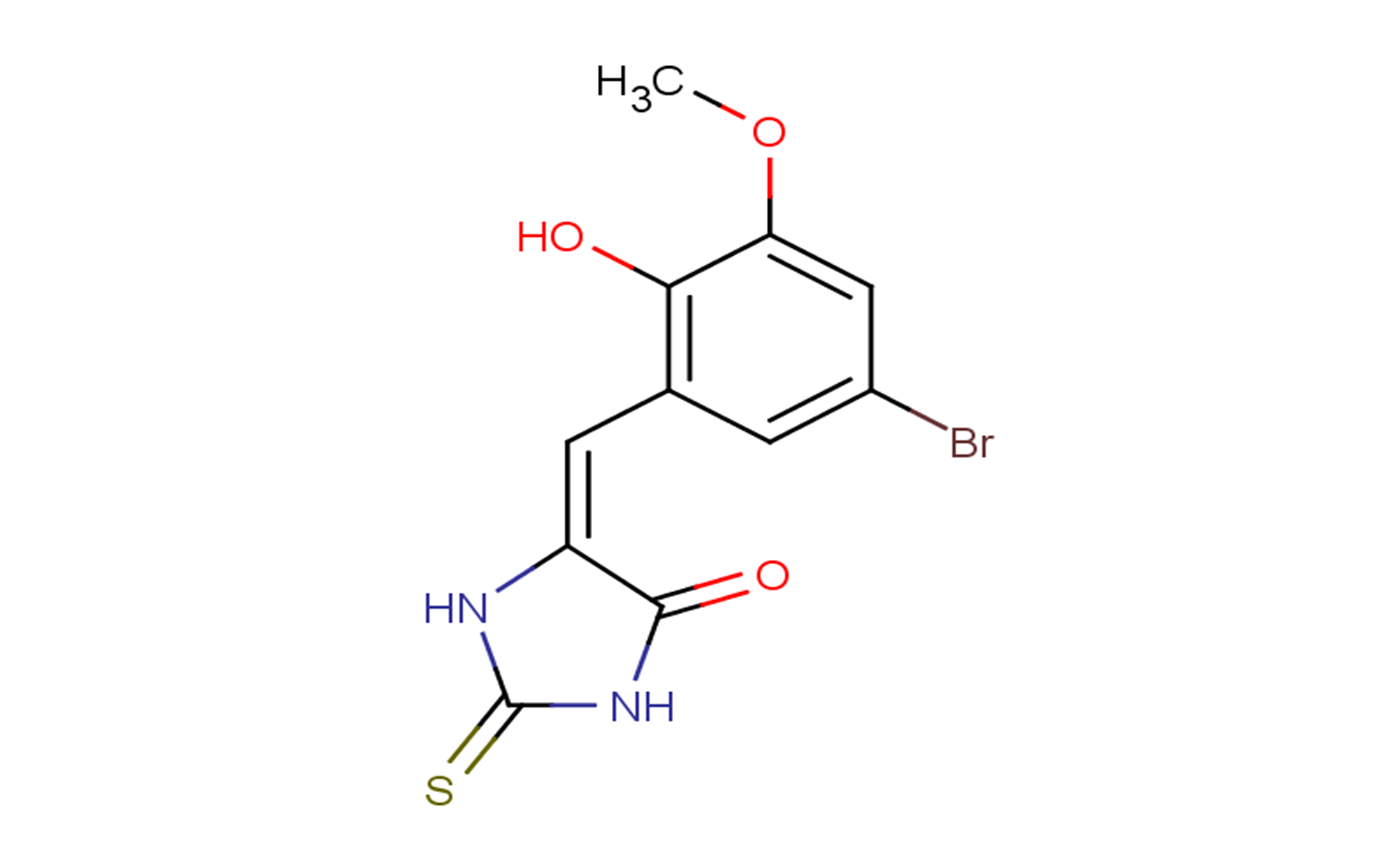
Physicochemical Properties
| Molecular Formula | C11H9BRN2O3S |
| Molecular Weight | 329.169760465622 |
| Exact Mass | 327.95 |
| Elemental Analysis | C, 40.14; H, 2.76; Br, 24.27; N, 8.51; O, 14.58; S, 9.74 |
| CAS # | 292168-90-2 |
| Related CAS # | 292168-90-2 |
| PubChem CID | 840180 |
| Appearance | Light yellow to orange solid |
| LogP | 2 |
| Hydrogen Bond Donor Count | 3 |
| Hydrogen Bond Acceptor Count | 4 |
| Rotatable Bond Count | 2 |
| Heavy Atom Count | 18 |
| Complexity | 402 |
| Defined Atom Stereocenter Count | 0 |
| SMILES | COC1=CC(=CC(=C1O)/C=C/2\C(=O)NC(=S)N2)Br |
| InChi Key | PYLYAEDUIKQBOT-XVNBXDOJSA-N |
| InChi Code | InChI=1S/C11H9BrN2O3S/c1-17-8-4-6(12)2-5(9(8)15)3-7-10(16)14-11(18)13-7/h2-4,15H,1H3,(H2,13,14,16,18)/b7-3+ |
| Chemical Name | (5E)-5-[(5-bromo-2-hydroxy-3-methoxyphenyl)methylidene]-2-sulfanylideneimidazolidin-4-one |
| Synonyms | (E/Z)-IT-603; s3384; IT-603; ZINC17136192; STL418592 |
| HS Tariff Code | 2934.99.9001 |
| Storage |
Powder-20°C 3 years 4°C 2 years In solvent -80°C 6 months -20°C 1 month |
| Shipping Condition | Room temperature (This product is stable at ambient temperature for a few days during ordinary shipping and time spent in Customs) |
Biological Activity
| Targets |
c-Rel (IC50 = 3 μM) IT-603 targets c-Rel (a subunit of NF-κB transcription factor), with a Ki value of 0.4 nM (c-Rel DNA-binding activity inhibition assay) and an IC₅₀ of 0.9 nM (c-Rel-dependent luciferase reporter assay) [1] IT-603 shows high selectivity for c-Rel over other NF-κB subunits: Ki > 10 μM for p65 (RelA), RelB, NF-κB1 (p50), and NF-κB2 (p52) [1] |
| ln Vitro |
c-Rel activity inhibition: IT-603 (0.1–10 nM) dose-dependently inhibited c-Rel DNA-binding activity, achieving 95% inhibition at 5 nM (EMSA assay); it blocked c-Rel-dependent transcription, reducing luciferase activity by 88% at 2 nM (c-Rel reporter assay) [1] - Inhibition of T cell alloactivation: In mixed lymphocyte reaction (MLR, human PBMCs + allogeneic dendritic cells), IT-603 (0.5–10 nM) dose-dependently suppressed T cell proliferation, with an IC₅₀ of 1.2 nM (CFSE staining); it reduced secretion of pro-inflammatory cytokines (IL-2: 65%, IFN-γ: 72%, TNF-α: 58%) at 5 nM (ELISA) [1] - Preservation of anti-tumor T cell activity: IT-603 (0.1–10 nM) did not inhibit proliferation or cytotoxicity of tumor-specific CD8⁺ T cells (CTLs) against MC38 colon cancer cells; CTL-mediated tumor cell lysis rate remained >85% at 10 nM (⁵¹Cr release assay) [1] - Downregulation of c-Rel target genes: 2 nM IT-603 reduced mRNA levels of IL-2 (70%), IFN-γ (68%), and Foxp3 (45%) in alloactivated T cells (qRT-PCR); it inhibited c-Rel nuclear translocation by 75% (Western blot for nuclear c-Rel) [1] - Low cytotoxicity: CC₅₀ > 1 μM in human PBMCs and normal fibroblasts; cell viability >90% at concentrations up to 50 nM [1] |
| ln Vivo |
Delay of allograft rejection (mouse models): - Skin transplantation (C57BL/6 → BALB/c): Oral IT-603 (5, 10 mg/kg, once daily) prolonged skin graft survival from 10 days (vehicle) to 18 days (5 mg/kg) and 25 days (10 mg/kg); histopathological analysis showed reduced T cell infiltration (62%) and inflammation in grafted skin [1] - Cardiac transplantation (BALB/c → C57BL/6): Intraperitoneal IT-603 (10 mg/kg, once daily) prolonged cardiac allograft survival by 12 days; serum IL-2 and IFN-γ levels were reduced by 55% and 60% respectively [1] - Preservation of anti-tumor immunity (mouse models): - MC38 colon cancer: Oral IT-603 (10 mg/kg, once daily) did not affect tumor growth inhibition by vaccine-induced CD8⁺ T cells; tumor volume was similar to vehicle group (p > 0.05), with maintained CTL activity against MC38 cells [1] - B16 melanoma: IT-603 (10 mg/kg, oral) did not impair tumor regression induced by anti-PD-1 therapy; survival rate was 70% (vs. 65% in anti-PD-1 alone group) [1] - No obvious toxicity: Treated mice showed no significant body weight loss (<5% change) or histopathological abnormalities in liver, kidney, or spleen [1] |
| Enzyme Assay |
c-Rel DNA-binding activity assay (EMSA): Recombinant human c-Rel/p65 heterodimer was incubated with biotin-labeled NF-κB consensus DNA probe and serial dilutions of IT-603 (0.01 nM–1 μM) in binding buffer at 25°C for 30 minutes. DNA-protein complexes were separated by native PAGE, transferred to membranes, and detected with streptavidin-HRP. Band intensity was quantified to calculate Ki value [1] - c-Rel-dependent luciferase assay: HEK293 cells were transfected with c-Rel expression plasmid and NF-κB luciferase reporter plasmid. After 24 hours, cells were treated with IT-603 (0.01 nM–1 μM) for 16 hours. Luciferase activity was measured to assess transcription inhibition, and IC₅₀ was calculated [1] - Selectivity assay for NF-κB subunits: Recombinant p65/p50, RelB/p50, and p50/p50 complexes were used in EMSA with respective DNA probes and IT-603 (0.1 nM–10 μM) to evaluate cross-reactivity [1] |
| Cell Assay |
Mixed Lymphocyte Reaction (MLR): Human PBMCs (responder cells) were co-cultured with irradiated allogeneic dendritic cells (stimulator cells) in 96-well plates. IT-603 (0.1–10 nM) was added at the start of culture. After 5 days, cell proliferation was measured by CFSE staining (flow cytometry), and culture supernatants were collected for cytokine detection (IL-2, IFN-γ, TNF-α) by ELISA [1] - Anti-tumor CTL assay: Splenic CD8⁺ T cells from tumor-vaccinated mice were isolated and co-cultured with MC38 or B16 tumor cells in the presence of IT-603 (0.1–10 nM). After 4 hours, cytotoxicity was measured by ⁵¹Cr release assay; IFN-γ secretion was detected by ELISA [1] - Western blot analysis: Alloactivated T cells were treated with IT-603 (0.5–5 nM) for 24 hours. Nuclear and cytoplasmic fractions were extracted, and c-Rel, p65, and IκBα proteins were detected by Western blot; band intensity was quantified to assess c-Rel nuclear translocation [1] - qRT-PCR analysis: Total RNA was extracted from treated T cells, and mRNA levels of c-Rel target genes (IL-2, IFN-γ, Foxp3) were quantified by qRT-PCR [1] |
| Animal Protocol |
Mouse skin transplantation model: C57BL/6 mouse skin grafts were transplanted onto BALB/c mice. IT-603 was administered orally at 5 or 10 mg/kg once daily, starting 1 day before transplantation. Graft survival was monitored daily; grafted skin was collected at rejection for histopathological analysis [1] - Mouse cardiac transplantation model: BALB/c mouse hearts were transplanted into C57BL/6 mice. IT-603 (10 mg/kg) was administered intraperitoneally once daily, starting 1 day post-transplantation. Graft survival was assessed by palpation; serum cytokines were measured by ELISA at 7 days post-transplantation [1] - Mouse tumor models: C57BL/6 mice were subcutaneously injected with MC38 colon cancer cells or B16 melanoma cells. When tumors reached ~50 mm³, mice were vaccinated (MC38 model) or treated with anti-PD-1 antibody (B16 model) plus oral IT-603 (10 mg/kg, once daily). Tumor volume was measured every 3 days, and survival was monitored for 40 days [1] - Drug formulation: IT-603 was dissolved in dimethyl sulfoxide (DMSO) and diluted with 0.5% carboxymethylcellulose sodium (CMC-Na) for oral administration; for intraperitoneal injection, it was diluted with normal saline (final DMSO concentration ≤5%) [1] |
| Toxicity/Toxicokinetics |
In vitro toxicity: CC₅₀ > 1 μM in human PBMCs and normal dermal fibroblasts [1] - In vivo acute toxicity: No mortality or obvious toxicity signs (lethargy, diarrhea) in mice treated with IT-603 at oral doses up to 200 mg/kg [1] - Subchronic toxicity (30-day, mouse): IT-603 (10 mg/kg po, qd) did not cause significant changes in hematological parameters (WBC, RBC, platelets) or liver/kidney function markers (ALT, AST, creatinine) [1] - Plasma protein binding rate: 95% (human plasma, ultrafiltration method) [1] |
| References |
[1]. A small molecule c-Rel inhibitor reduces alloactivation of T-cells without compromising anti-tumor activity. Cancer Discov. 2014 May; 4(5): 578-591. |
| Additional Infomation |
IT-603 is a synthetic small-molecule inhibitor of the c-Rel subunit of the NF-κB transcription factor, with high selectivity over other NF-κB family members [1] - Its mechanism of action involves binding to the DNA-binding domain of c-Rel, inhibiting its nuclear translocation and DNA-binding activity, thereby blocking transcription of pro-inflammatory cytokines and T cell alloactivation genes [1] - Unlike non-selective NF-κB inhibitors, it preserves anti-tumor T cell function by sparing other NF-κB subunits (e.g., p65) required for anti-tumor immunity [1] - It has potential therapeutic applications in preventing allograft rejection (e.g., organ transplantation) while maintaining the patient’s ability to fight tumors or infections [1] |
Solubility Data
| Solubility (In Vitro) | DMSO: 66~125 mg/mL (200.5~379.7 mM) |
| Solubility (In Vivo) |
Note: Listed below are some common formulations that may be used to formulate products with low water solubility (e.g. < 1 mg/mL), you may test these formulations using a minute amount of products to avoid loss of samples. Injection Formulations (e.g. IP/IV/IM/SC) Injection Formulation 1: DMSO : Tween 80: Saline = 10 : 5 : 85 (i.e. 100 μL DMSO stock solution → 50 μL Tween 80 → 850 μL Saline) *Preparation of saline: Dissolve 0.9 g of sodium chloride in 100 mL ddH ₂ O to obtain a clear solution. Injection Formulation 2: DMSO : PEG300 :Tween 80 : Saline = 10 : 40 : 5 : 45 (i.e. 100 μL DMSO → 400 μLPEG300 → 50 μL Tween 80 → 450 μL Saline) Injection Formulation 3: DMSO : Corn oil = 10 : 90 (i.e. 100 μL DMSO → 900 μL Corn oil) Example: Take the Injection Formulation 3 (DMSO : Corn oil = 10 : 90) as an example, if 1 mL of 2.5 mg/mL working solution is to be prepared, you can take 100 μL 25 mg/mL DMSO stock solution and add to 900 μL corn oil, mix well to obtain a clear or suspension solution (2.5 mg/mL, ready for use in animals). Injection Formulation 4: DMSO : 20% SBE-β-CD in saline = 10 : 90 [i.e. 100 μL DMSO → 900 μL (20% SBE-β-CD in saline)] *Preparation of 20% SBE-β-CD in Saline (4°C,1 week): Dissolve 2 g SBE-β-CD in 10 mL saline to obtain a clear solution. Injection Formulation 5: 2-Hydroxypropyl-β-cyclodextrin : Saline = 50 : 50 (i.e. 500 μL 2-Hydroxypropyl-β-cyclodextrin → 500 μL Saline) Injection Formulation 6: DMSO : PEG300 : castor oil : Saline = 5 : 10 : 20 : 65 (i.e. 50 μL DMSO → 100 μLPEG300 → 200 μL castor oil → 650 μL Saline) Injection Formulation 7: Ethanol : Cremophor : Saline = 10: 10 : 80 (i.e. 100 μL Ethanol → 100 μL Cremophor → 800 μL Saline) Injection Formulation 8: Dissolve in Cremophor/Ethanol (50 : 50), then diluted by Saline Injection Formulation 9: EtOH : Corn oil = 10 : 90 (i.e. 100 μL EtOH → 900 μL Corn oil) Injection Formulation 10: EtOH : PEG300:Tween 80 : Saline = 10 : 40 : 5 : 45 (i.e. 100 μL EtOH → 400 μLPEG300 → 50 μL Tween 80 → 450 μL Saline) Oral Formulations Oral Formulation 1: Suspend in 0.5% CMC Na (carboxymethylcellulose sodium) Oral Formulation 2: Suspend in 0.5% Carboxymethyl cellulose Example: Take the Oral Formulation 1 (Suspend in 0.5% CMC Na) as an example, if 100 mL of 2.5 mg/mL working solution is to be prepared, you can first prepare 0.5% CMC Na solution by measuring 0.5 g CMC Na and dissolve it in 100 mL ddH2O to obtain a clear solution; then add 250 mg of the product to 100 mL 0.5% CMC Na solution, to make the suspension solution (2.5 mg/mL, ready for use in animals). Oral Formulation 3: Dissolved in PEG400 Oral Formulation 4: Suspend in 0.2% Carboxymethyl cellulose Oral Formulation 5: Dissolve in 0.25% Tween 80 and 0.5% Carboxymethyl cellulose Oral Formulation 6: Mixing with food powders Note: Please be aware that the above formulations are for reference only. InvivoChem strongly recommends customers to read literature methods/protocols carefully before determining which formulation you should use for in vivo studies, as different compounds have different solubility properties and have to be formulated differently. (Please use freshly prepared in vivo formulations for optimal results.) |
| Preparing Stock Solutions | 1 mg | 5 mg | 10 mg | |
| 1 mM | 3.0379 mL | 15.1897 mL | 30.3794 mL | |
| 5 mM | 0.6076 mL | 3.0379 mL | 6.0759 mL | |
| 10 mM | 0.3038 mL | 1.5190 mL | 3.0379 mL |