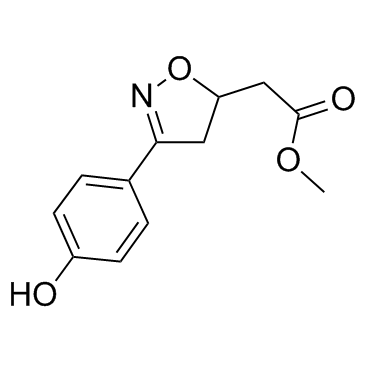
ISO-1, formerly known as MIF Antagonist and ISO-1 and Macrophage Migration Inhibitory Factor, is a MIF inhibitor. ISO-1 has CAS#478336-92-4. INVIVO-6924 Protects Photoreceptors and Reduces Gliosis in Experimental Retinal Detachment. Systemic administration of the MIF inhibitor ISO-1 significantly blocked photoreceptor apoptosis, outer nuclear layer (ONL) thinning, and retinal gliosis. ISO-1 and MIF knockout (MIFKO) had greater accumulation of Müller glia pERK expression in the detached retina, suggesting that Müller survival pathways might underlie the neuroprotective response.
Physicochemical Properties
| Molecular Formula | C12H13NO4 |
| Molecular Weight | 235.239 |
| Exact Mass | 235.084 |
| CAS # | 478336-92-4 |
| Related CAS # | 478336-92-4; |
| PubChem CID | 4633677 |
| Appearance | White to off-white solid powder |
| Density | 1.3±0.1 g/cm3 |
| Boiling Point | 365.0±48.0 °C at 760 mmHg |
| Melting Point | 114 °C |
| Flash Point | 174.6±29.6 °C |
| Vapour Pressure | 0.0±0.8 mmHg at 25°C |
| Index of Refraction | 1.582 |
| LogP | 0.89 |
| Hydrogen Bond Donor Count | 1 |
| Hydrogen Bond Acceptor Count | 5 |
| Rotatable Bond Count | 4 |
| Heavy Atom Count | 17 |
| Complexity | 308 |
| Defined Atom Stereocenter Count | 0 |
| InChi Key | AIXMJTYHQHQJLU-UHFFFAOYSA-N |
| InChi Code | InChI=1S/C12H13NO4/c1-16-12(15)7-10-6-11(13-17-10)8-2-4-9(14)5-3-8/h2-5,10,14H,6-7H2,1H3 |
| Chemical Name | 4,5-dihydro-3-(4-hydroxyphenyl)-5-isoxazoleacetic acid, methyl ester |
| Synonyms | ISO-1 ISO 1 ISO1 MIF Antagonist Macrophage Migration Inhibitory Factor |
| HS Tariff Code | 2934.99.9001 |
| Storage |
Powder-20°C 3 years 4°C 2 years In solvent -80°C 6 months -20°C 1 month |
| Shipping Condition | Room temperature (This product is stable at ambient temperature for a few days during ordinary shipping and time spent in Customs) |
Biological Activity
| ln Vitro | Without recombinant MIF added, ISO-1 (0.1–20 μM; 16 hours) has a mild inhibitory effect on Cox-2 secretion [1]. |
| ln Vivo | ISO-1 (ip; 3.5–35 mg/kg; twice daily; 2 weeks) has anti-inflammatory properties and increases survival from lethal endotoxemia [2]. Intraperitoneal injection ISO-1 (35 mg/kg, twice daily, 3 days) significantly lowers Flk1 expression in the implants and decreases mean implant size [3]. |
| Cell Assay |
Western Blot Analysis[1] Cell Types: RAW 264.7 macrophages Tested Concentrations: 0.1μM, 1μM, 10μM, 20μM Incubation Duration: 16 hrs (hours) Experimental Results: Inhibition of Cox-2 secretion. |
| Animal Protocol |
Animal/Disease Models: C57Bl/6 MIF+/+ and MIF–/– mice [2] Doses: 3.5-35 mg/kg Route of Administration: intraperitoneal (ip) injection; 3.5-35 mg/kg; twice (two times) daily; 2 weeks Experimental Results: Yes Preventing fatal sepsis. Animal/Disease Models: Female C57BL/6-Tg(ACTB-EGFP)1Osb/J mice [3] Doses: 35 mg/kg Route of Administration: intraperitoneal (ip) injection; 35 mg/kg; twice (two times) daily; 3 days Experimental Results: In utero The average size of the endometriotic implants diminished. |
| References |
[1]. The tautomerase active site of macrophage migration inhibitory factor is a potential target for discovery of novel anti-inflammatory agents. J Biol Chem. 2002 Jul 12;277(28):24976-82. [2]. ISO-1 binding to the tautomerase active site of MIF inhibits its pro-inflammatory activity and increases survival in severe sepsis. J Biol Chem. 2005 Nov 4;280(44):36541-4. [3]. Inhibition of macrophage migration inhibitory factor reduces endometriotic implant size in mice with experimentally induced disease. J Endometr. 2011 Sep 30;3(3):135-142. |
| Additional Infomation | 5-Isoxazoleacetic acid, 4,5-dihydro-3-(4-hydroxyphenyl)-, methyl ester is a member of phenols. |
Solubility Data
| Solubility (In Vitro) | DMSO : ~50 mg/mL (~212.55 mM) |
| Solubility (In Vivo) |
Solubility in Formulation 1: 5 mg/mL (21.25 mM) in 5% DMSO + 95% Saline (add these co-solvents sequentially from left to right, and one by one), clear solution; with sonication. Preparation of saline: Dissolve 0.9 g of sodium chloride in 100 mL ddH₂ O to obtain a clear solution. Solubility in Formulation 2: ≥ 2.5 mg/mL (10.63 mM) (saturation unknown) in 10% DMSO + 40% PEG300 + 5% Tween80 + 45% Saline (add these co-solvents sequentially from left to right, and one by one), clear solution. For example, if 1 mL of working solution is to be prepared, you can add 100 μL of 25.0 mg/mL clear DMSO stock solution to 400 μL PEG300 and mix evenly; then add 50 μL Tween-80 to the above solution and mix evenly; then add 450 μL normal saline to adjust the volume to 1 mL. Preparation of saline: Dissolve 0.9 g of sodium chloride in 100 mL ddH₂ O to obtain a clear solution. Solubility in Formulation 3: ≥ 2.5 mg/mL (10.63 mM) (saturation unknown) in 10% DMSO + 90% (20% SBE-β-CD in Saline) (add these co-solvents sequentially from left to right, and one by one), clear solution. For example, if 1 mL of working solution is to be prepared, you can add 100 μL of 25.0 mg/mL clear DMSO stock solution to 900 μL of 20% SBE-β-CD physiological saline solution and mix evenly. Preparation of 20% SBE-β-CD in Saline (4°C,1 week): Dissolve 2 g SBE-β-CD in 10 mL saline to obtain a clear solution. Solubility in Formulation 4: ≥ 2.5 mg/mL (10.63 mM) (saturation unknown) in 10% DMSO + 90% Corn Oil (add these co-solvents sequentially from left to right, and one by one), clear solution. For example, if 1 mL of working solution is to be prepared, you can add 100 μL of 25.0 mg/mL clear DMSO stock solution to 900 μL corn oil and mix evenly. (Please use freshly prepared in vivo formulations for optimal results.) |
| Preparing Stock Solutions | 1 mg | 5 mg | 10 mg | |
| 1 mM | 4.2510 mL | 21.2549 mL | 42.5098 mL | |
| 5 mM | 0.8502 mL | 4.2510 mL | 8.5020 mL | |
| 10 mM | 0.4251 mL | 2.1255 mL | 4.2510 mL |