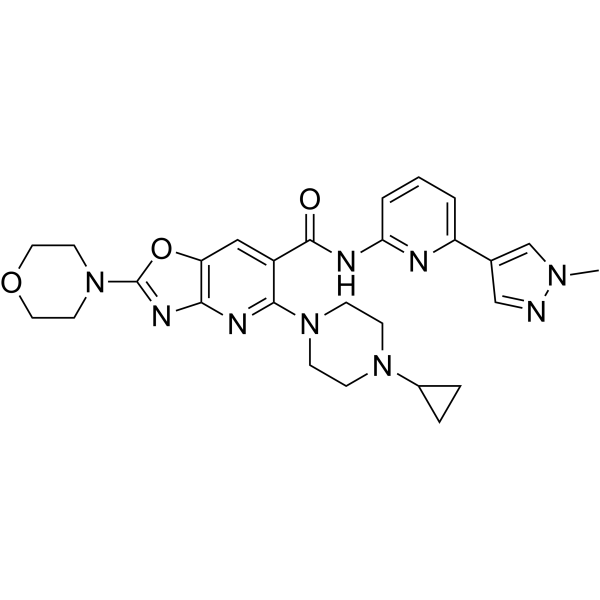
Physicochemical Properties
| Molecular Formula | C21H31N5O2 |
| Molecular Weight | 385.50314450264 |
| Exact Mass | 385.247 |
| CAS # | 2196204-23-4 |
| PubChem CID | 131839619 |
| Appearance | White to off-white solid powder |
| LogP | 2.4 |
| Hydrogen Bond Donor Count | 2 |
| Hydrogen Bond Acceptor Count | 6 |
| Rotatable Bond Count | 4 |
| Heavy Atom Count | 28 |
| Complexity | 489 |
| Defined Atom Stereocenter Count | 0 |
| SMILES | O1CCN(CC1)C1CCC(CC1)NC1=C2C(=NC=N1)NC=C2C1CCOCC1 |
| InChi Key | DJVYXMINSBMUHH-UHFFFAOYSA-N |
| InChi Code | InChI=1S/C21H31N5O2/c1-3-17(26-7-11-28-12-8-26)4-2-16(1)25-21-19-18(15-5-9-27-10-6-15)13-22-20(19)23-14-24-21/h13-17H,1-12H2,(H2,22,23,24,25) |
| Chemical Name | N-(4-morpholin-4-ylcyclohexyl)-5-(oxan-4-yl)-7H-pyrrolo[2,3-d]pyrimidin-4-amine |
| Synonyms | IRAK4IN28; IRAK4-IN-28; IRAK4 inhibitor 28 |
| HS Tariff Code | 2934.99.9001 |
| Storage |
Powder-20°C 3 years 4°C 2 years In solvent -80°C 6 months -20°C 1 month |
| Shipping Condition | Room temperature (This product is stable at ambient temperature for a few days during ordinary shipping and time spent in Customs) |
Biological Activity
| ln Vitro | AZ1495 (compound 28) (10 μM, 1 h) is kinase selective for IRAK4 with IC50 values of 0.005 μM (enzyme assay) and 0.052 μM (cell assay) [1]. AZ1495 (10 μM, 1 h) exhibits a kinase inhibitory effect on IRAK4, with an IC50 value of 0.005 μM and a Kd value of 0.0007 μM[1]. AZ1495 (0.001-100 μM, 72 h) suppresses NF-κB activation and proliferation of ABC-DLBCL cell line in a dose-dependent manner [1]. AZ1495 (0-3.3 μM, 14 hours) coupled with BTK inhibitors in OCI-LY10 cells totally suppresses NF-κB activation and promotes cell death at lower dosages [1]. |
| ln Vivo | AZ1495 (Compound 28) (orally, daily, 12.5 mg/kg) coupled with ibrutinib induced tumor regression in an ABC-DLBCL animal model (OCI-LY10 cells) [1]. AZ1495 (IV, 2 mg/kg and PO, 5 mg/kg) is characterized by high clearance (Cl) in rats (75 mL/min/kg) and moderate prediction based on hepatocyte data (Clint 15 μl /min/106 cells), anticipated clearance rate 42 mL/min/kg), poor bioavailability, consistent with significant first-pass impact [1]. Active renal secretion of AZ1495 (iv, 1 mg/kg) in dogs is low [1]. |
| Cell Assay |
Cell Viability Assay[1] Cell Types: OCI-LY10 and SUDHL2 Cell Tested Concentrations: 0.001-100 μM Incubation Duration: 72 hrs (hours) Experimental Results: Inhibited the growth of OCI-LY10 cells in a dose-dependent manner, while GCB cell line SUDHL2 did not IRAK4 inhibitors are sensitive and do not increase cell killing. Cell death of OCI-LY10 cells increased upon increasing the concentrations of compound 28 and BTK ibrutinib. Western Blot Analysis[1] Cell Types: OCI-LY10 Cell Tested Concentrations: 0-3.3 μM Incubation Duration: 14 h Experimental Results: Inhibited IκBα phosphorylation in a dose-dependent manner in OCI-LY10 cells. Shown that combination with 10 nM ibrutinib induces apoptosis by cleaving caspase 3 in OCI-LY10 cells. |
| Animal Protocol |
Animal/Disease Models: CB.17 SCID (severe combined immunodeficient) mouse [1] Doses: 12.5 mg/kg Route of Administration: po (po (oral gavage)) daily, 12.5 mg/kg Experimental Results: Single agents have modest antitumor activity, but ibrutinib combination can cause Tumor regression occurred and was well tolerated. Animal/Disease Models: Rat[1] Doses: 2 mg/kg, 5mg/kg Route of Administration: intravenous (iv) (iv)injection, 2 mg/kg and po (po (oral gavage)) 5mg/kg Experimental Results: Species dose (mg/kg) Cl (mL/min/ kg) Vss (L/kg) PO Half-life (h) IV Half-life (h) Fabs (%) F (%) Rat 2,5 75 2.1 2.0 0.8 100 28 Dog 1 29 3.0 - 3.3 - - Animal/Disease Models: dog [1 ] Doses: 1 mg/kg Route of Administration: iv., 1 mg/kg Experimental Results: Type dose (mg/kg) Cl (mL/min/kg) Vss (L/kg) PO half-life (h) IV half-life (h) Fab (%) F (%) Rat 2,5 75 2.1 2.0 0.8 100 28 Dog 1 29 3.0 - 3.3 - - |
| References |
[1]. Discovery and Optimization of Pyrrolopyrimidine Inhibitors of Interleukin-1 Receptor Associated Kinase 4 (IRAK4) for the Treatment of Mutant MYD88L265P Diffuse Large B-Cell Lymphoma. J Med Chem. 2017 Dec 28;60(24):10071-10091. |
Solubility Data
| Solubility (In Vitro) | DMSO : ~10 mg/mL (~25.94 mM) |
| Solubility (In Vivo) |
Solubility in Formulation 1: ≥ 1 mg/mL (2.59 mM) (saturation unknown) in 10% DMSO + 40% PEG300 + 5% Tween80 + 45% Saline (add these co-solvents sequentially from left to right, and one by one), clear solution. For example, if 1 mL of working solution is to be prepared, you can add 100 μL of 10.0 mg/mL clear DMSO stock solution to 400 μL of PEG300 and mix evenly; then add 50 μL of Tween-80 to the above solution and mix evenly; then add 450 μL of normal saline to adjust the volume to 1 mL. Preparation of saline: Dissolve 0.9 g of sodium chloride in 100 mL ddH₂ O to obtain a clear solution. Solubility in Formulation 2: ≥ 1 mg/mL (2.59 mM) (saturation unknown) in 10% DMSO + 90% (20% SBE-β-CD in Saline) (add these co-solvents sequentially from left to right, and one by one), clear solution. For example, if 1 mL of working solution is to be prepared, you can add 100 μL of 10.0 mg/mL clear DMSO stock solution to 900 μL of 20% SBE-β-CD physiological saline solution and mix evenly. Preparation of 20% SBE-β-CD in Saline (4°C,1 week): Dissolve 2 g SBE-β-CD in 10 mL saline to obtain a clear solution. Solubility in Formulation 3: ≥ 1 mg/mL (2.59 mM) (saturation unknown) in 10% DMSO + 90% Corn Oil (add these co-solvents sequentially from left to right, and one by one), clear solution. For example, if 1 mL of working solution is to be prepared, you can add 100 μL of 10.0 mg/mL clear DMSO stock solution to 900 μL of corn oil and mix evenly. (Please use freshly prepared in vivo formulations for optimal results.) |
| Preparing Stock Solutions | 1 mg | 5 mg | 10 mg | |
| 1 mM | 2.5940 mL | 12.9702 mL | 25.9403 mL | |
| 5 mM | 0.5188 mL | 2.5940 mL | 5.1881 mL | |
| 10 mM | 0.2594 mL | 1.2970 mL | 2.5940 mL |