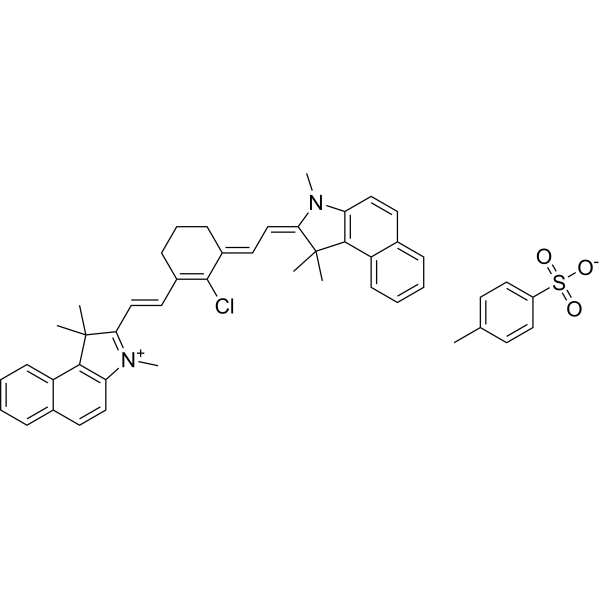
Physicochemical Properties
| Molecular Formula | C47H47CLN2O3S |
| Molecular Weight | 755.41 |
| Exact Mass | 754.3 |
| CAS # | 134127-48-3 |
| Related CAS # | IR 813 perchlorate;201024-57-9 |
| PubChem CID | 44669077 |
| Appearance | Light brown to brown solid powder |
| LogP | 12.473 |
| Hydrogen Bond Donor Count | 0 |
| Hydrogen Bond Acceptor Count | 4 |
| Rotatable Bond Count | 3 |
| Heavy Atom Count | 54 |
| Complexity | 1360 |
| Defined Atom Stereocenter Count | 0 |
| SMILES | CC1=CC=C(C=C1)S(=O)(=O)[O-].CC1(C(=[N+](C2=C1C3=CC=CC=C3C=C2)C)/C=C/C4=C(/C(=C/C=C/5\C(C6=C(N5C)C=CC7=CC=CC=C76)(C)C)/CCC4)Cl)C |
| InChi Key | LQVQHHTYXSPHSQ-UHFFFAOYSA-M |
| InChi Code | InChI=1S/C40H40ClN2.C7H8O3S/c1-39(2)34(42(5)32-22-18-26-12-7-9-16-30(26)36(32)39)24-20-28-14-11-15-29(38(28)41)21-25-35-40(3,4)37-31-17-10-8-13-27(31)19-23-33(37)43(35)6;1-6-2-4-7(5-3-6)11(8,9)10/h7-10,12-13,16-25H,11,14-15H2,1-6H3;2-5H,1H3,(H,8,9,10)/q+1;/p-1 |
| Chemical Name | (2E)-2-[(2E)-2-[2-chloro-3-[(E)-2-(1,1,3-trimethylbenzo[e]indol-3-ium-2-yl)ethenyl]cyclohex-2-en-1-ylidene]ethylidene]-1,1,3-trimethylbenzo[e]indole;4-methylbenzenesulfonate |
| HS Tariff Code | 2934.99.9001 |
| Storage |
Powder-20°C 3 years 4°C 2 years In solvent -80°C 6 months -20°C 1 month Note: Please store this product in a sealed and protected environment (e.g. under nitrogen), avoid exposure to moisture and light. |
| Shipping Condition | Room temperature (This product is stable at ambient temperature for a few days during ordinary shipping and time spent in Customs) |
Biological Activity
| ln Vitro | In red blood cells, IR 813 (17.3 μM, 2 h) tosylate causes a hemolysis rate of 31.4%[1]. In MRC-5 cells, IR 813 (5.9 μM, 24 h) tosylate causes 50% cell death[1]. |
| ln Vivo | For the purpose of observing local lymph nodes in mice, IR 813 tosylate exhibits a peak fluorescence intensity four hours after injection in addition to a fast extravasation[1]. Guidelines (The protocol listed below is our suggested one; it should be adjusted to meet your unique requirements as it just offers as a guideline)[1]. 1. Animal: For the purpose of reducing tissue autofluorescence in the NIR region, ten-week-old female Balb/cOlaAnN mice are housed in a 12-hour light/dark cycle with unlimited access to food and drink. 2. Dosage: A single subcutaneous injection of 5.1 nmol of IR 813 dye (20 μL of 0.173 mg/mL, diluted in a PEG-400/ethanol/water=3:2:5, v/v/v) is given to mice in their right anterior paw. 3. Imaging: Fluorescence intensity in the axillary lymph node (ALN) is monitored for one week (5 min, 1 h, 4 h, 24 h, 7 days) using the Fluobeam700 NIR imaging system to provide in vivo optical imaging (739 nm excitation light (3.5 mW), 750 nm long-pass emission cutoff filter). 4. Data analysis: Using ImageJ 1.44 software, semiquantitative data is extracted from the fluorescence images. |
| References |
[1]. Surface chemistry architecture of silica nanoparticles determine the efficiency of in vivo fluorescence lymph node mapping. ACS Nano. 2013 Oct 22;7(10):8645-57. |
Solubility Data
| Solubility (In Vitro) | DMSO: 62.5 mg/mL (82.74 mM) |
| Solubility (In Vivo) |
Note: Listed below are some common formulations that may be used to formulate products with low water solubility (e.g. < 1 mg/mL), you may test these formulations using a minute amount of products to avoid loss of samples. Injection Formulations (e.g. IP/IV/IM/SC) Injection Formulation 1: DMSO : Tween 80: Saline = 10 : 5 : 85 (i.e. 100 μL DMSO stock solution → 50 μL Tween 80 → 850 μL Saline) *Preparation of saline: Dissolve 0.9 g of sodium chloride in 100 mL ddH ₂ O to obtain a clear solution. Injection Formulation 2: DMSO : PEG300 :Tween 80 : Saline = 10 : 40 : 5 : 45 (i.e. 100 μL DMSO → 400 μLPEG300 → 50 μL Tween 80 → 450 μL Saline) Injection Formulation 3: DMSO : Corn oil = 10 : 90 (i.e. 100 μL DMSO → 900 μL Corn oil) Example: Take the Injection Formulation 3 (DMSO : Corn oil = 10 : 90) as an example, if 1 mL of 2.5 mg/mL working solution is to be prepared, you can take 100 μL 25 mg/mL DMSO stock solution and add to 900 μL corn oil, mix well to obtain a clear or suspension solution (2.5 mg/mL, ready for use in animals). Injection Formulation 4: DMSO : 20% SBE-β-CD in saline = 10 : 90 [i.e. 100 μL DMSO → 900 μL (20% SBE-β-CD in saline)] *Preparation of 20% SBE-β-CD in Saline (4°C,1 week): Dissolve 2 g SBE-β-CD in 10 mL saline to obtain a clear solution. Injection Formulation 5: 2-Hydroxypropyl-β-cyclodextrin : Saline = 50 : 50 (i.e. 500 μL 2-Hydroxypropyl-β-cyclodextrin → 500 μL Saline) Injection Formulation 6: DMSO : PEG300 : castor oil : Saline = 5 : 10 : 20 : 65 (i.e. 50 μL DMSO → 100 μLPEG300 → 200 μL castor oil → 650 μL Saline) Injection Formulation 7: Ethanol : Cremophor : Saline = 10: 10 : 80 (i.e. 100 μL Ethanol → 100 μL Cremophor → 800 μL Saline) Injection Formulation 8: Dissolve in Cremophor/Ethanol (50 : 50), then diluted by Saline Injection Formulation 9: EtOH : Corn oil = 10 : 90 (i.e. 100 μL EtOH → 900 μL Corn oil) Injection Formulation 10: EtOH : PEG300:Tween 80 : Saline = 10 : 40 : 5 : 45 (i.e. 100 μL EtOH → 400 μLPEG300 → 50 μL Tween 80 → 450 μL Saline) Oral Formulations Oral Formulation 1: Suspend in 0.5% CMC Na (carboxymethylcellulose sodium) Oral Formulation 2: Suspend in 0.5% Carboxymethyl cellulose Example: Take the Oral Formulation 1 (Suspend in 0.5% CMC Na) as an example, if 100 mL of 2.5 mg/mL working solution is to be prepared, you can first prepare 0.5% CMC Na solution by measuring 0.5 g CMC Na and dissolve it in 100 mL ddH2O to obtain a clear solution; then add 250 mg of the product to 100 mL 0.5% CMC Na solution, to make the suspension solution (2.5 mg/mL, ready for use in animals). Oral Formulation 3: Dissolved in PEG400 Oral Formulation 4: Suspend in 0.2% Carboxymethyl cellulose Oral Formulation 5: Dissolve in 0.25% Tween 80 and 0.5% Carboxymethyl cellulose Oral Formulation 6: Mixing with food powders Note: Please be aware that the above formulations are for reference only. InvivoChem strongly recommends customers to read literature methods/protocols carefully before determining which formulation you should use for in vivo studies, as different compounds have different solubility properties and have to be formulated differently. (Please use freshly prepared in vivo formulations for optimal results.) |
| Preparing Stock Solutions | 1 mg | 5 mg | 10 mg | |
| 1 mM | 1.3238 mL | 6.6189 mL | 13.2378 mL | |
| 5 mM | 0.2648 mL | 1.3238 mL | 2.6476 mL | |
| 10 mM | 0.1324 mL | 0.6619 mL | 1.3238 mL |