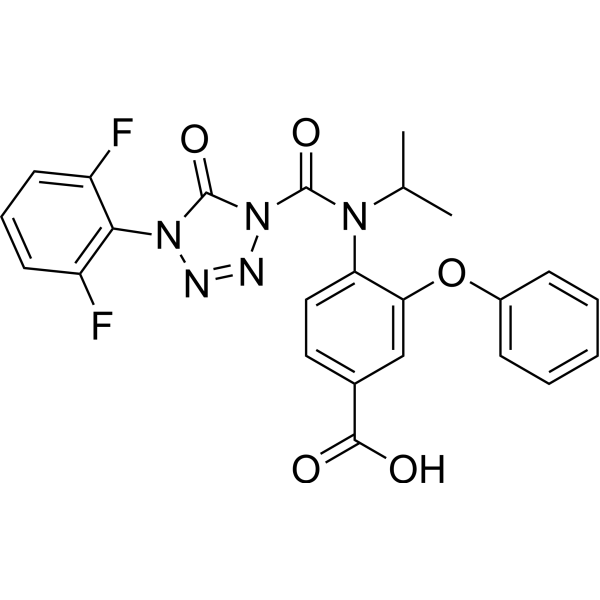
Physicochemical Properties
| Molecular Formula | C24H19F2N5O5 |
| Molecular Weight | 495.434972047806 |
| Exact Mass | 495.135 |
| CAS # | 1346564-56-4 |
| PubChem CID | 68208572 |
| Appearance | White to off-white solid powder |
| LogP | 5.2 |
| Hydrogen Bond Donor Count | 1 |
| Hydrogen Bond Acceptor Count | 9 |
| Rotatable Bond Count | 6 |
| Heavy Atom Count | 36 |
| Complexity | 845 |
| Defined Atom Stereocenter Count | 0 |
| SMILES | FC1C=CC=C(C=1N1C(N(C(N(C2=CC=C(C(=O)O)C=C2OC2C=CC=CC=2)C(C)C)=O)N=N1)=O)F |
| InChi Key | VYXOFKWKPKVNID-UHFFFAOYSA-N |
| InChi Code | InChI=1S/C24H19F2N5O5/c1-14(2)29(19-12-11-15(22(32)33)13-20(19)36-16-7-4-3-5-8-16)23(34)31-24(35)30(27-28-31)21-17(25)9-6-10-18(21)26/h3-14H,1-2H3,(H,32,33) |
| Chemical Name | 4-[[4-(2,6-difluorophenyl)-5-oxotetrazole-1-carbonyl]-propan-2-ylamino]-3-phenoxybenzoic acid |
| HS Tariff Code | 2934.99.9001 |
| Storage |
Powder-20°C 3 years 4°C 2 years In solvent -80°C 6 months -20°C 1 month |
| Shipping Condition | Room temperature (This product is stable at ambient temperature for a few days during ordinary shipping and time spent in Customs) |
Biological Activity
| Targets | IC50: 0.3 nM (FASN)[1] |
| ln Vitro | In cellular occupancy experiments, IPI-9119 inhibits FASN with an IC50 of about 10 nM. It also exhibits selectivity against various other serine hydrolases that is greater than 400-fold[2]. IPI-9119 (0.1-0.5 μM; 6 days) causes cell cycle arrest and apoptosis in addition to inhibiting cell growth[1]. IPI-9119 (0.05-5 μM; 6 days) suppresses the expression of the AR-FL and AR-V7 proteins[1]. |
| ln Vivo | In animal models with CRPC xenografts, IPI-9119 (SC pump infusion; 0.5 μL/h; 100 mg/mL; for 28 days) suppresses the formation of tumors[1]. |
| Cell Assay |
Cell Viability Assay[1] Cell Types: Prostate cancer (PCa) cells ( AD LNCaP, AI C4-2, LNCaP-95 and 22Rv1 AI cells) Tested Concentrations: 0.1, 0.5 μM Incubation Duration: 6 days Experimental Results: Inhibited PCa cell growth. Had no growth inhibition in FASN KO PCa cells. Cell Cycle Analysis[1] Cell Types: PCa cells Tested Concentrations: 0.1, 0.5 μM Incubation Duration: 6 days Experimental Results: diminished the proportion of S-phase cells and increased that of G0/G1-, sub-G1–phase cells and diminished expression of cyclin A2. Western Blot Analysis[1] Cell Types: PCa cells Tested Concentrations: 0.05, 0.1, 0.25, 0.5, 5 μM Incubation Duration: 6 days Experimental Results: Dramatically diminished AR-FL protein levels in AD LNCaP, AI C4-2 cells (expressing only AR-FL ) and diminished the expression of AR-V7 in LNCaP-95, 22Rv1 AI cells driven by this variant. |
| Animal Protocol |
Animal/Disease Models: 8-10-week male Ncr Nu Castrated mice or castrated NOD male SCID with 22Rv1 or LNCaP-95 cells[1] Doses: 100 mg/mL Route of Administration: SC pump infusion (0.5 μL/h; 100 mg/mL); for 28 days Experimental Results: Inhibited tumor growth of castration-resistant prostate cancer ( CRPC) xenografts mouse models. |
| References |
[1]. Inhibition of de novo lipogenesis targets androgen receptor signaling in castration-resistant prostate cancer. Proc Natl Acad Sci U S A. 2019 Jan 8;116(2):631-640. [2]. Abstract 1891: Pharmacological target validation studies of fatty acid synthase in carcinoma using the potent, selective and orally bioavailable inhibitor IPI-9119. |
Solubility Data
| Solubility (In Vitro) | DMSO: 100 mg/mL (201.84 mM) |
| Solubility (In Vivo) |
Solubility in Formulation 1: ≥ 2.08 mg/mL (4.20 mM) (saturation unknown) in 10% DMSO + 40% PEG300 + 5% Tween80 + 45% Saline (add these co-solvents sequentially from left to right, and one by one), clear solution. For example, if 1 mL of working solution is to be prepared, you can add 100 μL of 20.8 mg/mL clear DMSO stock solution to 400 μL PEG300 and mix evenly; then add 50 μL Tween-80 to the above solution and mix evenly; then add 450 μL normal saline to adjust the volume to 1 mL. Preparation of saline: Dissolve 0.9 g of sodium chloride in 100 mL ddH₂ O to obtain a clear solution. Solubility in Formulation 2: ≥ 2.08 mg/mL (4.20 mM) (saturation unknown) in 10% DMSO + 90% (20% SBE-β-CD in Saline) (add these co-solvents sequentially from left to right, and one by one), clear solution. For example, if 1 mL of working solution is to be prepared, you can add 100 μL of 20.8 mg/mL clear DMSO stock solution to 900 μL of 20% SBE-β-CD physiological saline solution and mix evenly. Preparation of 20% SBE-β-CD in Saline (4°C,1 week): Dissolve 2 g SBE-β-CD in 10 mL saline to obtain a clear solution. Solubility in Formulation 3: ≥ 2.08 mg/mL (4.20 mM) (saturation unknown) in 10% DMSO + 90% Corn Oil (add these co-solvents sequentially from left to right, and one by one), clear solution. For example, if 1 mL of working solution is to be prepared, you can add 100 μL of 20.8 mg/mL clear DMSO stock solution to 900 μL of corn oil and mix evenly. (Please use freshly prepared in vivo formulations for optimal results.) |
| Preparing Stock Solutions | 1 mg | 5 mg | 10 mg | |
| 1 mM | 2.0184 mL | 10.0920 mL | 20.1841 mL | |
| 5 mM | 0.4037 mL | 2.0184 mL | 4.0368 mL | |
| 10 mM | 0.2018 mL | 1.0092 mL | 2.0184 mL |