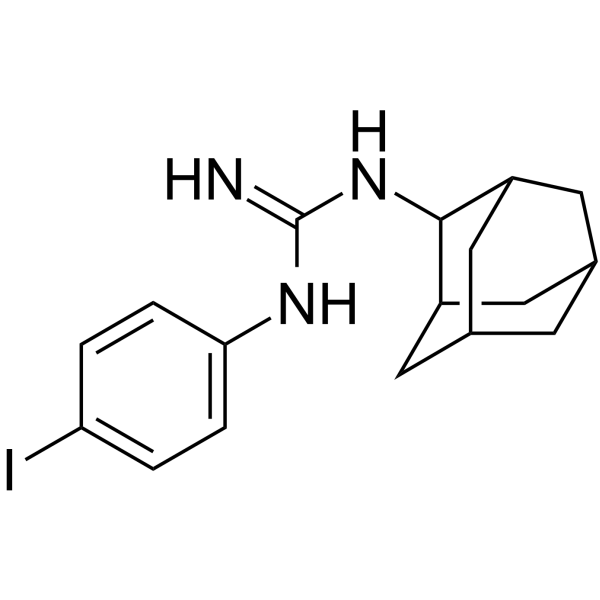
Physicochemical Properties
| Molecular Formula | C17H22IN3 |
| Molecular Weight | 395.28115606308 |
| Exact Mass | 395.086 |
| CAS # | 193527-91-2 |
| PubChem CID | 4239764 |
| Appearance | White to off-white solid powder |
| LogP | 4.615 |
| Hydrogen Bond Donor Count | 2 |
| Hydrogen Bond Acceptor Count | 1 |
| Rotatable Bond Count | 3 |
| Heavy Atom Count | 21 |
| Complexity | 386 |
| Defined Atom Stereocenter Count | 0 |
| InChi Key | UUKPIWYXWLJPJF-UHFFFAOYSA-N |
| InChi Code | InChI=1S/C17H22IN3/c18-14-1-3-15(4-2-14)20-17(19)21-16-12-6-10-5-11(8-12)9-13(16)7-10/h1-4,10-13,16H,5-9H2,(H3,19,20,21) |
| Chemical Name | 2-(2-adamantyl)-1-(4-iodophenyl)guanidine |
| HS Tariff Code | 2934.99.9001 |
| Storage |
Powder-20°C 3 years 4°C 2 years In solvent -80°C 6 months -20°C 1 month Note: This product requires protection from light (avoid light exposure) during transportation and storage. |
| Shipping Condition | Room temperature (This product is stable at ambient temperature for a few days during ordinary shipping and time spent in Customs) |
Biological Activity
| ln Vitro | When IPAG inhibits Sigma1, PD-L1 in PC3 (hormone-insensitive prostate cancer) and MDA-MB-231 (triple-negative breast cancer) cell lines is autolysosomally degraded, and the amount of functional PD-L1 on the cell surface cells is decreased [2]. 100±8 μg per 106 cells were generated on average after IPAG treatment. IPAG has the ability to stop cell division. Cell mass is decreased by IPAG therapy [3]. The phosphorylation of the translation regulatory proteins p70S6K, S6, and 4E-BP1 is inhibited by IPAG administration [3]. |
| Cell Assay |
Cell Viability Assay[3] Cell Types: T47D Cell Tested Concentrations: 10 μM Incubation Duration: 24 hrs (hours) Experimental Results: The average forward scatter height (FSC-H) of DMSO (control) measured 412±5, while the average FSC-H of IPAG The treated cells were 412±5 and 390±4. Western Blot Analysis [3] Cell Types: T47D Cell Tested Concentrations: 10 μM Incubation Duration: Experimental Results: diminished levels of phosphothreonine 389-p70S6 kinase (P-S6K), phosphoserine 235/236-ribosomal S6 (P-S6) , and phosphoserine 65-4E-BP1 (P-4E-BP1). |
| References |
[1]. Simple ammonium salts acting on sigma-1 receptors yield potential treatments for cancer and depression. Sci Rep. 2020 Jun 8;10(1):9251. [2]. Small-Molecule Modulators of Sigma1 and Sigma2/TMEM97 in the Context of Cancer: Foundational Concepts and Emerging Themes. Front Pharmacol. 2019 Oct 21;10:1141. [3]. Inhibition of tumor cell growth by Sigma1 ligand mediated translational repression. Biochem Biophys Res Commun. 2012 Sep 21;426(2):177-82. |
| Additional Infomation | IPAG is a potent sigma-receptor antagonist. |
Solubility Data
| Solubility (In Vitro) | DMSO : ~8.33 mg/mL (~21.07 mM) |
| Solubility (In Vivo) |
Solubility in Formulation 1: ≥ 0.83 mg/mL (2.10 mM) (saturation unknown) in 10% DMSO + 40% PEG300 + 5% Tween80 + 45% Saline (add these co-solvents sequentially from left to right, and one by one), suspension solution. For example, if 1 mL of working solution is to be prepared, you can add 100 μL of 8.3 mg/mL clear DMSO stock solution to 400 μL of PEG300 and mix evenly; then add 50 μL of Tween-80 to the above solution and mix evenly; then add 450 μL of normal saline to adjust the volume to 1 mL. Preparation of saline: Dissolve 0.9 g of sodium chloride in 100 mL ddH₂ O to obtain a clear solution. Solubility in Formulation 2: ≥ 0.83 mg/mL (2.10 mM) (saturation unknown) in 10% DMSO + 90% (20% SBE-β-CD in Saline) (add these co-solvents sequentially from left to right, and one by one), clear solution. For example, if 1 mL of working solution is to be prepared, you can add 100 μL of 8.3 mg/mL clear DMSO stock solution to 900 μL of 20% SBE-β-CD physiological saline solution and mix evenly. Preparation of 20% SBE-β-CD in Saline (4°C,1 week): Dissolve 2 g SBE-β-CD in 10 mL saline to obtain a clear solution. Solubility in Formulation 3: ≥ 0.83 mg/mL (2.10 mM) (saturation unknown) in 10% DMSO + 90% Corn Oil (add these co-solvents sequentially from left to right, and one by one), clear solution. For example, if 1 mL of working solution is to be prepared, you can add 100 μL of 8.3 mg/mL clear DMSO stock solution to 900 μL of corn oil and mix evenly. (Please use freshly prepared in vivo formulations for optimal results.) |
| Preparing Stock Solutions | 1 mg | 5 mg | 10 mg | |
| 1 mM | 2.5299 mL | 12.6493 mL | 25.2985 mL | |
| 5 mM | 0.5060 mL | 2.5299 mL | 5.0597 mL | |
| 10 mM | 0.2530 mL | 1.2649 mL | 2.5299 mL |