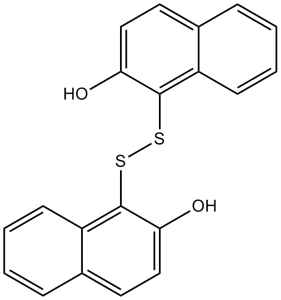
IPA-3 (IPA3; IPA 3) is a novel, potent, selective and non-ATP competitive PAK1 (p21-activated protein kinase 1) inhibitor with potential antitumor activity. It inhibits the growth of liver cancer cells by suppressing PAK1 and NF-κB activation and has IC50 of 2.5 μM, and shows no inhibition to group II PAKs (PAKs 4-6).
Physicochemical Properties
| Molecular Formula | C20H14O2S2 | |
| Molecular Weight | 350.45 | |
| Exact Mass | 350.043 | |
| CAS # | 42521-82-4 | |
| Related CAS # |
|
|
| PubChem CID | 521106 | |
| Appearance | Light yellow to yellow solid powder | |
| Density | 1.5±0.1 g/cm3 | |
| Boiling Point | 543.7±35.0 °C at 760 mmHg | |
| Melting Point | 172℃ | |
| Flash Point | 263.4±24.7 °C | |
| Vapour Pressure | 0.0±1.5 mmHg at 25°C | |
| Index of Refraction | 1.836 | |
| LogP | 4.96 | |
| Hydrogen Bond Donor Count | 2 | |
| Hydrogen Bond Acceptor Count | 4 | |
| Rotatable Bond Count | 3 | |
| Heavy Atom Count | 24 | |
| Complexity | 380 | |
| Defined Atom Stereocenter Count | 0 | |
| InChi Key | RFAXLXKIAKIUDT-UHFFFAOYSA-N | |
| InChi Code | InChI=1S/C20H14O2S2/c21-17-11-9-13-5-1-3-7-15(13)19(17)23-24-20-16-8-4-2-6-14(16)10-12-18(20)22/h1-12,21-22H | |
| Chemical Name | 1,1-disulfanediylbis(naphthalen-2-ol) | |
| Synonyms |
|
|
| HS Tariff Code | 2934.99.9001 | |
| Storage |
Powder-20°C 3 years 4°C 2 years In solvent -80°C 6 months -20°C 1 month |
|
| Shipping Condition | Room temperature (This product is stable at ambient temperature for a few days during ordinary shipping and time spent in Customs) |
Biological Activity
| ln Vitro | Part of the mechanism by which IPA-3 suppresses Pak1 activation is covalent attachment to Pak1's regulatory domain. Pak1 is covalently bound by IPA-3 in a temperature- and time-dependent manner. Binding of the Pak1 activator Cdc42 is inhibited by IPA-3. Direct binding of IPA-3 occurs with the Pak1 autoregulatory domain. In cells, IPA-3 reversibly prevents PMA-induced membrane ruffling[1]. Human primary Schwann and schwannoma cells exhibit reduced cell spreading in response to IPA-3 (2 μM, 5 μM, or 20 μM). In a dose-dependent manner, IPA-3 therapy dramatically lowers adherent Schwann and schwannoma cell counts[2]. IPA-3 is an allosteric inhibitor of p21-activated kinase 1 (Pak1) that is non-ATP-competitive. The IPA-3 control chemical is PIR3.5. On Thr423, IPA-3 inhibits the autophosphorylation of Pak1 induced by Cdc42. Additionally, sphingosine-dependent Pak1 autophosphorylation is inhibited by IPA-3. IPA-3 does not specifically target Pak1's exposed cysteine residues. The disulfide bond in IPA-3 is essential for the inhibition of Pak1, and Pak1 inhibition by IPA-3 is eliminated in vitro when the reducing agent dithiothreitol (DTT) is reduced. IPA-3 prevents different activators from activating Pak1, but it has no effect on Pak1 that has already been activated. In mouse embryonic fibroblasts, IPA-3 suppresses the activation of Pak in response to PDGF[3]. | ||
| ln Vivo |
|
||
| Animal Protocol |
|
||
| References |
[1]. An allosteric kinase inhibitor binds the p21-activated kinase autoregulatory domain covalently. Mol Cancer Ther. 2009 Sep;8(9):2559-65. [2]. PAK kinase regulates Rac GTPase and is a potential target in human schwannomas. Exp Neurol. 2009 Jul;218(1):137-44. [3]. An isoform-selective, small-molecule inhibitor targets the autoregulatory mechanism of p21-activated kinase. Chem Biol. 2008 Apr;15(4):322-31. |
||
| Additional Infomation | IPA-3 is an organic disulfide obtained by oxidative dimerisation of 1-sulfanylnaphthalen-2-ol. It has a role as an EC 2.7.11.1 (non-specific serine/threonine protein kinase) inhibitor. It is an organic disulfide and a member of naphthols. |
Solubility Data
| Solubility (In Vitro) |
|
|||
| Solubility (In Vivo) |
Solubility in Formulation 1: 2.5 mg/mL (7.13 mM) in 10% DMSO + 40% PEG300 + 5% Tween80 + 45% Saline (add these co-solvents sequentially from left to right, and one by one), clear solution; with sonication. For example, if 1 mL of working solution is to be prepared, you can add 100 μL of 25.0 mg/mL clear DMSO stock solution to 400 μL PEG300 and mix evenly; then add 50 μL Tween-80 to the above solution and mix evenly; then add 450 μL normal saline to adjust the volume to 1 mL. Preparation of saline: Dissolve 0.9 g of sodium chloride in 100 mL ddH₂ O to obtain a clear solution. Solubility in Formulation 2: 2.5 mg/mL (7.13 mM) in 10% DMSO + 90% (20% SBE-β-CD in Saline) (add these co-solvents sequentially from left to right, and one by one), suspension solution; with ultrasonication. For example, if 1 mL of working solution is to be prepared, you can add 100 μL of 25.0 mg/mL clear DMSO stock solution to 900 μL of 20% SBE-β-CD physiological saline solution and mix evenly. Preparation of 20% SBE-β-CD in Saline (4°C,1 week): Dissolve 2 g SBE-β-CD in 10 mL saline to obtain a clear solution. Solubility in Formulation 3: ≥ 2.5 mg/mL (7.13 mM) (saturation unknown) in 10% DMSO + 90% Corn Oil (add these co-solvents sequentially from left to right, and one by one), clear solution. For example, if 1 mL of working solution is to be prepared, you can add 100 μL of 25.0 mg/mL clear DMSO stock solution to 900 μL of corn oil and mix evenly. (Please use freshly prepared in vivo formulations for optimal results.) |
| Preparing Stock Solutions | 1 mg | 5 mg | 10 mg | |
| 1 mM | 2.8535 mL | 14.2674 mL | 28.5347 mL | |
| 5 mM | 0.5707 mL | 2.8535 mL | 5.7069 mL | |
| 10 mM | 0.2853 mL | 1.4267 mL | 2.8535 mL |