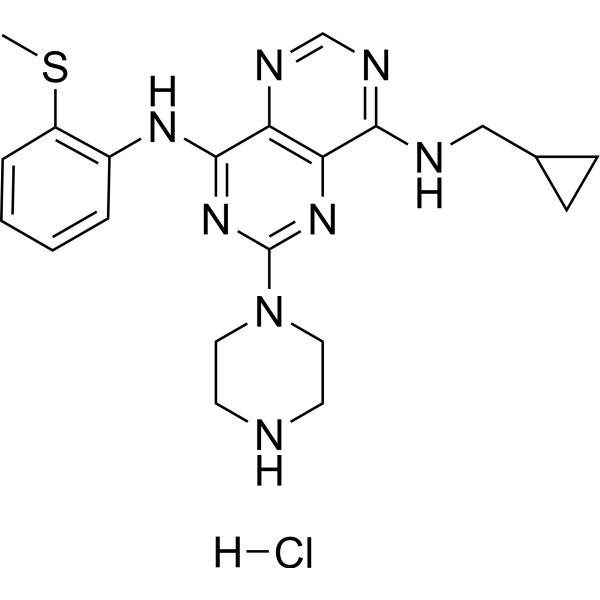
Physicochemical Properties
| Molecular Formula | C21H27CLN8S |
| Molecular Weight | 459.013 |
| Exact Mass | 458.176 |
| CAS # | 1303470-48-5 |
| Related CAS # | KHK-IN-1;1303469-70-6 |
| PubChem CID | 92044374 |
| Appearance | Light yellow to yellow solid powder |
| Hydrogen Bond Donor Count | 4 |
| Hydrogen Bond Acceptor Count | 9 |
| Rotatable Bond Count | 7 |
| Heavy Atom Count | 31 |
| Complexity | 543 |
| Defined Atom Stereocenter Count | 0 |
| InChi Key | VKIBPWKARAEIHN-UHFFFAOYSA-N |
| InChi Code | InChI=1S/C21H26N8S.ClH/c1-30-16-5-3-2-4-15(16)26-20-17-18(19(25-13-24-17)23-12-14-6-7-14)27-21(28-20)29-10-8-22-9-11-29;/h2-5,13-14,22H,6-12H2,1H3,(H,23,24,25)(H,26,27,28);1H |
| Chemical Name | 8-N-(cyclopropylmethyl)-4-N-(2-methylsulfanylphenyl)-2-piperazin-1-ylpyrimido[5,4-d]pyrimidine-4,8-diamine;hydrochloride |
| Synonyms | INVIVO 0485; INVIVO0485; INVIVO-0485 |
| HS Tariff Code | 2934.99.9001 |
| Storage |
Powder-20°C 3 years 4°C 2 years In solvent -80°C 6 months -20°C 1 month Note: Please store this product in a sealed and protected environment, avoid exposure to moisture. |
| Shipping Condition | Room temperature (This product is stable at ambient temperature for a few days during ordinary shipping and time spent in Customs) |
Biological Activity
| ln Vitro | KHK-IN-1 hydrochloride does not significantly inhibit cytochrome P450 (1A2, 2C19, 2D6, 2C9, and 3A4) and is stable in human and rat liver microsomal preparations (88% and 72% residual at 10 minutes)[1]. HepG2 cell lysate generation of F1P is inhibited by KHK-IN-1 hydrochloride (0-10 µM; incubate for 30 minutes, then add 15 mM fructose and incubate for an additional 3 hours) with an IC50 value of 400 nM [1]. |
| ln Vivo | In rats, KHK-IN-1 hydrochloride (10 mg/kg; oral; single dosage) has an oral bioavailability of 34% [1]. |
| Cell Assay |
Cell viability assay [1] Cell Types: HepG2 Cell Tested Concentrations: 0-10 µM Incubation Duration: Incubate for 30 minutes, then add 15 mM fructose, and incubate for another 3 hrs (hours). Experimental Results: F1P production in HepG2 cell lysate was inhibited (IC50= 400 nm ). |
| Animal Protocol |
Animal/Disease Models: Male SD (SD (Sprague-Dawley)) rat (approximately 250 g) [1]. Doses: 10 mg/kg Route of Administration: po (oral gavage); single Experimental Results:demonstrated reasonable oral bioavailability in rats (F=34%; oral t1/2=4 h), but had a high volume of distribution ( Vdss=32 L/kg) and high clearance (CL=160 mL/min/kg). |
| References |
[1]. Inhibitors of Ketohexokinase: Discovery of Pyrimidinopyrimidines with Specific Substitution that Complements the ATP-Binding Site. ACS Med Chem Lett. 2011 Apr 18;2(7):538-43. |
Solubility Data
| Solubility (In Vitro) |
DMSO : ~25 mg/mL (~54.47 mM) H2O : ~14.29 mg/mL (~31.13 mM) |
| Solubility (In Vivo) |
Solubility in Formulation 1: ≥ 2.08 mg/mL (4.53 mM) (saturation unknown) in 10% DMSO + 40% PEG300 + 5% Tween80 + 45% Saline (add these co-solvents sequentially from left to right, and one by one), clear solution. For example, if 1 mL of working solution is to be prepared, you can add 100 μL of 20.8 mg/mL clear DMSO stock solution to 400 μL PEG300 and mix evenly; then add 50 μL Tween-80 to the above solution and mix evenly; then add 450 μL normal saline to adjust the volume to 1 mL. Preparation of saline: Dissolve 0.9 g of sodium chloride in 100 mL ddH₂ O to obtain a clear solution. Solubility in Formulation 2: ≥ 2.08 mg/mL (4.53 mM) (saturation unknown) in 10% DMSO + 90% (20% SBE-β-CD in Saline) (add these co-solvents sequentially from left to right, and one by one), clear solution. For example, if 1 mL of working solution is to be prepared, you can add 100 μL of 20.8 mg/mL clear DMSO stock solution to 900 μL of 20% SBE-β-CD physiological saline solution and mix evenly. Preparation of 20% SBE-β-CD in Saline (4°C,1 week): Dissolve 2 g SBE-β-CD in 10 mL saline to obtain a clear solution. (Please use freshly prepared in vivo formulations for optimal results.) |
| Preparing Stock Solutions | 1 mg | 5 mg | 10 mg | |
| 1 mM | 2.1786 mL | 10.8930 mL | 21.7860 mL | |
| 5 mM | 0.4357 mL | 2.1786 mL | 4.3572 mL | |
| 10 mM | 0.2179 mL | 1.0893 mL | 2.1786 mL |