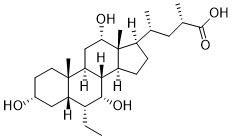
INT-777 (INT777), a semisynthetic bile acid, is a novel and potent TGR5 agonist (bile acid receptor agonist) with an EC50 of 0.82 μM. It is able to mitigate inflammatory response in human endometriotic stromal cells and thus has therapeutic implication for endometriosis.
Physicochemical Properties
| Molecular Formula | C₂₇H₄₆O₅ |
| Molecular Weight | 450.6511 |
| Exact Mass | 450.335 |
| CAS # | 1199796-29-6 |
| Related CAS # | INT-777 R-enantiomer;1198786-98-9 |
| PubChem CID | 45483949 |
| Appearance | White to yellow solid powder |
| LogP | 4.33 |
| Hydrogen Bond Donor Count | 4 |
| Hydrogen Bond Acceptor Count | 5 |
| Rotatable Bond Count | 5 |
| Heavy Atom Count | 32 |
| Complexity | 710 |
| Defined Atom Stereocenter Count | 13 |
| SMILES | CC[C@@H]1[C@@H]2C[C@@H](CC[C@@]2([C@H]3C[C@@H]([C@]4([C@H]([C@@H]3[C@@H]1O)CC[C@@H]4[C@H](C)C[C@H](C)C(=O)O)C)O)C)O |
| InChi Key | NPBCMXATLRCCLF-IRRLEISYSA-N |
| InChi Code | InChi Code InChI=1S/C27H46O5/c1-6-17-20-12-16(28)9-10-26(20,4)21-13-22(29)27(5)18(14(2)11-15(3)25(31)32)7-8-19(27)23(21)24(17)30/h14-24,28-30H,6-13H2,1-5H3,(H,31,32)/t14-,15+,16-,17-,18-,19+,20+,21+,22+,23+,24-,26+,27-/m1/s1 |
| Chemical Name | (2S,4R)-4-((3R,5S,6R,7R,8R,9S,10S,12S,13R,14S,17R)-6-ethyl-3,7,12-trihydroxy-10,13-dimethylhexadecahydro-1H-cyclopenta[a]phenanthren-17-yl)-2-methylpentanoic acid |
| Synonyms | INT-777 S-EMCAINT 777 6-EMCAINT777 |
| HS Tariff Code | 2934.99.9001 |
| Storage |
Powder-20°C 3 years 4°C 2 years In solvent -80°C 6 months -20°C 1 month |
| Shipping Condition | Room temperature (This product is stable at ambient temperature for a few days during ordinary shipping and time spent in Customs) |
Biological Activity
| Targets |
EC50: 0.82 μM (TGR5)[1] TGR5 receptor (EC₅₀ = 0.82 μM, efficacy = 166%) FXR receptor (EC₅₀ > 100 μM, efficacy = 18%) [1] TGR5 receptor (selective and potent agonist, reported in Figure 1 as a 30-fold improvement over CA) [2] |
| ln Vitro |
A novel, highly effective, and selective TGR5 agonist with notable in vivo activity is called INT-777 [1]. In a cAMP-dependent way, INT-777 (3 μM) boosts ATP synthesis in the human enteroendocrine cell line NCI-H716 [2]. Adding INT-777 (10 μM) to the serosal side of distal colon segments stripped of serosal tissue results in a decrease in Isc and an increase in TEER. In preparations of the muco-submucosa that were treated with TTX and neuron-free, the impact of INT-777 on basal secretion was diminished [3]. INT-777 dose-dependently induces GLP-1 release ex vivo in ileal explants isolated from high-fat-fed TGR5 transgenic mice. [1] In STC-1 murine enteroendocrine cell line, bile acid-mediated activation of TGR5 leads to increased intracellular cAMP levels, triggering GLP-1 release. [1] In enteroendocrine STC-1 cells, INT-777 triggered a dose-dependent increase in intracellular cAMP levels. This induction was abrogated upon reduction of TGR5 expression by a specific TGR5 shRNA. [2] In human enteroendocrine NCI-H716 cells, INT-777 increased intracellular calcium influx in a TGR5- and cAMP-dependent manner. This effect was potentiated by TGR5 overexpression and inhibited by TGR5 RNA interference or adenylate cyclase inhibitor MDL-12330A. [2] In NCI-H716 cells, INT-777 treatment increased GLP-1 release, an effect inhibited by MDL-12330A. [2] In mouse enteroendocrine STC-1 cells, GLP-1 release triggered by INT-777 was enhanced by TGR5 overexpression and prevented by TGR5 RNA interference or MDL-12330A. [2] In STC-1 cells, treatment with INT-777 resulted in a cAMP-dependent increase in cytochrome c oxidase (Cox) activity, cellular oxygen consumption, and ATP/ADP ratio. [2] In primary brown adipocytes isolated from C57BL/6J mice, treatment with 3 μM INT-777 for 12 hours increased basal O₂ consumption, and the response to the uncoupling agent FCCP was more pronounced. [2] |
| ln Vivo |
INT-777 (1 μM/min/kg, oral) is a strong choleretic that favors the biliary-hepatic shunt channel with ducts in HF-fed TGR5-Tg men. It also inhibits the activation and subsequent binding of carboxy-CoA [1]. When given to TGR5-Tg mice that are fed a high-fat diet, INT-777 (30 mg/kg/day) enhances energy expenditure and decreases obesity and hepatic steatosis [2]. In diet-induced obese mice, pharmacological targeting of TGR5 by INT-777 increases energy expenditure, resulting in reduced weight gain and adiposity. [1] INT-777 improves liver function in high-fat-fed mice, reducing steatosis and fibrosis. [1] In diet-induced obese (DIO) C57BL/6J mice, dietary intervention with INT-777 (30 mg/kg/day) for 10 weeks significantly attenuated body weight gain (~15%), reduced fat mass, and decreased liver and fat pad mass compared to high-fat (HF)-fed controls. [2] In DIO mice, INT-777 treatment increased energy expenditure (as measured by O₂ consumption and CO₂ production) and reduced the respiratory quotient during the dark period, consistent with increased fat oxidation. [2] INT-777 treatment improved liver function in DIO mice, evidenced by reduced liver steatosis (assessed by oil-red-O staining and liver lipid content), lower plasma levels of liver enzymes, and absence of liver fibrosis (assessed by Sirius red staining). [2] Plasma triglyceride and non-esterified fatty acid (NEFA) levels were significantly reduced in HF-fed mice treated with INT-777. [2] In both DIO and db/db mice, treatment with INT-777 (30 mg/kg/day) robustly improved oral glucose tolerance and improved glucose-stimulated insulin secretion profiles. Fasting glucose and insulin levels were decreased. [2] Hyperinsulinemic-euglycemic clamp studies in DIO mice treated with INT-777 showed normalized glucose infusion rates, hepatic glucose production, glucose disposal rates, and insulin-mediated suppression of glucose production. Insulin-stimulated glucose uptake was improved in liver and muscle. [2] In TGR5 transgenic (TGR5-Tg) mice fed a high-fat diet, oral glucose tolerance was markedly improved compared to controls, associated with enhanced postprandial GLP-1 and insulin secretion. Pancreatic islets from TGR5-Tg mice showed higher insulin content and a more normal size distribution. [2] In TGR5 deficient (TGR5⁻/⁻) mice fed a high-fat diet, glucose tolerance was impaired. The ability of INT-777 to improve glucose tolerance and insulin secretion was blunted in TGR5⁻/⁻ mice, confirming its TGR5-dependent action. [2] Pre-administration of INT-777 (30 mg/kg) moderately increased GLP-1 release after a glucose challenge in TGR5⁺/⁺ mice, an effect markedly potentiated by co-administration of a DPP4 inhibitor. This effect was blunted in TGR5⁻/⁻ mice. [2] |
| Enzyme Assay |
The ability of compounds to activate TGR5 was assessed in CHO cells transiently transfected with human TGR5, using a cAMP-responsive element-driven luciferase reporter assay. [1] FXR activity was evaluated in COS1 cells using a cell-based bioluminescence assay. [1] Cytochrome c oxidase (Cox) activity was evaluated in STC-1 cells by following the oxidation of fully reduced cytochrome C at 550 nm. Cells were treated with INT-777 at indicated concentrations for 1 hour. Vehicle or the adenylate cyclase inhibitor MDL-12330A (1 μM) was added 15 minutes prior to treatment. [2] cAMP production was measured in STC-1 cells transfected with control or mTGR5 shRNA and treated with indicated concentrations of INT-777. [2] |
| Cell Assay |
The experiments are carried out in STC-1 or NCI-H716 cells treated with vehicle (DMSO) or INT-777. INT-777 is assessed for its agonistic activity on TGR5. cAMP production is performed. Cytochrome C oxidase activity is evaluated by following the oxidation of fully reduced cytochrome C at 550 nm. ATP/ADP ratio and GLP-1 release is measured according to the manufacturers instruction. Primary brown adipocytes are prepared and ileal explants are prepared. TGR5-mediated GLP-1 release was assessed in STC-1 enteroendocrine cells. [1] Ex vivo GLP-1 release was measured in ileal explants from TGR5 transgenic mice after exposure to INT-777. [1] Intracellular calcium levels were quantified in NCI-H716 cells seeded in Matrigel-coated 96-well plates. After transfection with mock vector, hTGR5 expression vector, or hTGR5 siRNA for 72 hours, cells were washed and assayed for intracellular calcium using Fluo-4 AM dye according to the manufacturer's protocol. Cells were then treated with INT-777 (1 μM or 10 μM), and calcium flux was measured. [2] GLP-1 release was measured in NCI-H716 and STC-1 cell culture supernatants after treatment with INT-777 (with or without glucose or inhibitors) according to the manufacturer's instructions. For STC-1 cells, a DPP4 inhibitor was added to the culture medium to prevent GLP-1 degradation. [2] Cellular oxygen consumption was measured in STC-1 cells using an extracellular flux analyzer. Cells were treated with vehicle or adenylate cyclase inhibitor MDL-12330A, followed by treatment with 1 μM INT-777. [2] ATP/ADP ratio was measured in STC-1 cell lysates after treatment with INT-777 according to the manufacturer's instructions. [2] Ex vivo GLP-1 release was measured in ileal explants isolated from high-fat-fed TGR5-Tg and control mice. Explants were exposed for 1 hour to indicated concentrations of lithocholic acid (LCA). [2] |
| Animal Protocol |
In bile fistula rat models, INT-777 was administered intravenously (femoral vein infusion) or intraduodenally at a dose of 1 μmol/min/kg body weight for 1 hour. Bile secretion parameters were collected and analyzed. [1] In diet-induced obese mice, INT-777 was administered pharmacologically to assess effects on energy expenditure, body weight, adiposity, and liver histology. [1] For dietary intervention studies in C57BL/6J mice, diet-induced obesity was induced by feeding 8-week-old mice a high-fat diet (60% calories from fat) for 14 weeks. INT-777 was then mixed with the high-fat diet at a dose sufficient to achieve an in vivo dose of 30 mg/kg/day for up to 10 weeks. Body weight, food intake, and metabolic parameters were monitored. [2] In db/db mice, 14-week-old animals were fed a chow diet without or with INT-777 (30 mg/kg/day) mixed into the diet for 6 weeks. [2] In TGR5⁺/⁺ and TGR5⁻/⁻ mice, high-fat diet feeding was initiated for 9 weeks. After a first oral glucose tolerance test (OGTT), the high-fat diet was supplemented with INT-777 at 30 mg/kg/day for 4 weeks, followed by a second OGTT. [2] For acute GLP-1 secretion studies, TGR5⁺/⁺ and TGR5⁻/⁻ mice on a chow diet received an oral gavage of saline or INT-777 (30 mg/kg), alone or in combination with a DPP4 inhibitor (3 mg/kg), 30 minutes prior to an oral glucose challenge. Blood was collected for GLP-1 measurement. [2] Hyperinsulinemic-euglycemic clamp studies were performed on DIO mice after 10 weeks of dietary intervention with INT-777. Mice were fasted, and a primed continuous infusion of insulin (10 mU/min/kg) was administered to maintain euglycemia. Tritiated glucose was infused to assess glucose kinetics, and ¹⁴C-2-deoxyglucose was injected to measure tissue-specific glucose uptake. [2] TGR5 transgenic (TGR5-Tg) mice were generated by oocyte injection of a bacterial artificial chromosome (BAC) containing the TGR5 locus. TGR5 deficient (TGR5⁻/⁻) mice were generated by crossing mice with a floxed TGR5 allele with CMV-Cre transgenic mice. [2] |
| ADME/Pharmacokinetics |
INT-777 is highly stable in human stool broth culture, with >95% remaining unchanged after 12 hours of incubation, indicating resistance to bacterial 7α-dehydroxylation. [1] It exhibits a potent choleretic effect, with a high maximum bile secretion rate and resistance to conjugation; >90% is secreted into bile in unconjugated form after intravenous or intraduodenal infusion. [1] INT-777 shows relatively high albumin binding (62%), which may facilitate its systemic circulation and targeting of peripheral tissues. [1] HPLC analysis confirmed the presence of INT-777 in the plasma of treated mice, with levels within the range of endogenous cholic acid and β-muricholic acid. [2] INT-777 treatment did not significantly alter overall plasma bile acid composition or the expression profile of enzymes involved in bile acid synthesis. [2] |
| References |
[1]. Discovery of 6alpha-ethyl-23(S)-methylcholic acid (S-EMCA, INT-777) as a potent and selective agonist for the TGR5 receptor, a novel target for diabesity. J Med Chem. 2009 Dec 24;52(24):7958-61. [2]. TGR5-mediated bile acid sensing controls glucose homeostasis. Cell Metab. 2009 Sep;10(3):167-77. [3]. Reduction of epithelial secretion in male rat distal colonic mucosa by bile acid receptor TGR5 agonist, INT-777: role of submucosal neurons. Neurogastroenterol Motil. 2016 Jun 3. doi: 10.1111/nmo. [4]. INT-777, a bile acid receptor agonist, extenuates pancreatic acinar cells necrosis in a mouse model of acute pancreatitis. Biochem Biophys Res Commun. 2018 Sep 3;503(1):38-44. |
| Additional Infomation |
INT-777 is a derivative of cholic acid with a 6α-ethyl and 23(S)-methyl modification, designed to enhance TGR5 selectivity and metabolic stability. [1] It is a potent and selective TGR5 agonist with potential therapeutic applications in metabolic disorders such as diabetes, obesity, and nonalcoholic steatohepatitis. [1] The compound is resistant to intestinal bacterial metabolism and exhibits favorable physicochemical properties, including lower detergency and higher metabolic stability compared to natural bile acids. [1] INT-777 is a semi-synthetic derivative of cholic acid with 6α-ethyl and 23(S)-methyl modifications, designed as a potent and selective TGR5 agonist with no activity on FXR. [2] The mechanism of action involves TGR5 activation leading to increased intracellular cAMP, which enhances mitochondrial oxidative phosphorylation, raises the ATP/ADP ratio, closes K_ATP channels, mobilizes calcium via Cav channels, and ultimately stimulates GLP-1 release from enteroendocrine L-cells. [2] Activation of TGR5 by INT-777 also increases energy expenditure in brown adipose tissue and muscle, contributing to reduced adiposity and improved metabolic profile. [2] The study suggests that pharmacological targeting of TGR5 with INT-777 represents a promising strategy for the treatment of diabetes, obesity, and associated metabolic disorders such as nonalcoholic steatohepatitis (NASH). [2] The effects of INT-777 on improving glucose tolerance, insulin sensitivity, and reducing hepatic steatosis were demonstrated to be dependent on TGR5 expression, as they were absent or blunted in TGR5-deficient mice. [2] |
Solubility Data
| Solubility (In Vitro) |
Ethanol :≥ 50 mg/mL (~110.95 mM) DMSO : ≥ 31 mg/mL (~68.79 mM) |
| Solubility (In Vivo) |
Solubility in Formulation 1: ≥ 2.5 mg/mL (5.55 mM) (saturation unknown) in 10% EtOH + 40% PEG300 + 5% Tween80 + 45% Saline (add these co-solvents sequentially from left to right, and one by one), clear solution. For example, if 1 mL of working solution is to be prepared, you can add 100 μL of 25.0 mg/mL clear EtOH stock solution to 400 μL PEG300 and mix evenly; then add 50 μL Tween-80 to the above solution and mix evenly; then add 450 μL normal saline to adjust the volume to 1 mL. Preparation of saline: Dissolve 0.9 g of sodium chloride in 100 mL ddH₂ O to obtain a clear solution. Solubility in Formulation 2: ≥ 2.5 mg/mL (5.55 mM) (saturation unknown) in 10% EtOH + 90% (20% SBE-β-CD in Saline) (add these co-solvents sequentially from left to right, and one by one), clear solution. For example, if 1 mL of working solution is to be prepared, you can add 100 μL of 25.0 mg/mL clear EtOH stock solution to 900 μL of 20% SBE-β-CD physiological saline solution and mix evenly. Preparation of 20% SBE-β-CD in Saline (4°C,1 week): Dissolve 2 g SBE-β-CD in 10 mL saline to obtain a clear solution. Solubility in Formulation 3: ≥ 2.5 mg/mL (5.55 mM) (saturation unknown) in 10% EtOH + 90% Corn Oil (add these co-solvents sequentially from left to right, and one by one), clear solution. For example, if 1 mL of working solution is to be prepared, you can add 100 μL of 25.0 mg/mL clear EtOH stock solution to 900 μL of corn oil and mix evenly. Solubility in Formulation 4: 5 mg/mL (11.10 mM) in 0.5% CMC-Na/saline water (add these co-solvents sequentially from left to right, and one by one), Suspension solution; with ultrasonication. Preparation of saline: Dissolve 0.9 g of sodium chloride in 100 mL ddH₂ O to obtain a clear solution. (Please use freshly prepared in vivo formulations for optimal results.) |
| Preparing Stock Solutions | 1 mg | 5 mg | 10 mg | |
| 1 mM | 2.2190 mL | 11.0951 mL | 22.1902 mL | |
| 5 mM | 0.4438 mL | 2.2190 mL | 4.4380 mL | |
| 10 mM | 0.2219 mL | 1.1095 mL | 2.2190 mL |