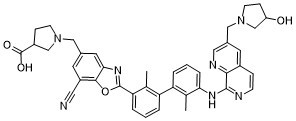
INCB-086550 (INCB-086550) is a novel, investigational and selective small molecule PD-1/PD-L1 inhibitor based on the biphenyl scaffold core structure first disclosed by BMS company. It acts by blocking the activity of the programmed cell death protein 1 (PD-1) inhibitory receptor with therapeutic antibodies against either the ligand (PD-L1) or PD-1 itself has proven to be an effective treatment modality for multiple cancers. Contrasting with antibodies, small molecules could demonstrate increased tissue penetration, distinct pharmacology, and potentially enhanced antitumor activity.
Physicochemical Properties
| Molecular Formula | C41H39N7O4 |
| Molecular Weight | 693.808 |
| Exact Mass | 693.31 |
| Elemental Analysis | C, 70.98; H, 5.67; N, 14.13; O, 9.22 |
| CAS # | 2230911-59-6 |
| PubChem CID | 135146787 |
| Appearance | Light yellow to yellow solid powder |
| Density | 1.42±0.1 g/cm3(Predicted) |
| Boiling Point | 859.8±65.0 °C(Predicted) |
| LogP | 3.1 |
| Hydrogen Bond Donor Count | 3 |
| Hydrogen Bond Acceptor Count | 11 |
| Rotatable Bond Count | 9 |
| Heavy Atom Count | 52 |
| Complexity | 1280 |
| Defined Atom Stereocenter Count | 2 |
| SMILES | O([H])[C@]1([H])C([H])([H])C([H])([H])N(C([H])([H])C2=C([H])N=C3C(=NC([H])=C([H])C3=C2[H])N([H])C2=C([H])C([H])=C([H])C(=C2C([H])([H])[H])C2C([H])=C([H])C([H])=C(C=2C([H])([H])[H])C2=NC3C(=C(C#N)C([H])=C(C=3[H])C([H])([H])N3C([H])([H])C([H])([H])[C@@]([H])(C(=O)O[H])C3([H])[H])O2)C1([H])[H] |
| InChi Key | QARLNMDDSQMINK-UHFFFAOYSA-N |
| InChi Code | InChI=1S/C41H39N7O4/c1-24-32(5-3-7-34(24)40-46-36-17-26(15-30(18-42)38(36)52-40)20-47-13-10-29(22-47)41(50)51)33-6-4-8-35(25(33)2)45-39-37-28(9-12-43-39)16-27(19-44-37)21-48-14-11-31(49)23-48/h3-9,12,15-17,19,29,31,49H,10-11,13-14,20-23H2,1-2H3,(H,43,45)(H,50,51) |
| Chemical Name | 1-((7-cyano-2-(3'-((3-((3-hydroxypyrrolidin-1-yl)methyl)-1,7-naphthyridin-8-yl)amino)-2,2'-dimethyl-[1,1'-biphenyl]-3-yl)benzo[d]oxazol-5-yl)methyl)pyrrolidine-3-carboxylic acid |
| Synonyms | INCB 086550; PD-1/PD-L1-IN-8; PD-1; INCB-86550; INCB86550; PD-L1-IN-8;INCB-086550;INCB086550; INCB 86550; |
| HS Tariff Code | 2934.99.9001 |
| Storage |
Powder-20°C 3 years 4°C 2 years In solvent -80°C 6 months -20°C 1 month |
| Shipping Condition | Room temperature (This product is stable at ambient temperature for a few days during ordinary shipping and time spent in Customs) |
Biological Activity
| ln Vitro | For pleural effusion cells, INCB086550 (0.1–10,000 nM, 20 hours) has no discernible toxicity [1]. PD-L1 on the cell surface dimerizes when exposed to NCB086550 (1 µmol/L) for 24 hours, which causes internalization [1]. |
| ln Vivo | In the MDA-MB-231 mouse model, INCB086550 (15, 200 mg/kg, active region, once or twice) suppresses over 90% of occupied cell surface PD-L1 [1]. The MC38 huPD-L1 tumor model is inhibited in its growth by INCB086550 (2, 20, or 200 mg/kg, twice daily in mouse model) [1]. |
| Cell Assay |
Cell viability assay [1] Cell Types: pleural effusion cells Tested Concentrations: 0.1-10000 nM Incubation Duration: 20 hrs (hours) Experimental Results: No obvious toxicity to pleural effusion cells. Immunofluorescence[1] Cell Types: CHO PD-L1 Cell Tested Concentrations: 1 µmol/L Incubation Duration: 24 hrs (hours) Experimental Results: Overall PD-L1 reduction in CHO PD-L1 cells. Demonstrates rapid internalization of PD-L1, reaching maximum in approximately 4 hrs (hours). |
| Animal Protocol |
Animal/Disease Models: Mice bearing MDA-MB-231 xenografts [1] Doses: 15, 200 mg/kg Route of Administration: po (oral gavage) Experimental Results: MDA-MB-231 unoccupied tumors after 24 hrs (hrs (hours)) Cell surface PD-L1 is diminished. Animal/Disease Models: C57BL/6 and NSG mice with established MC38-huPD-L1 tumors [1] Doses: 2, 20 or 200 mg/kg Route of Administration: po (oral gavage) Experimental Results: Induction of PD- L1 dose-dependent reduction was achieved using the antibody clone MIH1 that binds to PD-1. At the 200 mg/kg dose, cell surface occupied by PD-L1 was diminished by >90%. |
| References |
[1]. BENZOOXAZOLE DERIVATIVES AS IMMUNOMODULATORS. WO2018119266A1. [2]. Characterization of INCB086550: A Potent and Novel Small-Molecule PD-L1 Inhibitor. Cancer Discov. 2022 Jun 2;12(6):1482-1499. |
| Additional Infomation | PD-L1 Inhibitor INCB086550 is an orally available, small molecule inhibitor of the immunosuppressive ligand, programmed cell death-1 ligand 1 (PD-L1; cluster of differentiation 274; CD274) with potential immune checkpoint inhibitory and antineoplastic activities. Upon administration, PD-L1 inhibitor INCB086550 specifically targets PD-L1 expressed on tumor cells preventing the binding and subsequent activation of its receptor, programmed cell death 1 (PD-1; PDCD1; CD279; programmed death-1). This reverses T-cell inactivation caused by PD-L1/PD-1 signaling, increases T-cell expansion and enhances the cytotoxic T-lymphocyte (CTL)-mediated anti-tumor immune response against PD-L1-expressing tumor cells. PD-L1, a transmembrane protein expressed on activated T-cells, is overexpressed in some cancer types and plays a significant role in immune evasion by tumor cells. |
Solubility Data
| Solubility (In Vitro) | H2O : ~83.33 mg/mL (~120.11 mM) |
| Solubility (In Vivo) |
Note: Listed below are some common formulations that may be used to formulate products with low water solubility (e.g. < 1 mg/mL), you may test these formulations using a minute amount of products to avoid loss of samples. Injection Formulations (e.g. IP/IV/IM/SC) Injection Formulation 1: DMSO : Tween 80: Saline = 10 : 5 : 85 (i.e. 100 μL DMSO stock solution → 50 μL Tween 80 → 850 μL Saline) *Preparation of saline: Dissolve 0.9 g of sodium chloride in 100 mL ddH ₂ O to obtain a clear solution. Injection Formulation 2: DMSO : PEG300 :Tween 80 : Saline = 10 : 40 : 5 : 45 (i.e. 100 μL DMSO → 400 μLPEG300 → 50 μL Tween 80 → 450 μL Saline) Injection Formulation 3: DMSO : Corn oil = 10 : 90 (i.e. 100 μL DMSO → 900 μL Corn oil) Example: Take the Injection Formulation 3 (DMSO : Corn oil = 10 : 90) as an example, if 1 mL of 2.5 mg/mL working solution is to be prepared, you can take 100 μL 25 mg/mL DMSO stock solution and add to 900 μL corn oil, mix well to obtain a clear or suspension solution (2.5 mg/mL, ready for use in animals). Injection Formulation 4: DMSO : 20% SBE-β-CD in saline = 10 : 90 [i.e. 100 μL DMSO → 900 μL (20% SBE-β-CD in saline)] *Preparation of 20% SBE-β-CD in Saline (4°C,1 week): Dissolve 2 g SBE-β-CD in 10 mL saline to obtain a clear solution. Injection Formulation 5: 2-Hydroxypropyl-β-cyclodextrin : Saline = 50 : 50 (i.e. 500 μL 2-Hydroxypropyl-β-cyclodextrin → 500 μL Saline) Injection Formulation 6: DMSO : PEG300 : castor oil : Saline = 5 : 10 : 20 : 65 (i.e. 50 μL DMSO → 100 μLPEG300 → 200 μL castor oil → 650 μL Saline) Injection Formulation 7: Ethanol : Cremophor : Saline = 10: 10 : 80 (i.e. 100 μL Ethanol → 100 μL Cremophor → 800 μL Saline) Injection Formulation 8: Dissolve in Cremophor/Ethanol (50 : 50), then diluted by Saline Injection Formulation 9: EtOH : Corn oil = 10 : 90 (i.e. 100 μL EtOH → 900 μL Corn oil) Injection Formulation 10: EtOH : PEG300:Tween 80 : Saline = 10 : 40 : 5 : 45 (i.e. 100 μL EtOH → 400 μLPEG300 → 50 μL Tween 80 → 450 μL Saline) Oral Formulations Oral Formulation 1: Suspend in 0.5% CMC Na (carboxymethylcellulose sodium) Oral Formulation 2: Suspend in 0.5% Carboxymethyl cellulose Example: Take the Oral Formulation 1 (Suspend in 0.5% CMC Na) as an example, if 100 mL of 2.5 mg/mL working solution is to be prepared, you can first prepare 0.5% CMC Na solution by measuring 0.5 g CMC Na and dissolve it in 100 mL ddH2O to obtain a clear solution; then add 250 mg of the product to 100 mL 0.5% CMC Na solution, to make the suspension solution (2.5 mg/mL, ready for use in animals). Oral Formulation 3: Dissolved in PEG400 Oral Formulation 4: Suspend in 0.2% Carboxymethyl cellulose Oral Formulation 5: Dissolve in 0.25% Tween 80 and 0.5% Carboxymethyl cellulose Oral Formulation 6: Mixing with food powders Note: Please be aware that the above formulations are for reference only. InvivoChem strongly recommends customers to read literature methods/protocols carefully before determining which formulation you should use for in vivo studies, as different compounds have different solubility properties and have to be formulated differently. (Please use freshly prepared in vivo formulations for optimal results.) |
| Preparing Stock Solutions | 1 mg | 5 mg | 10 mg | |
| 1 mM | 1.4413 mL | 7.2066 mL | 14.4132 mL | |
| 5 mM | 0.2883 mL | 1.4413 mL | 2.8826 mL | |
| 10 mM | 0.1441 mL | 0.7207 mL | 1.4413 mL |