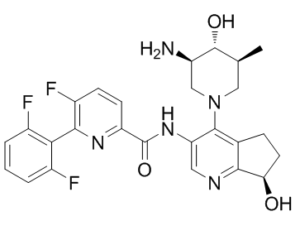
INCB053914 is a novel, potent, selective, and ATP-competitive small molecule pan-inhibitor of PIM (Proviral Integration site of Moloney murine leukemia virus) kinases with IC50 values of 0.24 nM, 30 nM and 0.12 nM for PIM1, PIM2 and PIM3 respectively in biochemical assays. In cell proliferation assays, INCB053914 is active as a single agent in the majority of cell lines derived from different hematological malignancies, including MM, AML, DLBCL, MCL and T-ALL, with IC50values ranging from 3 - 300 nM. INCB053914 synergizes with a variety of cytotoxic and targeted agents, reducing the viability of a panel of hematological tumor cell lines. In pharmacodynamic assays, INCB053914 inhibits phosphorylation of S6RP, P70S6K, 4E-BP-1 and BAD, known PIM kinase targets. INCB053914 may have therapeutic utility in hematologic malignancies when combined with other inhibitors of oncogenic kinases or standard chemotherapeutics.
Physicochemical Properties
| Molecular Formula | C26H26F3N5O3 | |
| Molecular Weight | 513.511556148529 | |
| Exact Mass | 513.198 | |
| CAS # | 1620012-39-6 | |
| Related CAS # | Uzansertib phosphate;2088852-47-3 | |
| PubChem CID | 90279868 | |
| Appearance | Typically exists as solid at room temperature | |
| LogP | 1.7 | |
| Hydrogen Bond Donor Count | 4 | |
| Hydrogen Bond Acceptor Count | 10 | |
| Rotatable Bond Count | 4 | |
| Heavy Atom Count | 37 | |
| Complexity | 803 | |
| Defined Atom Stereocenter Count | 4 | |
| SMILES | C[C@H]1CN(C[C@H]([C@@H]1O)N)C2=C3CC[C@H](C3=NC=C2NC(=O)C4=NC(=C(C=C4)F)C5=C(C=CC=C5F)F)O |
|
| InChi Key | PTORCEYGCGXHDH-OVMXCRKPSA-N | |
| InChi Code | InChI=1S/C26H26F3N5O3/c1-12-10-34(11-17(30)25(12)36)24-13-5-8-20(35)22(13)31-9-19(24)33-26(37)18-7-6-16(29)23(32-18)21-14(27)3-2-4-15(21)28/h2-4,6-7,9,12,17,20,25,35-36H,5,8,10-11,30H2,1H3,(H,33,37)/t12-,17+,20+,25+/m0/s1 | |
| Chemical Name |
|
|
| Synonyms |
|
|
| HS Tariff Code | 2934.99.9001 | |
| Storage |
Powder-20°C 3 years 4°C 2 years In solvent -80°C 6 months -20°C 1 month |
|
| Shipping Condition | Room temperature (This product is stable at ambient temperature for a few days during ordinary shipping and time spent in Customs) |
Biological Activity
| ln Vitro | All multiple myeloma (MM) cell lines examined are inhibited in their ability to proliferate by usansertib; typical GI50 values for AML, MM, DLBCL, MCL, and T-ALL cell lines range from 13.2 nM to 230.0 nM [1]. In MOLM-16 (AML) phosphorylated), Pfeiffer (DLBCL), and KMS-12-PE/BM (MM) cell lines, umansertib (0.1, 0.3, 1, 3, 10, 30, 100, 300, and 1000 nM) inhibits downstream PIM kinase substrates (p70S6K/S6 and 4E-BP1) in a dose-dependent manner [1]. In MOLM-16 and KMS-12-BM cells, PIM kinase-mediated BAD phosphorylation is especially susceptible to Uzansertib inhibition (average IC50 of 4 nM and 27 nM, respectively) [1]. |
| ln Vivo | Uzansertib (25–100 mg/kg; oral; twice daily; for 15 days) dose-dependently suppresses tumor growth in mice expressing KMS-12-BM (MM) or MOLM-16 (AML)[1]. Four hours after injection, uzansertib showed dose-dependent reduction of BAD phosphorylation in comparison to vehicle (IC50=70 nM for MOLM-16 tumors and IC50=145 nM for KMS-12-BM tumors) [1]. |
| Animal Protocol |
Animal/Disease Models: Female immunocompromised (severe combined immunodeficiency [SCID]) mice (5-9 weeks old) [1] carrying MOLM-16 (AML) or KMS-12-BM (MM) Doses: 25, 50 , 75, 100 mg/kg. Doses: Oral; twice a day; for 15 days. Experimental Results: Inhibited tumor growth in mice in a dose-dependent manner. |
| References |
[1]. Preclinical characterization of INCB053914, a novel pan-PIM kinase inhibitor, alone and in combination with anticancer agents, in models of hematologic malignancies. PLoS One. 2018 Jun 21;13(6):e0199108. |
| Additional Infomation |
Uzansertib is under investigation in clinical trial NCT02587598 (Study of INCB053914 in Subjects With Advanced Malignancies). Uzansertib is an orally available, small molecule and selective ATP-competitive pan-inhibitor of proviral integration sites for Moloney murine leukemia virus (PIM) kinases, with potential antineoplastic activity. Upon oral administration, uzansertib binds to and inhibits the activities of the three PIM isoforms, PIM1, PIM2 and PIM3. This prevents phosphorylation of their downstream targets and inhibits proliferation in cells that overexpress PIMs. PIMs, constitutively active proto-oncogenic serine/threonine kinases upregulated in various types of cancers, play key roles in tumor cell proliferation and survival. |
Solubility Data
| Solubility (In Vitro) |
|
|||
| Solubility (In Vivo) |
Note: Listed below are some common formulations that may be used to formulate products with low water solubility (e.g. < 1 mg/mL), you may test these formulations using a minute amount of products to avoid loss of samples. Injection Formulations (e.g. IP/IV/IM/SC) Injection Formulation 1: DMSO : Tween 80: Saline = 10 : 5 : 85 (i.e. 100 μL DMSO stock solution → 50 μL Tween 80 → 850 μL Saline) *Preparation of saline: Dissolve 0.9 g of sodium chloride in 100 mL ddH ₂ O to obtain a clear solution. Injection Formulation 2: DMSO : PEG300 :Tween 80 : Saline = 10 : 40 : 5 : 45 (i.e. 100 μL DMSO → 400 μLPEG300 → 50 μL Tween 80 → 450 μL Saline) Injection Formulation 3: DMSO : Corn oil = 10 : 90 (i.e. 100 μL DMSO → 900 μL Corn oil) Example: Take the Injection Formulation 3 (DMSO : Corn oil = 10 : 90) as an example, if 1 mL of 2.5 mg/mL working solution is to be prepared, you can take 100 μL 25 mg/mL DMSO stock solution and add to 900 μL corn oil, mix well to obtain a clear or suspension solution (2.5 mg/mL, ready for use in animals). Injection Formulation 4: DMSO : 20% SBE-β-CD in saline = 10 : 90 [i.e. 100 μL DMSO → 900 μL (20% SBE-β-CD in saline)] *Preparation of 20% SBE-β-CD in Saline (4°C,1 week): Dissolve 2 g SBE-β-CD in 10 mL saline to obtain a clear solution. Injection Formulation 5: 2-Hydroxypropyl-β-cyclodextrin : Saline = 50 : 50 (i.e. 500 μL 2-Hydroxypropyl-β-cyclodextrin → 500 μL Saline) Injection Formulation 6: DMSO : PEG300 : castor oil : Saline = 5 : 10 : 20 : 65 (i.e. 50 μL DMSO → 100 μLPEG300 → 200 μL castor oil → 650 μL Saline) Injection Formulation 7: Ethanol : Cremophor : Saline = 10: 10 : 80 (i.e. 100 μL Ethanol → 100 μL Cremophor → 800 μL Saline) Injection Formulation 8: Dissolve in Cremophor/Ethanol (50 : 50), then diluted by Saline Injection Formulation 9: EtOH : Corn oil = 10 : 90 (i.e. 100 μL EtOH → 900 μL Corn oil) Injection Formulation 10: EtOH : PEG300:Tween 80 : Saline = 10 : 40 : 5 : 45 (i.e. 100 μL EtOH → 400 μLPEG300 → 50 μL Tween 80 → 450 μL Saline) Oral Formulations Oral Formulation 1: Suspend in 0.5% CMC Na (carboxymethylcellulose sodium) Oral Formulation 2: Suspend in 0.5% Carboxymethyl cellulose Example: Take the Oral Formulation 1 (Suspend in 0.5% CMC Na) as an example, if 100 mL of 2.5 mg/mL working solution is to be prepared, you can first prepare 0.5% CMC Na solution by measuring 0.5 g CMC Na and dissolve it in 100 mL ddH2O to obtain a clear solution; then add 250 mg of the product to 100 mL 0.5% CMC Na solution, to make the suspension solution (2.5 mg/mL, ready for use in animals). Oral Formulation 3: Dissolved in PEG400 Oral Formulation 4: Suspend in 0.2% Carboxymethyl cellulose Oral Formulation 5: Dissolve in 0.25% Tween 80 and 0.5% Carboxymethyl cellulose Oral Formulation 6: Mixing with food powders Note: Please be aware that the above formulations are for reference only. InvivoChem strongly recommends customers to read literature methods/protocols carefully before determining which formulation you should use for in vivo studies, as different compounds have different solubility properties and have to be formulated differently. (Please use freshly prepared in vivo formulations for optimal results.) |
| Preparing Stock Solutions | 1 mg | 5 mg | 10 mg | |
| 1 mM | 1.9474 mL | 9.7369 mL | 19.4738 mL | |
| 5 mM | 0.3895 mL | 1.9474 mL | 3.8948 mL | |
| 10 mM | 0.1947 mL | 0.9737 mL | 1.9474 mL |