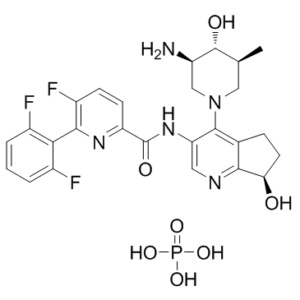
INCB053914 is a novel, potent, selective, and ATP-competitive small molecule pan-inhibitor of PIM (Proviral Integration site of Moloney murine leukemia virus) kinases with IC50 values of 0.24 nM, 30 nM and 0.12 nM for PIM1, PIM2 and PIM3 respectively in biochemical assays. In cell proliferation assays, INCB053914 is active as a single agent in the majority of cell lines derived from different hematological malignancies, including MM, AML, DLBCL, MCL and T-ALL, with IC50values ranging from 3 - 300 nM. INCB053914 synergizes with a variety of cytotoxic and targeted agents, reducing the viability of a panel of hematological tumor cell lines. In pharmacodynamic assays, INCB053914 inhibits phosphorylation of S6RP, P70S6K, 4E-BP-1 and BAD, known PIM kinase targets. INCB053914 may have therapeutic utility in hematologic malignancies when combined with other inhibitors of oncogenic kinases or standard chemotherapeutics.
Physicochemical Properties
| Molecular Formula | C26H29F3N5O7P | |
| Molecular Weight | 611.5067 | |
| Exact Mass | 611.175 | |
| CAS # | 2088852-47-3 | |
| Related CAS # | Uzansertib;1620012-39-6 | |
| PubChem CID | 126673672 | |
| Appearance | White to off-white solid powder | |
| Hydrogen Bond Donor Count | 7 | |
| Hydrogen Bond Acceptor Count | 14 | |
| Rotatable Bond Count | 4 | |
| Heavy Atom Count | 42 | |
| Complexity | 853 | |
| Defined Atom Stereocenter Count | 4 | |
| SMILES | P(=O)(O[H])(O[H])O[H].FC1C([H])=C([H])C(C(N([H])C2=C([H])N=C3[C@@]([H])(C([H])([H])C([H])([H])C3=C2N2C([H])([H])[C@]([H])([C@@]([H])([C@@]([H])(C([H])([H])[H])C2([H])[H])O[H])N([H])[H])O[H])=O)=NC=1C1C(=C([H])C([H])=C([H])C=1F)F |
|
| InChi Key | CYYVLFVRZDZABX-SEDYQSMDSA-N | |
| InChi Code | InChI=1S/C26H26F3N5O3.H3O4P/c1-12-10-34(11-17(30)25(12)36)24-13-5-8-20(35)22(13)31-9-19(24)33-26(37)18-7-6-16(29)23(32-18)21-14(27)3-2-4-15(21)28;1-5(2,3)4/h2-4,6-7,9,12,17,20,25,35-36H,5,8,10-11,30H2,1H3,(H,33,37);(H3,1,2,3,4)/t12-,17+,20+,25+;/m0./s1 | |
| Chemical Name |
|
|
| Synonyms |
|
|
| HS Tariff Code | 2934.99.9001 | |
| Storage |
Powder-20°C 3 years 4°C 2 years In solvent -80°C 6 months -20°C 1 month Note: Please store this product in a sealed and protected environment, avoid exposure to moisture. |
|
| Shipping Condition | Room temperature (This product is stable at ambient temperature for a few days during ordinary shipping and time spent in Customs) |
Biological Activity
| ln Vitro | All investigated multiple myeloma (MM) cell lines are inhibited in their proliferation by umansertib phosphate; typical GI50 values for AML, MM, DLBCL, MCL, and T-ALL cell lines range from 13.2 nM to 230.0 nM [1]. The phosphorylation of downstream PIM kinase substrates (p70S6K/S6 and 4E-BP1) is inhibited by umansertib phosphate (0.1, 0.3, 1, 3, 10, 30, 100, 300, 1000 nM) in a dose-dependent manner in MOLM-16 alteration. AML), KMS-12-PE/BM (MM), and Pfeiffer (DLBCL) cell lines [1]. In MOLM-16 and KMS-12-BM cells, PIM kinase-mediated BAD phosphorylation is especially susceptible to Uzansertib phosphate inhibition (mean IC50 of 4 nM and 27 nM, respectively) [1]. |
| ln Vivo | In mice with MOLM-16 (AML) or KMS-12-BM (MM) tumors, usansertib phosphate (25–100 mg/kg; oral; twice daily; for 15 days) suppresses tumor growth in a dose-dependent manner[1]. Four hours after injection, uzansertib phosphate showed dose-dependent reduction of BAD phosphorylation in comparison to vehicle (IC50=70 nM for MOLM-16 tumors and IC50=145 nM for KMS-12-BM tumors) [1]. |
| Animal Protocol |
Animal/Disease Models: Female immunocompromised (severe combined immunodeficiency [SCID]) mice (5-9 weeks old) [1] carrying MOLM-16 (AML) or KMS-12-BM (MM) Doses: 25, 50 , 75, 100 mg/kg. Doses: Oral; twice a day; for 15 days. Experimental Results: Inhibited tumor growth in mice in a dose-dependent manner. |
| References |
[1]. Preclinical characterization of INCB053914, a novel pan-PIM kinase inhibitor, alone and in combination with anticancer agents, in models of hematologic malignancies. PLoS One. 2018 Jun 21;13(6):e0199108. |
Solubility Data
| Solubility (In Vitro) |
|
|||
| Solubility (In Vivo) |
Solubility in Formulation 1: ≥ 1.8 mg/mL (2.94 mM) (saturation unknown) in 10% DMSO + 40% PEG300 + 5% Tween80 + 45% Saline (add these co-solvents sequentially from left to right, and one by one), clear solution. For example, if 1 mL of working solution is to be prepared, you can add 100 μL of 18.0 mg/mL clear DMSO stock solution to 400 μL PEG300 and mix evenly; then add 50 μL Tween-80 to the above solution and mix evenly; then add 450 μL normal saline to adjust the volume to 1 mL. Preparation of saline: Dissolve 0.9 g of sodium chloride in 100 mL ddH₂ O to obtain a clear solution. Solubility in Formulation 2: ≥ 1.8 mg/mL (2.94 mM) (saturation unknown) in 10% DMSO + 90% (20% SBE-β-CD in Saline) (add these co-solvents sequentially from left to right, and one by one), clear solution. For example, if 1 mL of working solution is to be prepared, you can add 100 μL of 18.0 mg/mL clear DMSO stock solution to 900 μL of 20% SBE-β-CD physiological saline solution and mix evenly. Preparation of 20% SBE-β-CD in Saline (4°C,1 week): Dissolve 2 g SBE-β-CD in 10 mL saline to obtain a clear solution. Solubility in Formulation 3: ≥ 1.8 mg/mL (2.94 mM) (saturation unknown) in 10% DMSO + 90% Corn Oil (add these co-solvents sequentially from left to right, and one by one), clear solution. For example, if 1 mL of working solution is to be prepared, you can add 100 μL of 18.0 mg/mL clear DMSO stock solution to 900 μL of corn oil and mix evenly. (Please use freshly prepared in vivo formulations for optimal results.) |
| Preparing Stock Solutions | 1 mg | 5 mg | 10 mg | |
| 1 mM | 1.6353 mL | 8.1765 mL | 16.3530 mL | |
| 5 mM | 0.3271 mL | 1.6353 mL | 3.2706 mL | |
| 10 mM | 0.1635 mL | 0.8176 mL | 1.6353 mL |