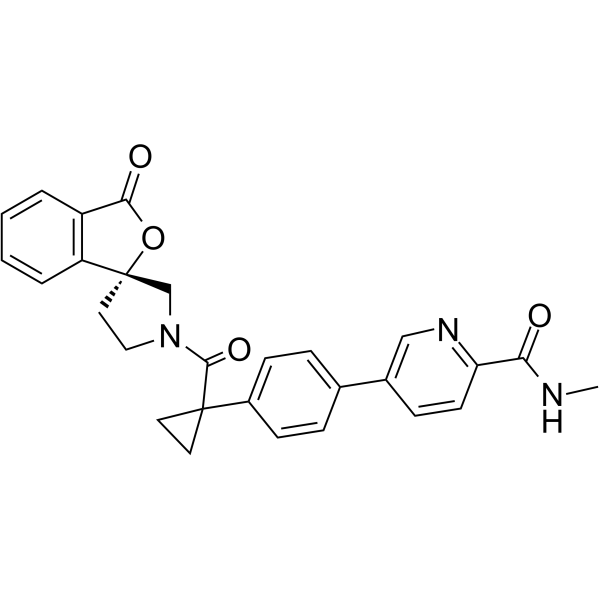
Physicochemical Properties
| Molecular Formula | C28H25N3O4 |
| Molecular Weight | 467.52 |
| Exact Mass | 467.184 |
| CAS # | 869974-19-6 |
| PubChem CID | 66662059 |
| Appearance | Off-white to light yellow solid powder |
| LogP | 2.9 |
| Hydrogen Bond Donor Count | 1 |
| Hydrogen Bond Acceptor Count | 5 |
| Rotatable Bond Count | 4 |
| Heavy Atom Count | 35 |
| Complexity | 864 |
| Defined Atom Stereocenter Count | 1 |
| SMILES | C1C=CC=C2C=1C(=O)O[C@@]12CCN(C1)C(=O)C1(CC1)C1C=CC(C2=CN=C(C(NC)=O)C=C2)=CC=1 |
| InChi Key | BDQCDIWFPIDPQU-NDEPHWFRSA-N |
| InChi Code | InChI=1S/C28H25N3O4/c1-29-24(32)23-11-8-19(16-30-23)18-6-9-20(10-7-18)27(12-13-27)26(34)31-15-14-28(17-31)22-5-3-2-4-21(22)25(33)35-28/h2-11,16H,12-15,17H2,1H3,(H,29,32)/t28-/m0/s1 |
| Chemical Name | N-methyl-5-[4-[1-[(1R)-3-oxospiro[2-benzofuran-1,3'-pyrrolidine]-1'-carbonyl]cyclopropyl]phenyl]pyridine-2-carboxamide |
| HS Tariff Code | 2934.99.9001 |
| Storage |
Powder-20°C 3 years 4°C 2 years In solvent -80°C 6 months -20°C 1 month |
| Shipping Condition | Room temperature (This product is stable at ambient temperature for a few days during ordinary shipping and time spent in Customs) |
Biological Activity
| ln Vitro | For 11β-HSD2, mineralocorticoid receptor (MR), and glucocorticoid receptor (GR), INCB13739 exhibits >1000-fold selectivity [1]. |
| ln Vivo | INCB13739 (oral) is efficiently distributed in adipose tissue and inhibits 11β-HSD1 activity by >90% for at least 24 hours after administration [1]. INCB13739 (3 mg/kg IV; 10 mg/kg PO; once) demonstrated good oral bioavailability in both rats and cynomolgus monkeys [1]. Pharmacokinetic parameters of INCB13739 in rats [1]. IV (3 mg/kg) PO (10 mg/kg) Cmax (μM) 6.46 ± 2.41 AUC0-24 (ng/mL*h) 11.2 ± 3.27 t1/2 (h) 1.4 ± 0.2 1.2 ± 0.3 CL ((L /h)/kg) 1.0 ± 0.2 Vdss (L/kg) 1.6 ± 0.5 F (%) 51 ± 15 |
| Animal Protocol |
Animal/Disease Models: Rat, cynomolgus monkey[1] Doses: 3 mg/kg (IV), 10 mg/ kg (PO) Route of Administration: IV and PO, once (pharmacokinetic/PK/PK analysis) Experimental Results: Demonstrated good oral administration in both rats (F%=51 ± 15%) and cynomolgus monkeys (F%=43%) bioavailability. |
| References |
[1]. Discovery of 1'-(1-phenylcyclopropane-carbonyl)-3H-spiro[isobenzofuran-1,3'-pyrrolidin]-3-one as a novel steroid mimetic scaffold for the potent and tissue-specific inhibition of 11β-HSD1 using a scaffold-hopping approach. Bioorg Med Chem Lett. 2022 Aug 1;69:128782. |
| Additional Infomation |
INCB13739 is developed as a new treatment for type 2 diabetes. It is an orally available small molecule inhibitor of 11beta-HSD1 (11-beta hydroxysteroid dehydrogenase type 1). 11beta-HSD1 is an enzyme that appears to be critical to the development of type 2 diabetes. Drug Indication Investigated for use/treatment in diabetes mellitus type 2 and diabetes prevention. Mechanism of Action INCB13739 is an inhibitor of 11beta-HSD1 (11-beta hydroxysteroid dehydrogenase type 1). 11beta-HSD1 is an enzyme that appears to be critical to the development of type 2 diabetes. INCB13739 completely inhibits the production of intra-adipose and intra-hepatic cortisol by 11beta-HSD1, while maintaining normal systemic cortisol levels, which are essential for immune function and response to stress. Pharmacodynamics 11beta-HSD1 is an enzyme that converts cortisone into the potent biologically active hormone cortisol. This conversion occurs intra-cellularly within several key metabolic tissues including the liver, adipose, muscle and pancreas. Cortisol acts as an antagonist of insulin action, and 11beta-HSD1 mediated production of cortisol has been hypothesized to contribute to human insulin resistance and type 2 diabetes. INCB13739 inhibits 11beta-HSD1 and has the potential to provide a broad spectrum impact on the multiple components seen in patients with type 2 diabetes. |
Solubility Data
| Solubility (In Vitro) | DMSO : ~125 mg/mL (~267.37 mM) |
| Solubility (In Vivo) |
Solubility in Formulation 1: ≥ 2.08 mg/mL (4.45 mM) (saturation unknown) in 10% DMSO + 40% PEG300 + 5% Tween80 + 45% Saline (add these co-solvents sequentially from left to right, and one by one), clear solution. For example, if 1 mL of working solution is to be prepared, you can add 100 μL of 20.8 mg/mL clear DMSO stock solution to 400 μL PEG300 and mix evenly; then add 50 μL Tween-80 to the above solution and mix evenly; then add 450 μL normal saline to adjust the volume to 1 mL. Preparation of saline: Dissolve 0.9 g of sodium chloride in 100 mL ddH₂ O to obtain a clear solution. Solubility in Formulation 2: ≥ 2.08 mg/mL (4.45 mM) (saturation unknown) in 10% DMSO + 90% (20% SBE-β-CD in Saline) (add these co-solvents sequentially from left to right, and one by one), clear solution. For example, if 1 mL of working solution is to be prepared, you can add 100 μL of 20.8 mg/mL clear DMSO stock solution to 900 μL of 20% SBE-β-CD physiological saline solution and mix evenly. Preparation of 20% SBE-β-CD in Saline (4°C,1 week): Dissolve 2 g SBE-β-CD in 10 mL saline to obtain a clear solution. Solubility in Formulation 3: ≥ 2.08 mg/mL (4.45 mM) (saturation unknown) in 10% DMSO + 90% Corn Oil (add these co-solvents sequentially from left to right, and one by one), clear solution. For example, if 1 mL of working solution is to be prepared, you can add 100 μL of 20.8 mg/mL clear DMSO stock solution to 900 μL of corn oil and mix evenly. (Please use freshly prepared in vivo formulations for optimal results.) |
| Preparing Stock Solutions | 1 mg | 5 mg | 10 mg | |
| 1 mM | 2.1389 mL | 10.6947 mL | 21.3895 mL | |
| 5 mM | 0.4278 mL | 2.1389 mL | 4.2779 mL | |
| 10 mM | 0.2139 mL | 1.0695 mL | 2.1389 mL |