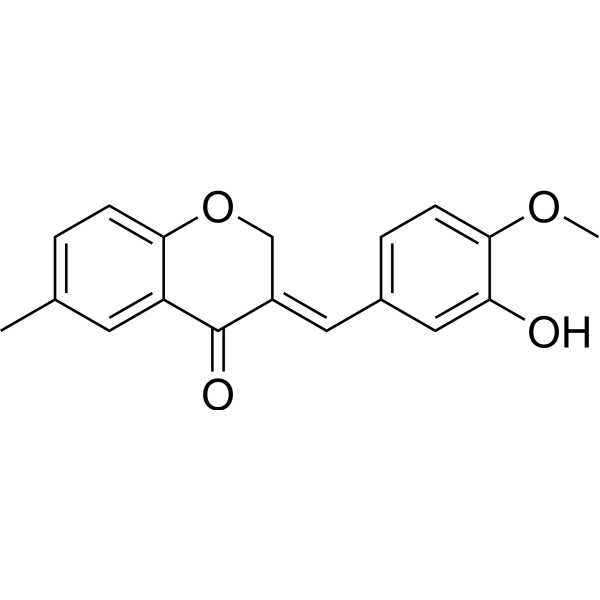
Physicochemical Properties
| Molecular Formula | C18H16O4 |
| Molecular Weight | 296.317245483398 |
| Exact Mass | 296.105 |
| CAS # | 1031206-36-6 |
| PubChem CID | 24987039 |
| Appearance | Light yellow to yellow solid powder |
| LogP | 3.367 |
| Hydrogen Bond Donor Count | 1 |
| Hydrogen Bond Acceptor Count | 4 |
| Rotatable Bond Count | 2 |
| Heavy Atom Count | 22 |
| Complexity | 444 |
| Defined Atom Stereocenter Count | 0 |
| SMILES | CC1=CC2=C(C=C1)OCC(=CC3=CC(=C(C=C3)OC)O)C2=O |
| InChi Key | BZCADTHMZLYKAR-MDWZMJQESA-N |
| InChi Code | InChI=1S/C18H16O4/c1-11-3-5-16-14(7-11)18(20)13(10-22-16)8-12-4-6-17(21-2)15(19)9-12/h3-9,19H,10H2,1-2H3/b13-8+ |
| Chemical Name | (3E)-3-[(3-hydroxy-4-methoxyphenyl)methylidene]-6-methylchromen-4-one |
| HS Tariff Code | 2934.99.9001 |
| Storage |
Powder-20°C 3 years 4°C 2 years In solvent -80°C 6 months -20°C 1 month |
| Shipping Condition | Room temperature (This product is stable at ambient temperature for a few days during ordinary shipping and time spent in Customs) |
Biological Activity
| ln Vitro | Human fibroblasts and human cancer cells proliferate at IMS2186 (0.3-10 μM; 22 h); their corresponding IC50 values are 1.0-3.0 μM and 0.3-3.0 μM[1]. With an IC50 of 0.1-0.3 μM, IMS2186 (0-10 μM; 22 h) suppresses the production of the pro-inflammatory cytokine PGE2/TNF-a in macrophages [1]. With an IC50 of 1 μM, IMS2186 (0.1-10 μM; 1.5 h) similarly prevents macrophage migration [1]. |
| ln Vivo | No ocular toxicity was seen following delivery of IMS2186 (2.5 mg in 0.5 mL; intravitreal injection; single dose) to the eye [1]. IMS2186 (100 μg/eye, i.e. 2.0 μL of 50 μg/μL solution; single dosage) displays anti-aging effects in a vascular model of laser-induced choroidal neovascularization (CNV) [1]. |
| Cell Assay |
Cell cycle analysis[1] Cell Types: Cancer H460 cells Tested Concentrations: 3 μM 0.3-1 μM[1]. , 10 μM Incubation Duration: Experimental Results: Demonstrates anti-proliferative activity mediated by arresting the cell cycle at G2/M. |
| Animal Protocol |
Animal/Disease Models: Laser-induced CNV rat model [1] Doses: 100 μg/eye, 50 μg/eye solution 2.0 μL μL Route of Administration: intravitreal injection; single dose Experimental Results: in lesion area measurement, compared with PBS The area has been diminished by 30%. |
| References | [1]. Falkenstein IA, et al. Toxicity and intraocular properties of a novel long-acting anti-proliferative and anti-angiogenic compound IMS2186. Curr Eye Res. 2008 Jul;33(7):599-609. |
Solubility Data
| Solubility (In Vitro) | DMSO : ~66.67 mg/mL (~224.99 mM) |
| Solubility (In Vivo) |
Solubility in Formulation 1: 1.25 mg/mL (4.22 mM) in 10% DMSO + 90% (20% SBE-β-CD in Saline) (add these co-solvents sequentially from left to right, and one by one), suspension solution; with sonication. For example, if 1 mL of working solution is to be prepared, you can add 100 μL of 12.5 mg/mL clear DMSO stock solution to 900 μL of 20% SBE-β-CD physiological saline solution and mix evenly. Preparation of 20% SBE-β-CD in Saline (4°C,1 week): Dissolve 2 g SBE-β-CD in 10 mL saline to obtain a clear solution. (Please use freshly prepared in vivo formulations for optimal results.) |
| Preparing Stock Solutions | 1 mg | 5 mg | 10 mg | |
| 1 mM | 3.3747 mL | 16.8737 mL | 33.7473 mL | |
| 5 mM | 0.6749 mL | 3.3747 mL | 6.7495 mL | |
| 10 mM | 0.3375 mL | 1.6874 mL | 3.3747 mL |