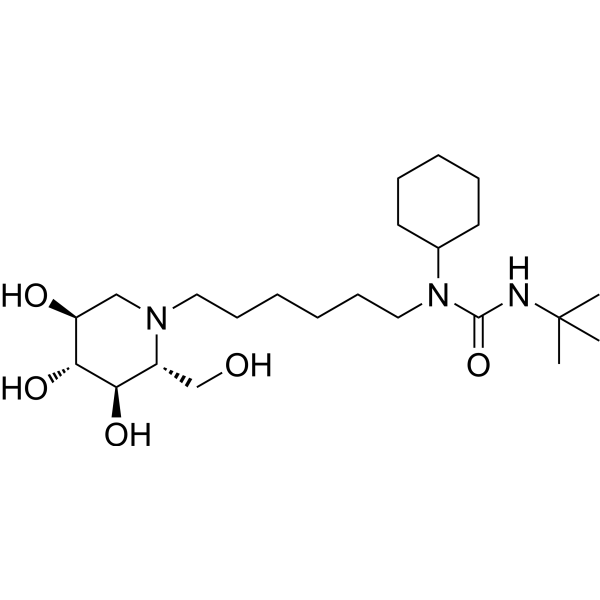
Physicochemical Properties
| Molecular Formula | C23H43N3O5 |
| Molecular Weight | 441.604626893997 |
| Exact Mass | 443.335 |
| CAS # | 1447464-73-4 |
| PubChem CID | 71713800 |
| Appearance | Off-white to light yellow solid powder |
| LogP | 1.7 |
| Hydrogen Bond Donor Count | 5 |
| Hydrogen Bond Acceptor Count | 6 |
| Rotatable Bond Count | 10 |
| Heavy Atom Count | 31 |
| Complexity | 536 |
| Defined Atom Stereocenter Count | 4 |
| SMILES | O=C(NC(C)(C)C)N(CCCCCCN1[C](CO)[C@H]([C]([C@H](C1)O)O)O)C1CCCCC1 |^1:15,19| |
| InChi Key | GFBNIASMQRMEDU-PLACYPQZSA-N |
| InChi Code | InChI=1S/C23H45N3O5/c1-23(2,3)24-22(31)26(17-11-7-6-8-12-17)14-10-5-4-9-13-25-15-19(28)21(30)20(29)18(25)16-27/h17-21,27-30H,4-16H2,1-3H3,(H,24,31)/t18-,19+,20-,21-/m1/s1 |
| Chemical Name | 3-tert-butyl-1-cyclohexyl-1-[6-[(2R,3R,4R,5S)-3,4,5-trihydroxy-2-(hydroxymethyl)piperidin-1-yl]hexyl]urea |
| Synonyms | IHVR19029; IHVR 19029; IHVR-19029 |
| HS Tariff Code | 2934.99.9001 |
| Storage |
Powder-20°C 3 years 4°C 2 years In solvent -80°C 6 months -20°C 1 month |
| Shipping Condition | Room temperature (This product is stable at ambient temperature for a few days during ordinary shipping and time spent in Customs) |
Biological Activity
| ln Vitro | With EC50 values of 0.25, 0.74, and 1.25 μM, respectively, IHVR-19029 may efficiently suppress the dengue virus (DENV), Takarib virus (TCRV), and bovine viral diarrhea virus (BVDV) [2]. IHVR-19029 and Favipiravir work in concert to suppress the replication of Ebola and yellow fever viruses in cultured cells [4]. |
| ln Vivo | IHVR-19029 (25-75 mg/kg; i.p.; twice daily for 10 days) suppresses EBOV and MARV infection in mice [2]. The AUC, C0, T1/2, CL and Vd values of IHVR-19029 (5 mg/kg; iv) are 1383 μg*h/mL, 1.79 μg/mL, 1.2 hours, 3.49 L/h/kg and 3.0 L/ kg, respectively[2]. The AUC value of IHVR-19029 (75/5/5 mg/kg; po/im/ip) is 945/1839/983 μg*h/mL, the Cmax value is 0.26/1.23/1.33 μg/ml, and the Tmax value is 2.1 /0.1/0.17 hours, the F values are 4.6/71/133% respectively[2]. |
| Animal Protocol |
Animal/Disease Models: balb/c (Bagg ALBino) mouse (12 weeks 233 years old) (MARV infection) [2] Doses: 25, 75 mg/kg Route of Administration: intraperitoneal (ip) injection; twice (two times) daily until day 10 Experimental Results: Observed effects on Marburg Virus (MARV)-induced death was Dramatically protective. Animal/Disease Models: C57B1/6 mice (8-12 weeks old) (EBOV infection) [2] Doses: 25, 75 mg/kg Route of Administration: intraperitoneal (ip) injection; twice (two times) daily for 10 days Experimental Results: Significant effects were observed survival rate. |
| References |
[1]. Meeting report: 31st International Conference on Antiviral Research. Antiviral Res. 2018 Oct;158:88-102. [2]. Small molecule inhibitors of ER α-glucosidases are active against multiple hemorrhagic fever viruses. Antiviral Res. 2013;98(3):432‐440. [3]. Ester Prodrugs of IHVR-19029 with Enhanced Oral Exposure and Prevention of Gastrointestinal Glucosidase Interaction.ACS Med Chem Lett. 2017 Jan 17;8(2):157-162. [4]. Enhancing the antiviral potency of ER α-glucosidase inhibitor IHVR-19029 against hemorrhagic fever viruses in vitro and in vivo. Antiviral Res. 2018 Feb;150:112-122. |
Solubility Data
| Solubility (In Vitro) | DMSO : ~100 mg/mL (~225.42 mM) |
| Solubility (In Vivo) |
Solubility in Formulation 1: ≥ 2.5 mg/mL (5.64 mM) (saturation unknown) in 10% DMSO + 40% PEG300 + 5% Tween80 + 45% Saline (add these co-solvents sequentially from left to right, and one by one), clear solution. For example, if 1 mL of working solution is to be prepared, you can add 100 μL of 25.0 mg/mL clear DMSO stock solution to 400 μL PEG300 and mix evenly; then add 50 μL Tween-80 to the above solution and mix evenly; then add 450 μL normal saline to adjust the volume to 1 mL. Preparation of saline: Dissolve 0.9 g of sodium chloride in 100 mL ddH₂ O to obtain a clear solution. Solubility in Formulation 2: ≥ 2.5 mg/mL (5.64 mM) (saturation unknown) in 10% DMSO + 90% (20% SBE-β-CD in Saline) (add these co-solvents sequentially from left to right, and one by one), clear solution. For example, if 1 mL of working solution is to be prepared, you can add 100 μL of 25.0 mg/mL clear DMSO stock solution to 900 μL of 20% SBE-β-CD physiological saline solution and mix evenly. Preparation of 20% SBE-β-CD in Saline (4°C,1 week): Dissolve 2 g SBE-β-CD in 10 mL saline to obtain a clear solution. Solubility in Formulation 3: ≥ 2.5 mg/mL (5.64 mM) (saturation unknown) in 10% DMSO + 90% Corn Oil (add these co-solvents sequentially from left to right, and one by one), clear solution. For example, if 1 mL of working solution is to be prepared, you can add 100 μL of 25.0 mg/mL clear DMSO stock solution to 900 μL of corn oil and mix evenly. (Please use freshly prepared in vivo formulations for optimal results.) |
| Preparing Stock Solutions | 1 mg | 5 mg | 10 mg | |
| 1 mM | 2.2645 mL | 11.3225 mL | 22.6449 mL | |
| 5 mM | 0.4529 mL | 2.2645 mL | 4.5290 mL | |
| 10 mM | 0.2264 mL | 1.1322 mL | 2.2645 mL |