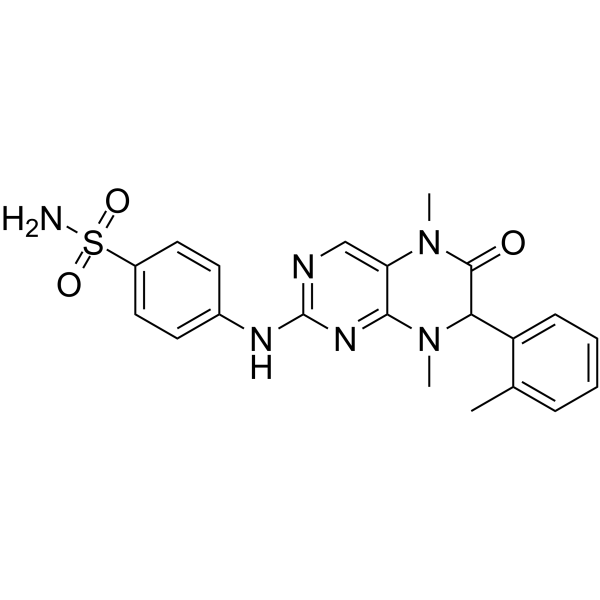
Physicochemical Properties
| Molecular Formula | C21H22N6O3S |
| Molecular Weight | 438.502782344818 |
| Exact Mass | 438.147 |
| CAS # | 2414484-25-4 |
| PubChem CID | 162477909 |
| Appearance | Off-white to light yellow solid powder |
| LogP | 2.3 |
| Hydrogen Bond Donor Count | 2 |
| Hydrogen Bond Acceptor Count | 8 |
| Rotatable Bond Count | 4 |
| Heavy Atom Count | 31 |
| Complexity | 751 |
| Defined Atom Stereocenter Count | 0 |
| SMILES | C1(S(N)(=O)=O)=CC=C(NC2=NC=C3C(=N2)N(C)C(C2=CC=CC=C2C)C(=O)N3C)C=C1 |
| InChi Key | FWEIAKDAIDQPRK-UHFFFAOYSA-N |
| InChi Code | InChI=1S/C21H22N6O3S/c1-13-6-4-5-7-16(13)18-20(28)26(2)17-12-23-21(25-19(17)27(18)3)24-14-8-10-15(11-9-14)31(22,29)30/h4-12,18H,1-3H3,(H2,22,29,30)(H,23,24,25) |
| Chemical Name | 4-[[5,8-dimethyl-7-(2-methylphenyl)-6-oxo-7H-pteridin-2-yl]amino]benzenesulfonamide |
| HS Tariff Code | 2934.99.9001 |
| Storage |
Powder-20°C 3 years 4°C 2 years In solvent -80°C 6 months -20°C 1 month |
| Shipping Condition | Room temperature (This product is stable at ambient temperature for a few days during ordinary shipping and time spent in Customs) |
Biological Activity
| ln Vitro | With an IC50 value of 23 nM, IHMT-MST1-58 (compound 19) exhibits strong action against MST1 [1]. Even at 10 μM (IC50 > 10 μM), IHMT-MST1-58 (1 μM) is inert against NEK3, but it demonstrates strong inhibitory activity against MST1 (IC50 = 23 nM) and weak activity against MST2 (IC50 = 652 nM) [1]. With Kd values of 240 nM and 2.7 μM, IHMT-MST1-58 (1 μM) exhibits strong binding affinity for MST1 and weak binding affinity for MST2 [1]. In vitro, MST1 phosphorylation is inhibited by IHMT-MST1-58 (0.1-10 μM; 1-2 hours) [1]. IHMT-MST1-58 (0.03, 0.1, and 0.3 μM; 48 hours) significantly shields β-cells from inflammatory cytokine-induced damage [1]. |
| ln Vivo | IHMT-MST1-58 (Compound 19) (oral, 50 mg/kg/day, QD) in combination with metformin causes a decrease in fasting blood glucose, displays a protective effect on beta cells, and reduces STZ-induced hemoglobin A1c levels T1D/T2D Small Mouse model[1]. Pharmacokinetic parameters of IHMT-MST1-58 in different species (intravenous or oral; 1 mg/kg, 5 mg/kg and 10 mg/kg) [1]. Mouse Rat Beagle Parameters iv(1 mg/kg) po(10 mg/kg) iv(1 mg/kg) po(10 mg/kg) iv(1 mg/kg) po(10 mg/kg) AUC0-t (ng/mL*h) 501.1 5583 2553±155.1 4858±2648 764.5±82.9 4939±1067 t1/2(h) 1.7 1.81 3.51±0.34 3.03±0.2 6.47±0.71 5.79±1.09 Cmax/ F(ng/ mL )1240 1922 944.0±219.1 1717±276 466.7±45.2 1113±417 F(%) - 110.8 - 73.3±40.1 - 106.5±20.9 |
| Cell Assay |
Western Blot Analysis[1] Cell Types: HepG2 hepatocytes, RAW264.7, RPE1 and HL7702 cells; INS-1 and RIN-m5F cell lines Tested Concentrations: 0-10 μM Incubation Duration: 2 hrs (hours) (HepG2 hepatocytes, RAW264.7 , RPE1 and HL7702 cells) Experimental Results: Inhibition of H2O2-stimulated MOB1 phosphorylation and MST1/2 autophosphorylation was dose-dependent in all four cell lines. Inhibits the phosphorylation of LATS1 (T1079) and YAP (S127) in HepG2 cells. MST1 phosphorylation and its downstream MOB1 autophosphorylation were strongly inhibited in both cell lines in a dose-dependent manner. |
| Animal Protocol |
Animal/Disease Models: Mouse[1] Doses: 50 mg/kg Route of Administration: po (po (oral gavage)) Single Experimental Results:plasma pancreatic parameter Cmax (ng/mL) 3990±390 12216±1509 AUC0-t (ng/mL*h) 13621±2127 51394±10098 Cl (mL/h/kg) 3734±641 996±189 animals Model: T1D mouse model and T2D mouse model [1] Doses: 50 mg/kg Route of Administration: po (po (oral gavage)) 50 mg/kg/day, QD Experimental Results: diminished FBG levels, improved food intake and water drinking, with low HbA1c and good antidiabetic effects, improving histological islet structure. Animal/Disease Models: Mouse, SD (SD (Sprague-Dawley)) Rat, and Beagle Dog[1] Doses: 1 mg/kg, 5 mg/kg, and 10 mg/kg Route of Administration: IV and Oral Experimental Results: In Different Species Demonstrates acceptable pharmacokinetic/PK/PK properties. |
| References |
[1]. Discovery of IHMT-MST1-58 as a Novel, Potent, and Selective MST1 Inhibitor for the Treatment of Type 1/2 Diabetes. J Med Chem. 2022 Sep 8;65(17):11818-11839. |
Solubility Data
| Solubility (In Vitro) | May dissolve in DMSO (in most cases), if not, try other solvents such as H2O, Ethanol, or DMF with a minute amount of products to avoid loss of samples |
| Solubility (In Vivo) |
Note: Listed below are some common formulations that may be used to formulate products with low water solubility (e.g. < 1 mg/mL), you may test these formulations using a minute amount of products to avoid loss of samples. Injection Formulations (e.g. IP/IV/IM/SC) Injection Formulation 1: DMSO : Tween 80: Saline = 10 : 5 : 85 (i.e. 100 μL DMSO stock solution → 50 μL Tween 80 → 850 μL Saline) *Preparation of saline: Dissolve 0.9 g of sodium chloride in 100 mL ddH ₂ O to obtain a clear solution. Injection Formulation 2: DMSO : PEG300 :Tween 80 : Saline = 10 : 40 : 5 : 45 (i.e. 100 μL DMSO → 400 μLPEG300 → 50 μL Tween 80 → 450 μL Saline) Injection Formulation 3: DMSO : Corn oil = 10 : 90 (i.e. 100 μL DMSO → 900 μL Corn oil) Example: Take the Injection Formulation 3 (DMSO : Corn oil = 10 : 90) as an example, if 1 mL of 2.5 mg/mL working solution is to be prepared, you can take 100 μL 25 mg/mL DMSO stock solution and add to 900 μL corn oil, mix well to obtain a clear or suspension solution (2.5 mg/mL, ready for use in animals). Injection Formulation 4: DMSO : 20% SBE-β-CD in saline = 10 : 90 [i.e. 100 μL DMSO → 900 μL (20% SBE-β-CD in saline)] *Preparation of 20% SBE-β-CD in Saline (4°C,1 week): Dissolve 2 g SBE-β-CD in 10 mL saline to obtain a clear solution. Injection Formulation 5: 2-Hydroxypropyl-β-cyclodextrin : Saline = 50 : 50 (i.e. 500 μL 2-Hydroxypropyl-β-cyclodextrin → 500 μL Saline) Injection Formulation 6: DMSO : PEG300 : castor oil : Saline = 5 : 10 : 20 : 65 (i.e. 50 μL DMSO → 100 μLPEG300 → 200 μL castor oil → 650 μL Saline) Injection Formulation 7: Ethanol : Cremophor : Saline = 10: 10 : 80 (i.e. 100 μL Ethanol → 100 μL Cremophor → 800 μL Saline) Injection Formulation 8: Dissolve in Cremophor/Ethanol (50 : 50), then diluted by Saline Injection Formulation 9: EtOH : Corn oil = 10 : 90 (i.e. 100 μL EtOH → 900 μL Corn oil) Injection Formulation 10: EtOH : PEG300:Tween 80 : Saline = 10 : 40 : 5 : 45 (i.e. 100 μL EtOH → 400 μLPEG300 → 50 μL Tween 80 → 450 μL Saline) Oral Formulations Oral Formulation 1: Suspend in 0.5% CMC Na (carboxymethylcellulose sodium) Oral Formulation 2: Suspend in 0.5% Carboxymethyl cellulose Example: Take the Oral Formulation 1 (Suspend in 0.5% CMC Na) as an example, if 100 mL of 2.5 mg/mL working solution is to be prepared, you can first prepare 0.5% CMC Na solution by measuring 0.5 g CMC Na and dissolve it in 100 mL ddH2O to obtain a clear solution; then add 250 mg of the product to 100 mL 0.5% CMC Na solution, to make the suspension solution (2.5 mg/mL, ready for use in animals). Oral Formulation 3: Dissolved in PEG400 Oral Formulation 4: Suspend in 0.2% Carboxymethyl cellulose Oral Formulation 5: Dissolve in 0.25% Tween 80 and 0.5% Carboxymethyl cellulose Oral Formulation 6: Mixing with food powders Note: Please be aware that the above formulations are for reference only. InvivoChem strongly recommends customers to read literature methods/protocols carefully before determining which formulation you should use for in vivo studies, as different compounds have different solubility properties and have to be formulated differently. (Please use freshly prepared in vivo formulations for optimal results.) |
| Preparing Stock Solutions | 1 mg | 5 mg | 10 mg | |
| 1 mM | 2.2805 mL | 11.4025 mL | 22.8050 mL | |
| 5 mM | 0.4561 mL | 2.2805 mL | 4.5610 mL | |
| 10 mM | 0.2281 mL | 1.1403 mL | 2.2805 mL |